Today was the perfect trifecta of crazy grocery shopping.
Super Bowl Sunday is tomorrow.
A winter storm that threatens to drop a foot of snow is barreling down on us.
It is the weekend.
Since our refrigerator was nearly empty we used our 11 month old alarm clock to get to the store early and beat the crowds. You know it is going to be a busy day when they have boxes of shovels out in the aisles.
Grocery shopping tends to favor those that plan ahead. For instance, today Kroger had a buy 6 items save $3 special. In many cases that stacks on top of regular sale prices. If you go to the store to pick up one item, you’re not going to be able to take advantage of these sales. Doing one or two big stock ups in a month lets you really optimize your spending.
Growing up, I remember following my mom around the grocery store whenever she went. My memory isn’t that great but a few details still seem clear all these years later. I remember getting yelled at to stay out of the way. I remember being fascinated with a coffee grinder and subsequently getting ‘lost’ because while I was absorbed in looking at the machine my mother had moved to a different aisle. Lastly, I remember asking if we could buy something once and my mom looked at it, looked at me, and said, “no, we only buy things that are on sale”. To a five or six year old, or however old I was at the time, I interpreted that to mean that only a select few items in the store were classified as ‘on sale’ and those items never changed. Crushed that we were limited to only ever buying the 15-20 items that I had seen ‘on sale’ stickers for that day, I resigned myself to eating the same type of cereal for the rest of my life.
Yup, kids are dumb.
20ish years later and now I try to buy only on sale items. Today’s find was 88¢ veggie pasta.
Quick, hop in this time machine and I will take you back to the day that Shae and I got married.
BEE BOO BOP! Ding!!
We’re there. Take a look at that young couple enjoying the summer sun.
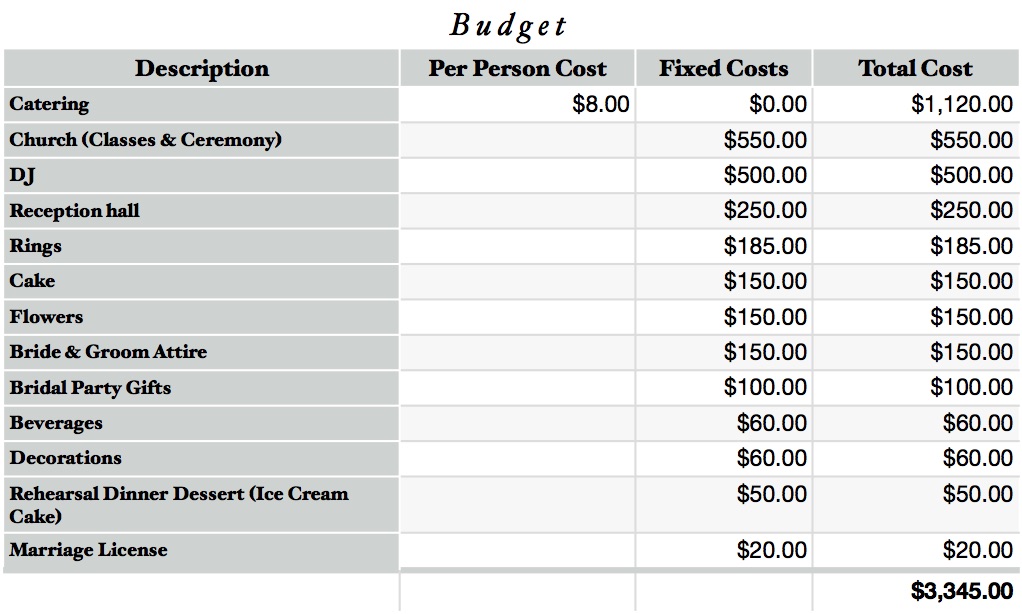
As you might expect, their wedding cost quite a bit less than the average $25k-$30k affair that most Americans have. Let’s take a peek at their budget.
Their biggest expense appears to be food and that was because they invited 110 guests to the wedding and had 30 for the rehearsal dinner. According to theKnot.com, the average wedding has 138 guests. Geez, if they didn’t invite so many friends and coworkers then they could have saved some money. Except they invited hardly any friends or coworkers. Almost all of the guests in attendance were extended family, and almost all of the guests at the rehearsal dinner were immediate family. Aye caramba!
$8/person is insanely cheap for catering. They scored a great deal by using a family friend who was just getting started in the business.
The menu was also very simple. Chicken, potatoes, corn on the cob, salad, and bread. The rehearsal dinner was beef brisket and switching the two or just doing the brisket both nights would be the only change they would make.
The wedding cake was a no thrills two tier plus sheet cake. It was nicely done by a family acquaintance and was delicious. There were no leftovers.
The venue for the ceremony, a church, had some stipulations that added to costs, such as required marital classes. At $5xx some dollars it wasn’t a budget buster.
One expense they could have cut would have been the DJ. Instead, spending more on alcohol would have helped guests have a better time. They scrooged on alcohol though because the reception venue said no (it was never enforced however).
Speaking of the reception, for a measly $250 they were able to use a community center for three days (rehearsal, reception, and brunch). That was a big money saver.
Their wedding bands were plain white gold bands from the department store.
The wedding photographer was Andrew’s brother and sister-in-law. The invites and RSVPs were designed and printed by another brother as wedding gifts.
Shae’s dress was a family heirloom. Some alterations were made for $50 and additional money was spent to clean and preserve it after the wedding. The headpiece was made by her mother.
In hindsight, things could have been done even cheaper. We went to a wedding last year that was very well done and almost certainly done on a smaller budget than ours. We did consider eloping, but figured our parents would kill us. Plus if we eloped we wouldn’t have funny photos like these:
Our honeymoon was a quiet week in the Midwest. The budget was around $1000 and included a hot air balloon ride (something that got rescheduled for our 1 year anniversary).
All told, wedding + honeymoon cost us $8,837.08 according to financial statements. Both were over budget due to all the nickels and dimes. With that said, I don’t think we would make too many changes from our younger counterparts. I for one am glad that we did not elope, as we often talked about when wedding planning was getting stressful. I am also glad that we abandoned the idea of having an outdoor reception on the family farm. Not only would it have cost more, but the stress of it possibly raining would have put everyone on edge. Especially when the morning sky looked like this.
At the end of the day, whether we had a big wedding or a small wedding. An expensive one or a frugal one, the thing that matters is the marriage. Mawage. Mawage is wot bwings us togeder tooday (for all of you Princess Bride fans).
It’s time to get back into the time machine and come back to the present.
Over six months have gone by since I last negotiated our internet rates with Comcast (see here). Our 25 Mbps (mega bit per second) connection went from the promo price of $35/month to $67. I tried calling in late December to get rolled over to a new promotion. Like always, I call in and navigate the voice menu to canceling all services. That lands you into their customer retention department and the best possible deals.
The rep offered $50/mo for internet and phone service. I really didn’t want to add a service that we are not going to use and the price is still about $10 more than what I want to pay so I declined.
Comcast runs new promos every 30 or so days, so I gave them a call back at the start of January to see if they had anything new. This rep offered $55 for internet and basic cable. An even worse deal in my opinion. She also offered a $40/mo for internet only, but it was a meager 6mbps. The only competitor in town has that same level of service for $30.
Again I declined, and figured I would call back in a day or two (the second rep was not very friendly).
This afternoon, I called for a third time, persistence is key! I got the first offer again, phone + internet for $50. I agreed, and have set a reminder on my calendar to try again in February.
The new deal is good for 12 months and will save us $204 over what we have now for the same level of service. It is not a particularly great deal, but it beats the standard rate and matches the competitors price without the hassle of moving accounts. Sometimes we just have to take the small wins. :-\
This is the last weekend before Christmas and because it was a bit chilly to walk outside with Frugal Boy I braved the mall. No, I’m not a masochist, I just know that Frugal Boy loves people watching and what better place is there to people watch than the mall before Christmas.
As I was unloading the stroller back at home, one of our neighbors came by and asked if I had finished my Christmas shopping. I told him no, I had never even started. He offered me luck on a seemingly impossible task, to save Christmas in less than a week. What I didn’t tell him, was that while I hadn’t done any traditional shopping, I was in fact done with gift giving.
The Frugal Gift For Your Spouse
Shae and I have always had an aversion to trying to find the ‘perfect’ gift for one another. The hassle of it all, shopping, buying, wrapping, keeping the secret, and hoping for a genuine positive reaction during the unveiling is all a bit more work than either of us would like to do. In something of a growing tradition, the goto token gift has become new pairs of socks, simple, practical, and fairly cheap.
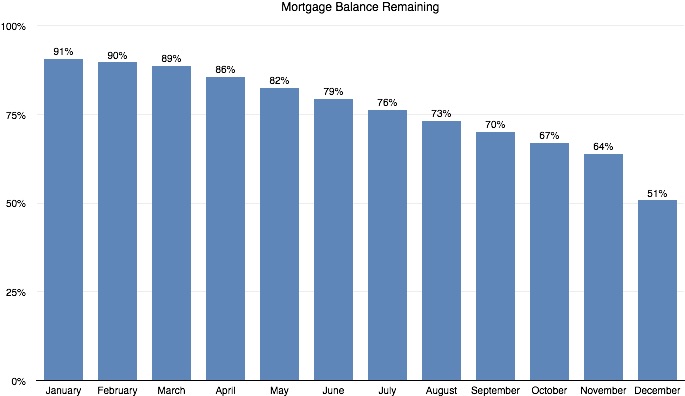
Our unconventional gifts to one another are both easy to give and a joy to receive. This year we both paid off a chunk of our mortgage for a combined extra prepayment of 10%. All told, in 2014 by living frugally, we have been able to shave off 40% of our mortgage this year alone.
10% Christmas Gift to Ourselves
The quadruple mortgage payments that we started making in April have set us on track to be mortgage free in about 12 months (assuming we give ourselves the same present next year)! Yippee!
The Frugal Gift For Your Child(ren)
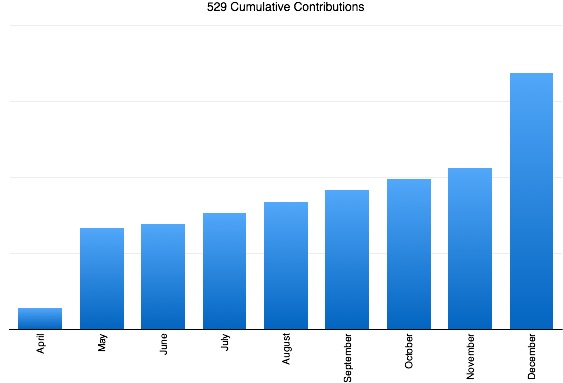
Frugal Boy isn’t old enough to really appreciate presents, so this year we just made a contribution to his 529, college savings, plan.
Merry Christmas Son
You can see two jumps in the chart. The first in May when we put inheritance money towards future education and another in December when we gave him his present early.
While a 100% monetary gift works well for babies, because they don’t understand the concept of a gift, it probably won’t be a smash hit with older children. In the future we will continue to spend a substantial amount of Frugal Boy’s gift budget on 529/savings contributions while spending a bit of money on a token toy. After all, as parents, it is our job to take care of the needs and necessities first. We can let his relatives spoil him with the ‘fun’ stuff. If our Christmas tree is any indication, that is exactly what is happening (100% of the presents are to Frugal Boy).
The Frugal Gift For Your Nieces and Nephews
We basically followed our standard method of operation for our own children. Babies received all cash gifts and should their parents choose to invest that money in an account that compounds that niece or nephew will receive the advantage of time. Older nieces and nephews received trinkets and a supplement of cash to round out their presents. As an uncle and an aunt, we tend to be more prone to spoiling than with our own child. Plus, what kid doesn’t want 1,000 stickers for Christmas? 😀
Wrapping Up
While we haven’t done the traditional gift giving this year, we have done a frugal edition of it. A grand total of zero items were purchased at the mall, and most gifts came from our checkbook. Sure it isn’t the picturesque Christmas that you see in the films, but then again is that even the meaning of Christmas in the first place? With that said, are you done with your Christmas shopping?
Today I was printing off Christmas letters to send off in the mail when I realized I had the perfect blog post sitting right underneath my desk. The printer! Sometimes I take for granted frugal choices that we made years ago.
Consumers today have two distinct choices when it comes to home printers, inkjet or laser.
Inkjet Printers
Chances are, this is the type of printer that you have in your home. These printers often come with additional features besides printing, such as built in scanners and copiers.
The majority of the inkjet printers sold are capable of printing glossy color photos, provided you have a color ink cartridge. An inkjet printer works by shooting liquid ink onto the media (paper, card stock, or what have you). That liquid dries by the time the page finishes printing.
Pros
Low sticker price
Can print glossy photos
Includes a scanner
Cons
Ink replacements are costly
Slow to print many consecutive pages
Water will cause ink to run
Laser Printers
This is most likely the type of printer at the office. Laser printers work differently than inkjet printers, surprise surprise! A laser shoots a drum that builds up static electricity. That static attracts toner, powdered ink, to stick to the page. Finally the toner is permanently fused onto the page.
Pros
Very Fast Pages/Minute
Toner is economical per page
Crisper text
Cons
Higher initial sticker cost
Color is not a basic option
Takes a while to warm up and start printing
Cost of Ownership Comparison
We have a laser print, almost the same model as shown in the above picture. I did a little research and found some numbers on Amazon and vendor sites to put together a total cost of ownership comparison between an inkjet and a laser printer.
For the inkjet printer, I tried to find a basic printer without a scanner or wireless. The Canon Office Products IP2820 seemed to fit the bill, and at a meager $29.99 price point it sure seemed like a painless purchase.
The Canon uses PG-245XL black ink cartridges that run $23.99 on Amazon and have a claimed page count of 300, although reviews say it is more like 200 pages before becoming unusable. That puts the cost per page between 8-12¢ depending on who you believe.
For the laser printer, I tried to find the closest model to the one we have and found the Brother Monochrome HL2230 for $76. It uses the TN-450 toner cartridge. The TN-450 costs $49.95 on Amazon and has an expected lifetime of 2600 pages or 1.9¢/page. Also, the HL2230 comes with a starter cartridge that is only rated for 700 pages.
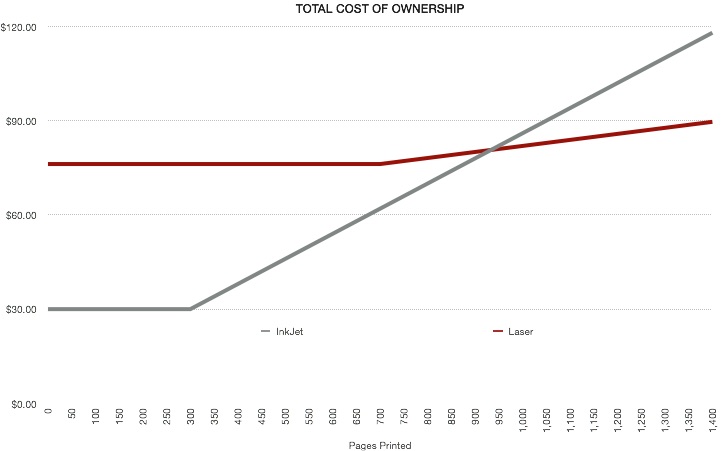
Then I calculated out the cost of ownership over the first 1,400 pages. Why 1,400? That is how many pages we have printed so far with our printer according to its information sheet (press the Go button three times, your printer may have a similar diagnostic detailed in the user manual you threw away years ago).
As you can see, it becomes cheaper to own a laser printer around 900 pages. If you tweak the original parameters a bit and use the less favorable 200 pages/ink replacement you get an even uglier picture for inkjets.
Now the breakeven is closer to 600 pages.
Conclusion
We’ve saved between $28.36 and $84.36 so far by using a monochrome laser printer. If you really want to print off photos, let your local photo center handle it or better yet, use some of the free 4×6 prints that places like Snapfish are constantly offering.
You don’t have to take my word that laser printers are cheaper to operate, just ask the folks over at Wired, who claim that using champagne would be cheaper than the ink cartridges that seem to only last a few dozen pages.
We replaced our starter toner at 764 pages, a bit above the stated expectancy. We still have another 1,959 pages to print before we have to buy more toner.