• About Me
  • Contact Me

Frugal Living

Indulging in life, financially responsible

Savings

Planning for (Early) Retirement

April 30, 2015 by Andrew Leave a Comment

You may have noticed an addition to the sidebar.  It is this little chart graphic that I try to update once a month.

pf goals 5-1

May 2015

It is our yard stick for two major financial goals in life.  The first is to pay off our mortgage and be completely debt free.  The second is to have enough interest earning assets socked away to be able to live indefinitely without having to work (aka retirement).

We currently have 62% of our mortgage paid off.  Our extra payments help to chip away about 3% every month.

The retirement bar rises more slowly and could even decrease if the stock market goes down.  We are currently at 12.3% of our retirement goal, but what is the goal number?  More importantly, how do you find out your own goal number?

Planning for Retirement

There are only a couple of numbers that you need to know in order to plan for retirement.  The most important number is your annual expenses.  Ya, ya, I know what you are thinking.  All of those retirement calculators and financial gurus on the internet talk about retirement in terms of income.  “You need to be able to replace 80% of your working income in order to retire.”  Let me tell you, that’s a load of crap.

What you really need, is to be able to cover 100% of your expenses.  You track those, right?  If not, now’s a great time to get started with Mint.

The great thing about basing your retirement goal off your expenses is that if you want to retire sooner, you just have to lower your expenses!  Man, I knew this frugal thing was going to pay off.  🙂

Before you rush off to figure out your annual expenses keep in mind that they should be adjusted for retirement.  If you are going to be mortgage free before you retire, you can drop those mortgage payments from your total.  The same goes for items such as daycare, estimated income tax (you’ll be retired), and any debts that you have paid off (student loans, credit card, car, etc…).

Okay, so do you have your annual expenses number?  Let’s use $30,000 as an example.

4% Rule

Here comes the second number.  If you guessed 4 you’re wrong.  The second number is 25.  Multiple your annual expenses by 25.

$30,000 x 25 = $750,000

There you go, that is how much money you need to save in interest earning assets (like stocks and bonds) in order to retire.  Do you see what I did there.  I said “retire”, I didn’t say “retire at 67”.  That’s right, once you have your nest egg you should be able to retire at any age and live indefinitely off your nest egg.

Suuuurre… say the skeptics.

Don’t believe me?  Let’s start with exhibit A, the Trinity Study.  The study, done by a group of professors in the 90s, and later updated with recent historical data, looked at rolling 30 year periods to see how stock portfolios (50/50 stocks to bonds) would have fared since as early as 1926.  The authors concluded that given a withdrawal rate of 4% per year, the likelihood of a portfolio surviving for 30 years was 96%.

It’s at this point that you look over to your SO, if you’re single you can skip this step, and you find out who among you is the more cautious.  The cautious partner will probably say that number is too small, and want to use a 3% withdrawal rate just to be safe.  So we really have two retirement numbers, the 4% and the ‘rock solid’.

If you’d like to read more about the Trinity Study and the 4% rule, Go Curry Cracker has a great write up on the topic.

Going back to our example, 4% of $750,000 is $30,000.  Yay, the math works!

But $750,000 is SOO much money.  Who could ever save up that amount of dough.

If you are close to the ‘normal’ retirement age, you may not have to.  Social Security and any pensions may be able to subsidize your annual expenses.  Instead of needing 30,000 from your portfolio a year, you may only need $10,000.  That shaves off a cool half million right there.  If you are still young and want to pursue early retirement then Social Security and pensions are too far away to be much of a serious help.  Instead you’ll have to focus on two things, cutting expenses and raising income.

Early Retirement

Mr Money Moustache (MMM), an avid early retirement blogger, has put together a simple table to correlate savings rate to years till retirement.
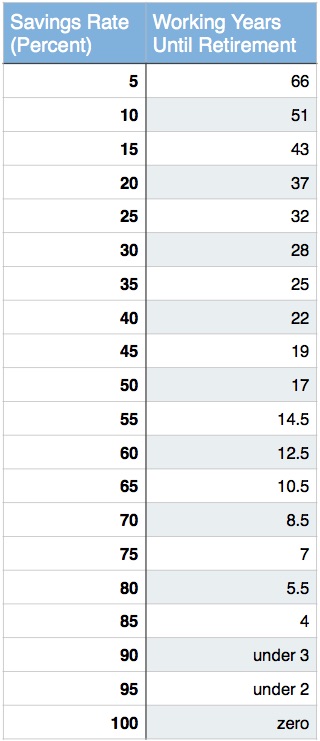
Savings Percent Years of Work

Saving 10-15% of your income for retirement will put you on track for retiring in your 60s or 70s, assuming you start in your early 20s.  We are currently putting aside 25% of our income, and even that amount of savings only puts us on track for late 50s.  Our goal is to increase our savings percent to 40 or 50 so we can retire early.  Preferably before we turn 40.  That may be possible if we are disciplined enough to pay off our mortgage early and save that freed up cash flow instead of spending it on lifestyle creep.

Some Final Thoughts

I use the word retirement, but what we are actually pursuing is early partial retirement.  The flexibility of working when, where, and on what we want is incredibly appealing.  It may not be necessary to reach 100% of our retirement number if we offset our annual expenses with partial working income.

The second thought, is that no where in here have I mentioned financial windfalls.  That could include  winning a lottery, or receiving an inheritance.  The reason for their omission is simple, you shouldn’t count on them or rely on them.

Finally, the 4% rule has been getting a lot of flak in the past few years saying it is obsolete and no longer valid. The arguments generally go that bond rates have plummeted in recent history and yield close to zero.  The 2008 crash and subsequent depression hit close to home and rattled a lot of 401k holders.  The 4% rule works if you remain flexible.  Should you buy a new car the year that the stock market drops 50%?  Probably not, maybe you can make do with what you have until your portfolio recovers in a year or two.  Is the market up 15% this year?  Maybe you should withdraw more than 4% to build up cash reserves for down years.

Posted in: Finance, Savings Tagged: early retirement, mortgage

Freebie Extravaganza

April 19, 2015 by Andrew 1 Comment

It has been a jam packed weekend for us with lots of freebies!

A Free Chair

Here is a free chair that I found on Friday.  The upholstering is a bit rough but it is a solid chair.  The label on the bottom says Fairfield, so someone probably paid a few hundred bucks once upon a time.

IMG_6315

Free Movie Rentals

Redbox is running a deal right now (PLKMP982) where you can get five free DVD rentals for each account that you have with them.  The deal runs until 4/30 and you must reserve your DVD online (the code won’t work at the kiosk).

So far we have watched Interstellar and The Imitation Game.  Both excellent movies that you should watch if you haven’t already!

MV5BMjIxNTU4MzY4MF5BMl5BanBnXkFtZTgwMzM4ODI3MjE@._V1_SX640_SY720_imitation_game

Free Laundry Detergent +

On Saturday, there was a cloth diaper expo in town.  The first twenty people got goodie bags.  We happened to be walking nearby so we stopped in and got a large bag filled with detergent, an insert, various balms, and literature.

IMG_6308


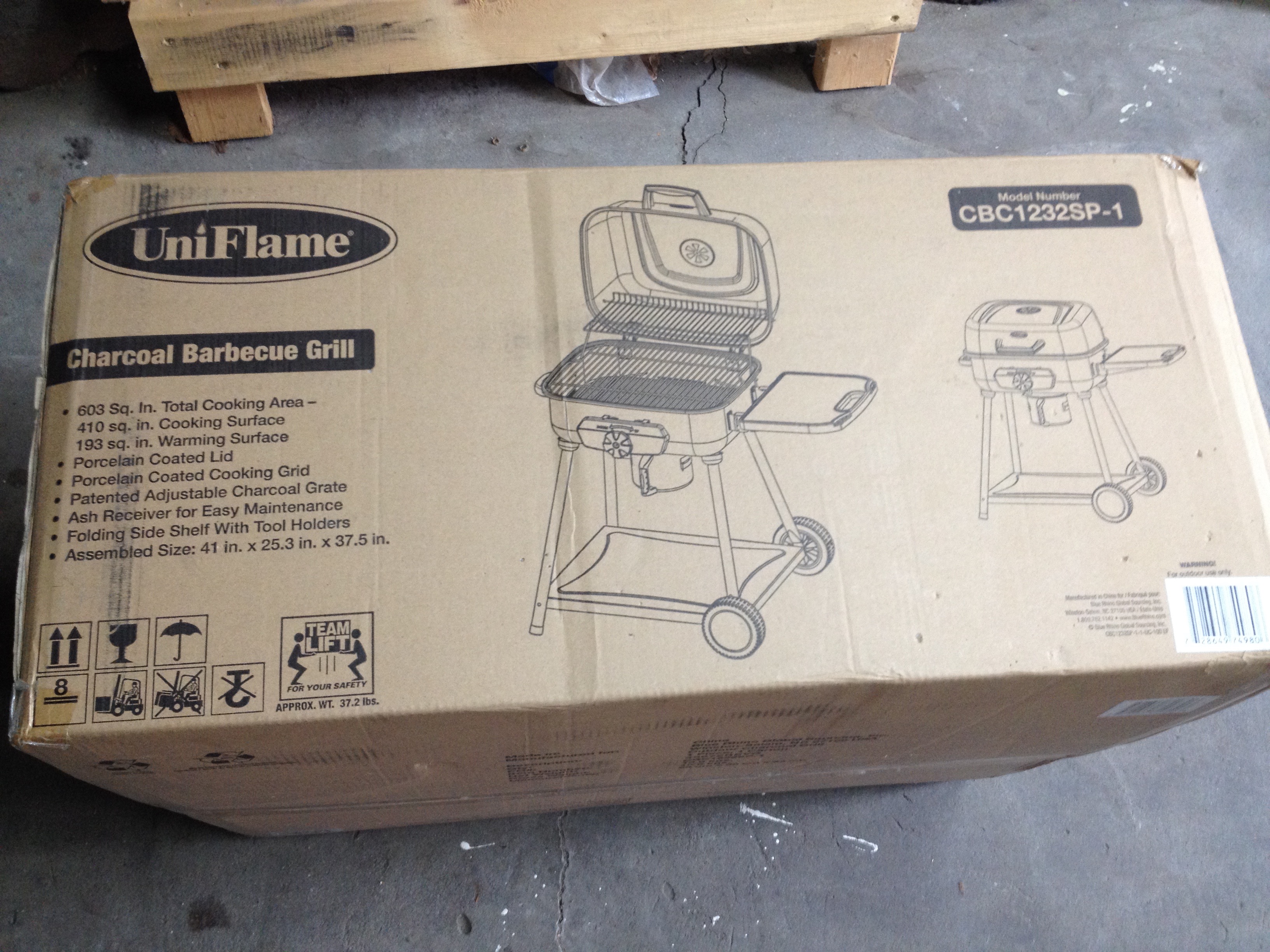
Free Charcoal Grill!

Also on Saturday we won a free charcoal grill as part of a city wide scavenger hunt.

IMG_6305

Our local library has been promoting National Library Week and the rollout of their brand new bookmobile by posting a scavenger hunt on Facebook every day for the past week.  It has been really fun to try and figure out the clues and race across town to get to the destination before other treasure seekers.  The prizes were usually claimed within 10-20 minutes of the first clue being posted and twice we were in sight of the goal line just to see someone else get their first.  The last prizes clue started with:

  • Subtract the number of dwarves from a baker’s dozen
  • Add the number of blind mice to the loneliest number
  • Subtract the number of calling birds from the number of gold rings

My gut told me that it was a call number so we went to the library.  We had books to return and they were having cake to celebrate the new bookmobile so even if I was wrong we would still score some free cake!

After getting to the library the second part of the clue was posted

  • .LVII
  • Add the value of two quarters to Walter Payton’s number
  • “Bam!” You got it!

I’ll leave the answer at the end of the post so you can see if you figured it out.

Here was Shae with the prize envelope.  We were so thrilled to have found one and win a prize!

IMG_6298

Then we took a group selfie to commemorate the occasion.  Frugal Boy was obviously not as excited as his parents, but he’ll come around after he gets to eat some meat seared over red hot coals.

IMG_6299

After eating some free cake and checking out the snazzy new bookmobile we headed home.

Free Garage Door Fix

Arriving home I pressed the button to open our garage door and the door shook a lot on the way up and then stopped 3/4 of the way.  In the words of Frugal Boy, “Uh Oooh!”

The culprit was easy to spot.  One of the rollers had dragged and bent its hinge completely out of alignment.

IMG_6300


I grabbed some tools and pulled the broken hardware off the door.

IMG_6301

My first attempt to fix the door was to go to Lowes and buy a new hinge and ten new rollers.  Our garage door dates back to the 70s and as this little incident proved, it is on its last legs.  Returning home, I lined up the new hinge where the old one was and discovered that it was incompatible.  The replacement hinge was far too tall and if I screwed it into place then the roller wouldn’t line up with the track.  I would have to move the entire track back at least 1/2″ to accommodate the replacement parts. To add insult to injury, the new rollers are too thick to fit into the old hinges.

In a last ditch effort, I resorted to Great Depression tactics and laid the old hinge on the garage floor and beat the snot out of it with a four pound hammer until it was straightened out again.  I also tightened up and replaced any missing nuts that had shaken loose from 40 years of operation.  So far so good and the fix was free!

Free Car (Blocks Sold Separately)

Saturday night, Shae asked me if I wanted to come with her to walk around the neighborhood to find any curbside deals.  A couple of blocks away we found a Little Tikes Cozy Coupe.  I asked the man outside of the house if we could have it and he was more than happy to let us drag it away.  He said that they had inherited it with the house and his kids had ridden it pretty hard.  The front wheels were bent and one of the columns had been ‘repaired’ long ago.

IMG_6302

This morning we went back to Lowes to return the incompatible garage hardware and to pick up some new wheels for Frugal Boy’s pimpin ride.

A couple of casters, long carriage bolts, some scrap wood, and a little ingenuity had Frugal Boy’s ride back on the street, err alley, err garage (it was raining today).

Screen Shot 2015-04-19 at 3.03.42 PM


So there you have it, our freebie filled weekend!  I still have to assemble the grill and break it in sometime, we have three more redbox movies to rent, leave a recommendation down in the comments, and our garage door is running on borrowed time.

Scavenger Hunt Answer

641.5784 which refers to a section of grilling cookbooks in the Adult Services Department. The reference to “Bam!” was intended to narrow down the options to Emeril Lagasse’s cookbook “Emeril at the Grill: A Cookbook for all Seasons.”

Posted in: Frugal Boy, Misc., Savings Tagged: library, Redbox, Toys

Picking an Energy Supplier

March 23, 2015 by Andrew Leave a Comment

Do you want to save $50-$100 bucks in five minutes?  Of course you do!  Keep reading to learn how.

Did you know that you can shop around and choose what company you buy energy from?  That’s right, you don’t have to purchase your electricity or gas from the company that pipes it to your door.  Our municipality just negotiated a new two year contract on behalf of residents for electric and after seeing the results of said negotiations I was left with more questions than answers.

The new two year fixed opt-out rate is for 5.6¢ per kilowatt hour (kWh) plus an additional 0.1¢ city imposed fee on top of that for managing the aggregation program.  That rate is for raw energy, and that energy still has to get from where it is generated to your house, and that is the distribution charge that you pay to your electric company.  In our case, we have Ameren.  Ameren’s website has a list of suppliers that you can purchase from so I did what any good nerd would do and opened up a blank spreadsheet and got to work.

Here is the result of a lunch break’s worth of internet sleuthing (click on it for a PDF version).

Electric Suppliers

Most of the suppliers were more costly than the negotiated aggregate rate.  I would kind of hope that the collective bargaining power of 30,000+ households could beat an anonymous internet quote.  With that said, there were two suppliers that offered better one year fixed rates than the default Homefield Energy.

MidAmerican Energy offers a 4.54¢/kWh one year fixed rate with no cancellation fee.  Viridian Energy offers a slightly higher 5.49¢/kWh one year fixed rate with a cancellation fee.  Both options beat the city negotiated rate.

Apples to Oranges

I hear you saying, “Okay Andrew, this isn’t a very good comparison.”  These lower rates are one year vs two year, and that is true.  In order for it to balance out, rates in the second year would have to increase to 6.7¢/kWh for MidAmerican Energy.  A number that is hardly even seen on the price matrix as of today.  I would peg the probability of such a rate increase in one year’s time as very small.

“Well, what about the environment Mr. Smart Guy?!”  Each energy supplier has their own breakdown of how their energy is generated (MidAmerican, Homefield Energy).  Coal, one of the worst polluters is also one of the cheapest forms of electric generation.  So how do Homefield Energy and MidAmerican Energy compete in terms of ‘greenness’?

Energy Supplier Greenness


Taking coal and natural gas together (arguably the two worst polluters) pins Homefield Energy as the dirtier supplier with 72.33% of their electrical generation coming from those two sources.  So in this case, it is not a matter of paying more to Homefield because they offer cleaner electrons.  In fact, MidAmerican has about 30% renewable energy (in the form of wind) compared to Homefield’s dismal 6%.

A Penny or Two Matters

So MidAmerican is cheaper and cleaner, but does it really matter to John and Jane Doe consumer?  I mean, it is only 1.06¢ difference per kWh.  According to U.S. Energy Information Administration, EIA, the average U.S. residential utility customer used 10,908 kWh in 2013.  Multiply that usage by the cost difference between these two suppliers (.0106) and you end up with $115.62 in savings per year.  Not too shabby for spending 5 minutes on an enrollment website.  We personally stand to save about $58 based off our usage (5514 kWh) in 2014.  Alternatively, we could spend an extra $50 and go with Viridian’s 100% renewable one year rate at 6.49¢/kWh.

Aggregate Contract?

At the end of my hour traipse through different electric supplier’s websites I am still left with the question of why our municipality agreed to the contract that they did.  There are cheaper options available and there are greener options as well.  Heck, for a cash strapped city that is always claiming to look for more revenue, it doesn’t take much creativity to set the opt-out rate at MidAmerican’s low price of 4.54¢/kWh and then add on a surcharge of 1.06¢/kWh to bring it up to their current contract rate.  The city would pocket about 3.9 million dollars!!

34,131 households * 10,908 kWh (average annual usage) * $0.0106

The precedent for adding a surcharge is already there, they currently add one and nobody has raised a fuss.  A spokesperson for one energy supplier said that less than 10% of customers opt out of aggregate contracts.  Most people simply don’t care.

Perhaps MidAmerican couldn’t generate enough electricity for 30,000 households.  That still leaves the possibility of using Viridian’s one year fixed rate @ 5.49¢/kWh.  Not only is it 50% renewable, quite an improvement over 6%, but if the same money raking strategy was employed here the city would still be able to generate over $400k in revenue.

34,131 households * 10,908 kWh (average annual usage) * $0.0011

I may be missing a piece of the puzzle, but it seems to me that there is a drastically better solution available than the one that has been presented to the public.  The current 0.1¢ surcharge to manage the aggregate program is estimated to generate about $370,000.  I spent a lunch break and found a better rate.

Posted in: Savings Tagged: Budget, tips, Utilities

Making Yogurt

March 11, 2015 by Shae Leave a Comment

We’re always looking for ways to save money, especially on things we use/buy regularly. You may remember our foray into making our own breakfast sandwiches. While not very big on cost savings when you factor in the time to make them, it does offer the opportunity to expand into variations other than the 3 flavors offered at Aldi.

Another food product we eat like it’s going out of style is yogurt. When we were starting out our lives post-college we went only for the cheapest yogurt we could get. At 33 cents for a 6 oz cup the Aldi & Kroger generic brands ruled the refrigerator. Then we started looking at the nutrition labels. The generic cups of yogurts, regardless of flavor, all had about 36 grams of sugar. We did the math:

4 grams of sugar = 1 teaspoon of sugar

36 grams of sugar = 9 teaspoons of sugar

9 teaspoons of sugar = 3 tablespoons of sugar

3 tablespoons of sugar in just one small container of yogurt. Yikes!  Now granted some (not much) of the sugar comes from the milk, but companies tend to make up for lack of fat (flavor) in products by adding sugar. It’s very difficult to find full fat or low sugar yogurts without spending over a dollar per 6oz cup. Not very frugal when you’re on a limited budget.

After that realization we coughed up a little extra money for the name-brand regular yogurt at about 50-70  cents a cup. The sugar content was reduced but not by much (24-26 grams or 2 tablespoons).

About a year ago we started on the Greek yogurts and bought tubs instead of individual cups when it made sense (coupons make the pre-portioned cups a better deal). The plain Greek yogurt quart tubs cost $3.89 and only have 10-16 grams of sugar. You’re probably thinking why not just get the generic “lite” or “carb master” variety and save yourself the money and have the lower sugar content. That comes to the matter of taste. I can’t stand the aftertaste of artificial sweeteners. Picky, I know.

 Now on to the main point of this post. I was browsing the web the other day and a recipe to make your own yogurt caught my eye. The process was very hands-off and for a little less than the cost of a quart tub you could have almost a gallon of yogurt (4 quarts if you can’t remember your US customary conversions). It only needed 4 things:

  • Slow cooker
  • Thermometer
  • Gallon of milk (the recipes say skim or 2% will work but whole milk is best)
  • 6oz cup of no-sugar/sweetner added, plain yogurt – look for the live and active cultures seal on the label

You begin by pouring your gallon of milk into your slow cooker, put the lid on and turn it to the low heat setting.

IMG_5980

We have a 4 quart slow cooker so we couldn’t quite fit in a whole gallon.

IMG_5981

You want the milk to heat to 180 degrees to kill off any bad bacteria present so the good bacteria from the starter yogurt can grow freely. This is important so use your thermometer to make sure the milk gets hot enough. Depending on the heat output of your slow cooker it can take several hours (ours took about 3 hours).

IMG_5982

Once the milk hits 180, turn off your slow cooker and let it sit with the lid on to cool to 95-115 degrees (another 2-3 hours). This is the ideal temperature for the good bacteria to grow. Take about a cup or so of the still warm milk out of the slow cooker and mix it with your starter yogurt. Pour that milk/yogurt mixture back into the rest of the milk and mix well.

At this point some recipes had you stick the yogurt in a cool oven with the light turned on. Other recipes had you use a thermos or cooler. The goal is to keep the milk at a stable, warm temperature while it ferments. We opted for wrapping the slow cooker in a blanket to insulate.

IMG_5983

Your job is done at this point and the live bacteria from the starter yogurt go to work. The yogurt should sit for 8-12 hours in its cocoon. If you like more sour tasting yogurt let it sit for the 12 hours, for a less tangy yogurt 8 hours should suffice. We let ours sit overnight for about 12 hours. Once the fermenting period is up you can transfer the yogurt to containers and place it in the refrigerator.

IMG_3407

We had about 3 1/2 quarts total of yogurt. About a quart was eaten by the time I remembered to take this picture.

Your homemade yogurt will keep for about 2 weeks (if you don’t eat it all before then). Our total cost was $3.69. $2.69 for the milk and another dollar for the starter yogurt. The next batch will cost even less as we’ll use a cup of yogurt from this batch as the starter. The taste is great, even after 12 hours it wasn’t very sour at all and the whole milk made it very creamy. Even Frugal Boy has been enjoying the yogurt.

Still hasn't gotten the hang of a spoon.

Still hasn’t gotten the hang of a spoon.

Posted in: DIY, Recipes, Savings Tagged: Cooking

Recycling

February 4, 2015 by Andrew Leave a Comment

Recycling_Symbols_green

Our city, like many municipalities, offers a free recycling program.  Why?  Simply put, recycling makes sense economically.  The city makes money off its recycling program because it can sell the material to companies that will reuse and repurpose the material.

Additionally, by offering a recycling program, the city reduces the volume of trash that is dumped in the landfill.  The city has to pay per cubic yard for material that ends up in the landfill.  Let’s sum up the economics here.  Recycling good, trash bad.

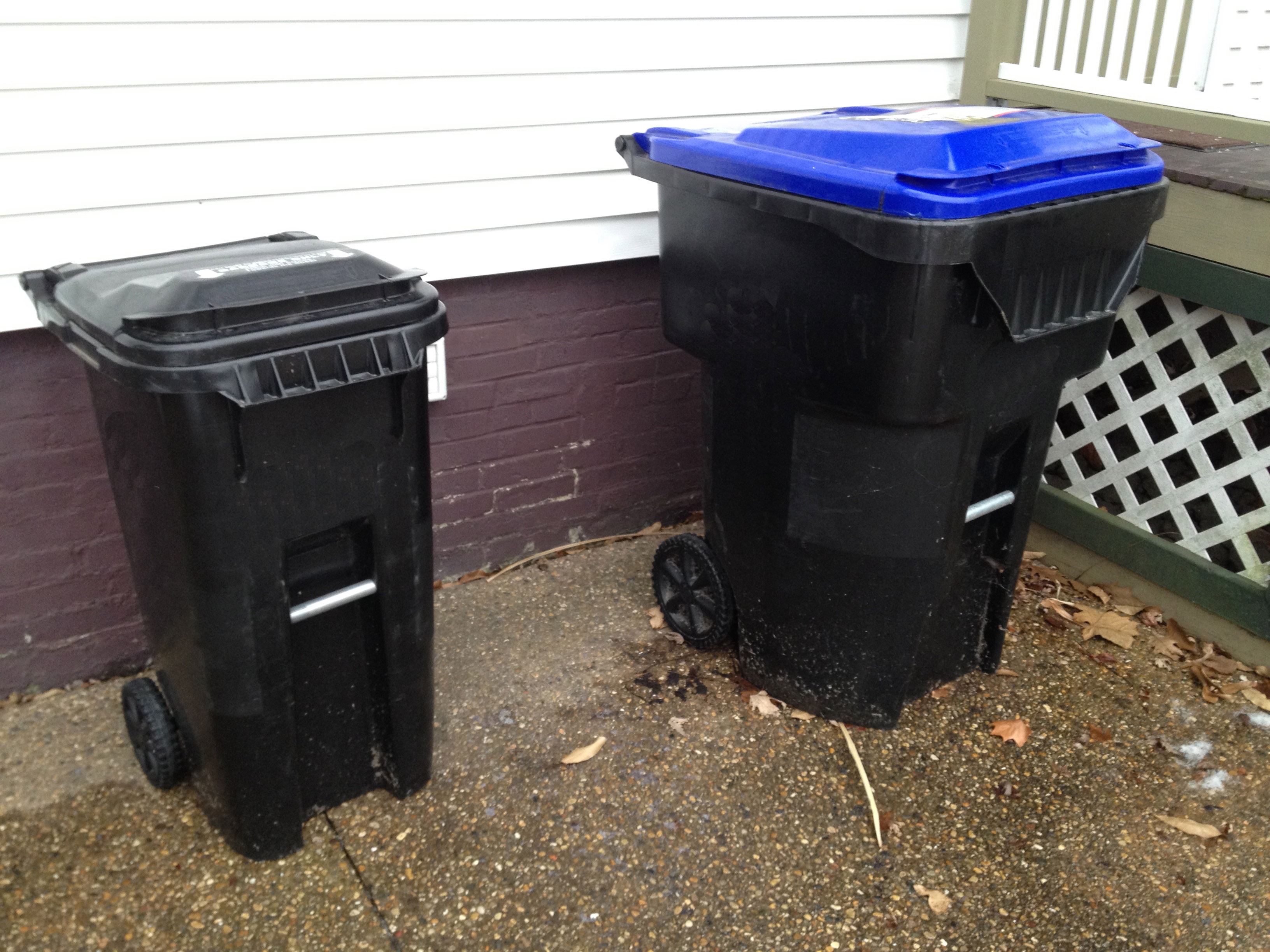
To that end, we do our part by putting out the least amount of trash a week as we can.  When the city offered us three different garbage cart sizes, we chose the smallest one, a 33 gallon cart.  Our recycling cart is the same size as the largest garbage bin, 96 gallons.

IMG_5420

Using cloth diapers has really helped us cut down on the amount of trash we contribute to the landfill.  One estimate puts disposable diapers at 50% of a households generated waste.  This display kind of puts that number in light.

visual-disposables-vs-clothWhat’s more is that it takes around 500 years for disposable diapers to decompose.  If you were put in disposables as a baby, then your diapers are still festering somewhere and still looking very much like diapers.  Umm, ewww.

Enough of my tangent.  What can be recycled to reduce waste?  Our municipality takes:

  • newspapers,
  • magazines and catalogs
  • junk mail and paper
  • cereal and food boxes
  • cardboard
  • books (remove hard covers)
  • plastics #1-5 & #7
    • water and soda bottles
    • milk and juice jugs
    • detergent bottles
    • plastic tubs and jars
  • glass bottles (green, clear, & brown)
  • glass jars (separate lids first)
  • aluminum cans
  • tin and steel cans

They do not accept:

  • ceramics
  • mirrors
  • window glass
  • scrap metal
  • food scraps
  • light bulbs
  • hazardous waste
  • motor oil bottles
  • hypodermic needles
  • medical waste
  • plastic bags
  • styrofoam
  • yard waste
  • garbage
  • electronics

Our municipality charges garbage by the size of the cart.  By getting the smallest cart and putting out less trash we save $48 a year.  The more important aspect for us is that we are doing less damage environmentally to the place we call home.

photo credit: NASA

photo credit: NASA


Posted in: Savings Tagged: recycle, Trash
« Previous 1 … 5 6 7 … 12 Next »

Recent Posts

  • Min/Maxing Car Sale for Highest Value and Lowest Headache
  • Buying a Car with Data Driven Decision Making
  • Hot Lunch
  • Baking with Dad
  • Winter Nights

Financial Goals

Recent Comments

  • suwaidi online on Building a New Desktop Computer
  • James Spurr on Building a Self Watering Raised Garden Bed
  • suwaidi online on Total Cost of Ownership – Inkjet vs Laser Printers
  • bcimechanical on Troubleshooting a Gas Furnace
  • g on Troubleshooting a Leaking Whirlpool Dishwasher [UPDATED]

Archives

  • December 2020
  • December 2018
  • July 2018
  • May 2018
  • April 2018
  • March 2018
  • February 2018
  • January 2018
  • December 2017
  • November 2017
  • October 2017
  • September 2017
  • August 2017
  • July 2017
  • June 2017
  • May 2017
  • April 2017
  • March 2017
  • February 2017
  • January 2017
  • December 2016
  • November 2016
  • October 2016
  • September 2016
  • August 2016
  • July 2016
  • June 2016
  • May 2016
  • April 2016
  • March 2016
  • February 2016
  • January 2016
  • December 2015
  • November 2015
  • October 2015
  • September 2015
  • August 2015
  • July 2015
  • June 2015
  • May 2015
  • April 2015
  • March 2015
  • February 2015
  • January 2015
  • December 2014
  • November 2014
  • October 2014
  • September 2014
  • August 2014
  • July 2014
  • June 2014
  • May 2014
  • April 2014
  • March 2014
  • February 2014
  • January 2014
  • December 2013
  • November 2013
  • October 2013
  • September 2013
  • August 2013

Categories

  • Business
  • DIY
  • Finance
  • Frugal Boy
  • Frugal Girl
  • House
  • Misc.
  • Parenting
  • Reading
  • Recipes
  • Savings
  • Technology
  • Travel
  • Uncategorized

Meta

  • Log in
  • Entries feed
  • Comments feed
  • WordPress.org

Copyright © 2026 Frugal Living.

Omega WordPress Theme by ThemeHall