Growing up, I remember my parents doing one yard sale. They probably did a lot more than one, but only one made an impression. We set up every folding table we had in the yard. Laid boards between them to make extra space and labeled dozens of well-loved trinkets for sale. Bargain hunters trickled through and we sold a tiny portion of what we had set out. Then we had to haul it all back into the house where it sat and sat, and sat, and sat.
Somewhere in my life journey a switch flipped and the thought of clutter became unappealing. I grew up in a three bedroom house with five siblings. Clutter was unavoidable, but now that I have a choice in the matter, I am a clutter phobic. Thankfully, Shae is also a clutter phobic and we actively work to keep our house clutter free.
So what is clutter? My general rule of thumb is that every item must serve some purpose and have been used within the past year. If a box hasn’t been opened in over a year, its contents are clutter. The box itself is clutter. The whole shebang must go.
Last week we were both feeling a strong itch to clean out some of the detritus so I set aside an hour a night to go through a dresser (misc electronics, stationery, etc.) drawer by drawer. Shae went through several boxes in the attic.
I generally make four or five piles as I sort through a box.
Recycling
Give Away
Sell
Trash
Keep
If at all possible, I like the piles to go from largest to smallest in that order.
Recycling and giving away are nice because it diverts material from landfills. At the same time, I make a conscious effort not to bombard family and friends with stuff. Do my nieces and nephews really NEED temporary tattoos or 10 beanie babies. Probably not, that is just making more work for their parents. Some items are valuable but no longer used, I’ll get to that in a second. Finally there is always something that can be thrown away.
In the course of a week, we set aside a number of sellable items with the intention of having an E-Yard Sale. Shippable niche items were listed on eBay, the popular online auction site. Larger general items were listed locally on Craigslist.
On eBay, I sold 2/3 items that I listed. I sold an old graphics card for $59 and a set of RAM modules for $20. A brand new A/C pressure switch for our old Nissan Altima did not sell and was tossed in the trash at the conclusion of the sale.I sold 1/2 items listed on Craigslist. I had picked up a pair of end tables off the curb while walking around our neighborhood. I sold them for $35 to a woman who was ecstatic to get them at that price. The folding tv tray table has not sold yet, but Shae might have found a buyer through a different classifieds website.
All told, I made over $100 by cleaning out some clutter from our house. Shae has made over $40 so far and still has some big ticket items pending. We also have three large boxes of toys, books, and misc crud that we will be donating to charity.
It feels so good to clean out our house. Working through sentimental attachments can be difficult, but donating to charity makes it easier. Isn’t it better to let someone else enjoy an item than to let it sit unseen in a box or drawer for years? Focusing on selling only items worth $10 or more online is also easier than setting up an entire conventional yard sale. You can set up an E-Yard Sale in your underwear!
Our garden is coming along. Everything is planted, but the back row has just started to germinate.
I love how the carrots look like a forest.
The lettuce and spinach has been growing like weeds. This picture was taken a few days ago and it has already doubled in size.
We’ve been eating fresh salad greens almost daily. My birthday was at the end of May and Shae grilled lamb bacon burgers. It was her first time grilling and I think she enjoyed it.
DIY projects have taken center stage again. This time we will be rebuilding our front porch. Here is a before shot.
It is shaping up to be a busy summer. Aren’t they always?
Summer seems to be here to stay and the house has been warming up. Shae and I talked again about getting air conditioning (our 1984 unit has never worked since we moved in). The conversation only took about 5 seconds as we both understood that the choice was to either get AC or pay off the house this year. The needs have once again trumped the wants.
The cheaper and lengthier option is to plant some shade trees in our yard. Our yard is very spartan of trees with only a silver maple along the street and an ornamental by the front of the house. Last fall we planted a Japanese dogwood in the front to replace the neighbors tree that fell over in heavy rains. We also planted a silver linden in the far backyard.
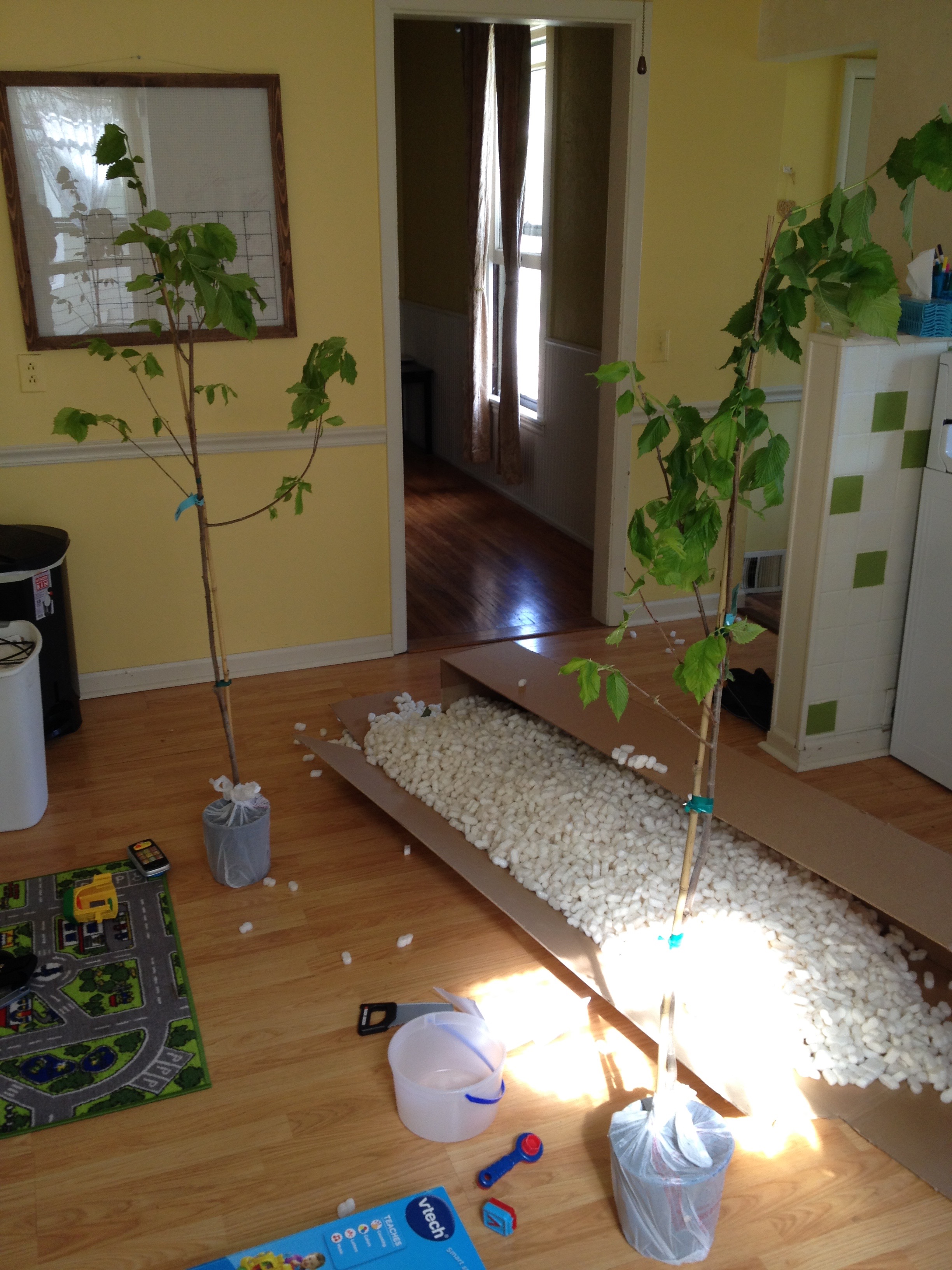
Yesterday my order of two Princeton American Elm trees arrived in the mail from a nursery in Joplin, Missouri.
Some Tree History
American elm trees were THE street boulevard tree in the United States. The vase like shape made great cathedral canopies that formed aesthetically pleasing shaded passageways for horse drawn carriages and early automobiles.
Then in the 1920s, disaster struck. Lumber imported from Europe contained an invasive beetle and the beetle carried spores for a deadly fungus. The beetles ate the bark from the American elm trees and spread the spores of the fungus from tree to tree. The fungus would cause necrosis and was the source of what came to be known as Dutch Elm Disease, or DED. DED wiped out millions of elm trees in America and the once beloved tree that inspired more Elm streets than Main streets was largely forgotten or shunned.
Municipalities, looking for a new streetscape tree to take the place of elms turned to the attractive ash tree. Of course, you know what happened to ash trees. Once again an invasive beetle, the emerald ash borer came into the ecosystem and devastated the ash tree population.
For the third time, municipalities had to search for replacement trees to line the streets with. This time silver maples, ornamental pears, lindens, and oaks were selected. Each has its own set of problems but so far none has been massacred like the elms and ashes before them.
Then something kind of miraculous happened. In the 1990s the USDA began research on hybridized elm trees with resistance to DED. Several new cultivars were developed including, Valley Forge, Jefferson, and New Harmony. Princeton was an old cultivar that was found to have natural DED resistance and cuttings (clones) of these old surviving trees were propagated after testing well against DED infection. The USDA testing for DED resistance found that the new cultivars had 86% to up to 95% survival rates (depending on the cultivar) when injected with two to three million spores. The typical beetle will carry around 100 spores.
Planting Steps
Shae and I measured and staked the locations for the two trees a few days ago. Princeton elms grow to 60-80′ tall and a crown diameter of 30-40′. In favorable conditions they can grow 3-6′ a year and can live between 100-300 years.
To plant our new trees, I dug a hole about three times the width of the pot and about the same depth as the pot. I removed all of the grass and mixed in some potting soil. The tree should be planted at the same height or slightly higher than the surrounding terrain. Planting too deep is detrimental to the tree because the roots need oxygen from the surface and the trunk doesn’t like to be covered up with soil or mulch.
Both trees were root bound. Root binding happens when a tree or shrub outgrows its container size. The roots will hit the edge of the container and then start circling around. The best way to deal with root bound plants is to cut an X in the bottom and four vertical slits on the sides to free up the roots. If the roots aren’t freed and pointed outwards, they will continue to grow around in circles and eventually strangle themselves.
I finished up the planting by adding a layer of triple shredded hardwood bark mulch to help keep moisture from evaporating. I also added a plastic guard to protect the trunk from animals, little boys, and the lawn mower. The mulch should not be touching the trunk and the sapling trees will need daily watering for the first couple of months until their roots are established.
Additional Care
Like a small human child, elm trees need the most care in the first 5-10 years of their lives. Annual pruning to develop a strong central leader (trunk) is recommended to keep the iconic vase like shape that elms are known for. Pruning should be done in the early spring or late fall when the tree is dormant. Bugs are not active yet and the risk of infection is lower at these times.
Conclusion
If all goes well, these trees should grow to be about 25-30 feet tall in 8-10 years. That should provide us with a nice shady backyard and a cooler house. Even if we have installed a new AC unit, we should still benefit with lower electricity bills because of the added shade.
I am 99% finished with a weekend home improvement project and it is only Thursday! Just don’t ask what weekend I started on. 😉
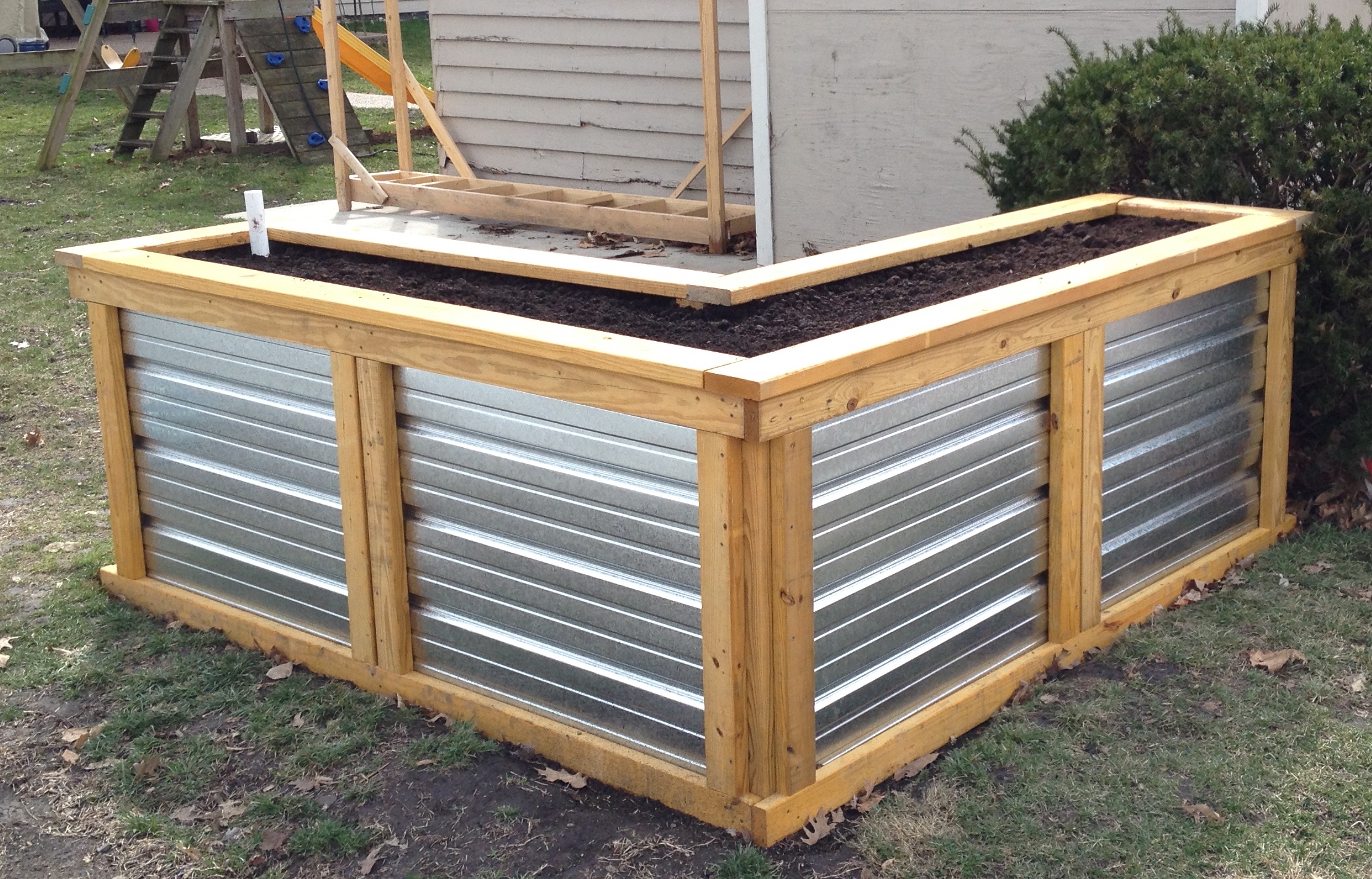
Shae and I have been talking for a while about building some kind of raised garden/flower bed in our backyard. I wanted something tall but affordable. Shae wanted low maintenance. Here is the almost finished product that has been erected in our backyard.
A view from the inside of the ‘L’
and a view from the alley.
From the Beginning
Every project of ours starts with a written plan. We often go through several iterations of a design before settling on ‘the one’. The first proposal was a simple rectangle and the site location for it was a completely different part of our backyard. It was only about a foot tall and made entirely from cedar.
Of course that didn’t really meet any of our specs. Cedar is an expensive wood, at least when compared to pine. The planter was only a foot tall and it wasn’t self watering. There had to be a design that would meet all of our requirements and eventually we started toying with an L shaped hybrid design that incorporated low cost treated, stained pine with galvanized sheet metal.
Several revisions later and we had our bill of materials.
Menards was running an 11% rebate sale, that we took advantage of. We also rented one of their trucks ($22.50) for 75 minutes from when you leave the outdoor yard.
We unloaded all of the material minus the dirt into our garage for the evening. I posted the below picture to Facebook and asked friends to guess what I was building. People were very creative in their guesses, although most were spot on that it had to do with gardening. That night I started building the frame in the garage.
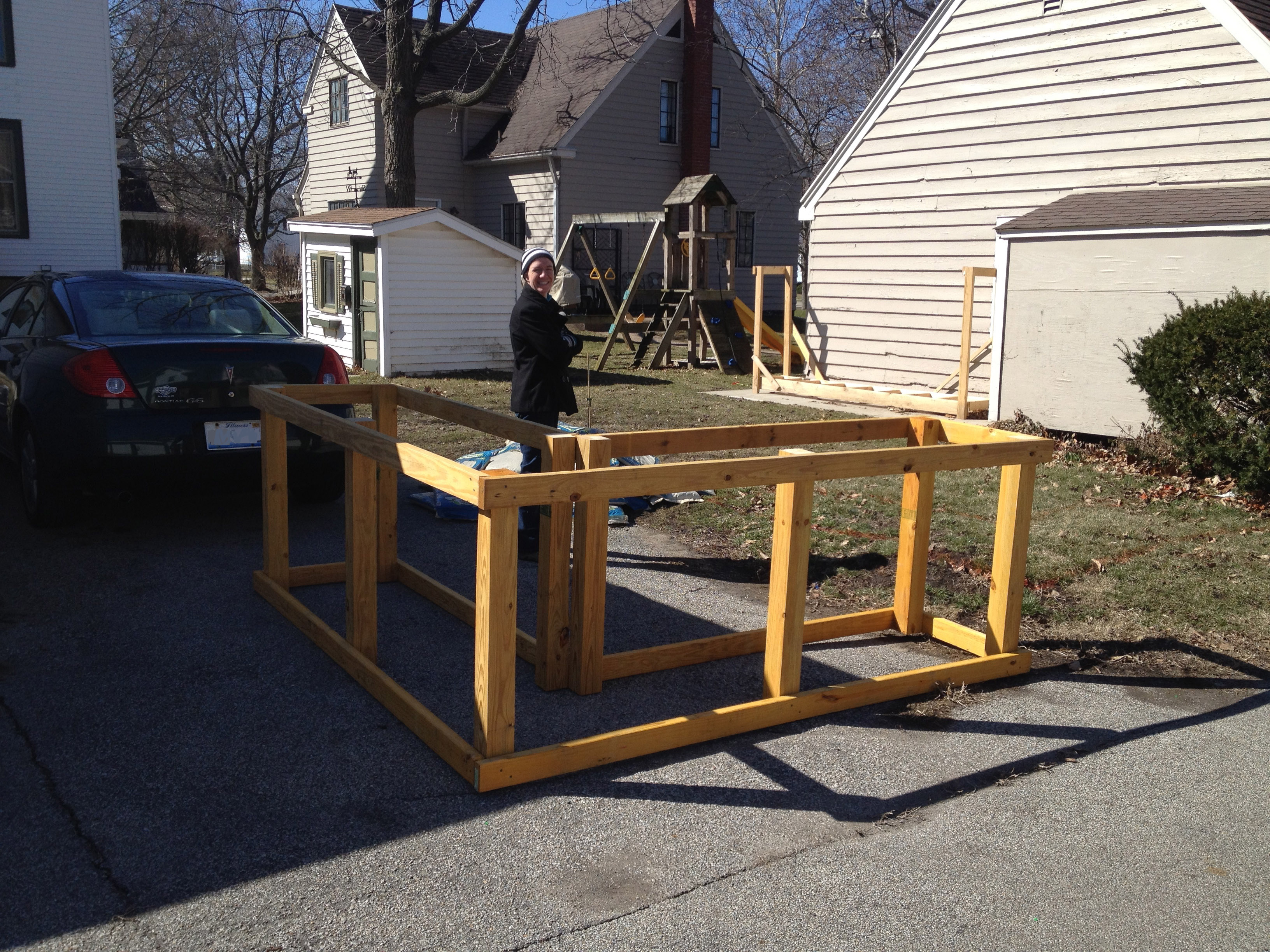
Saturday morning, Shae helped me drag the frame out of the garage and put it next to its final resting place. It was a bit taller than either of us anticipated!
Due to its weight, we decided that I would build the rest of it in place, so we marked out where it would go on the grass.
Then dug out and leveled the ground so the planter would sit evenly.
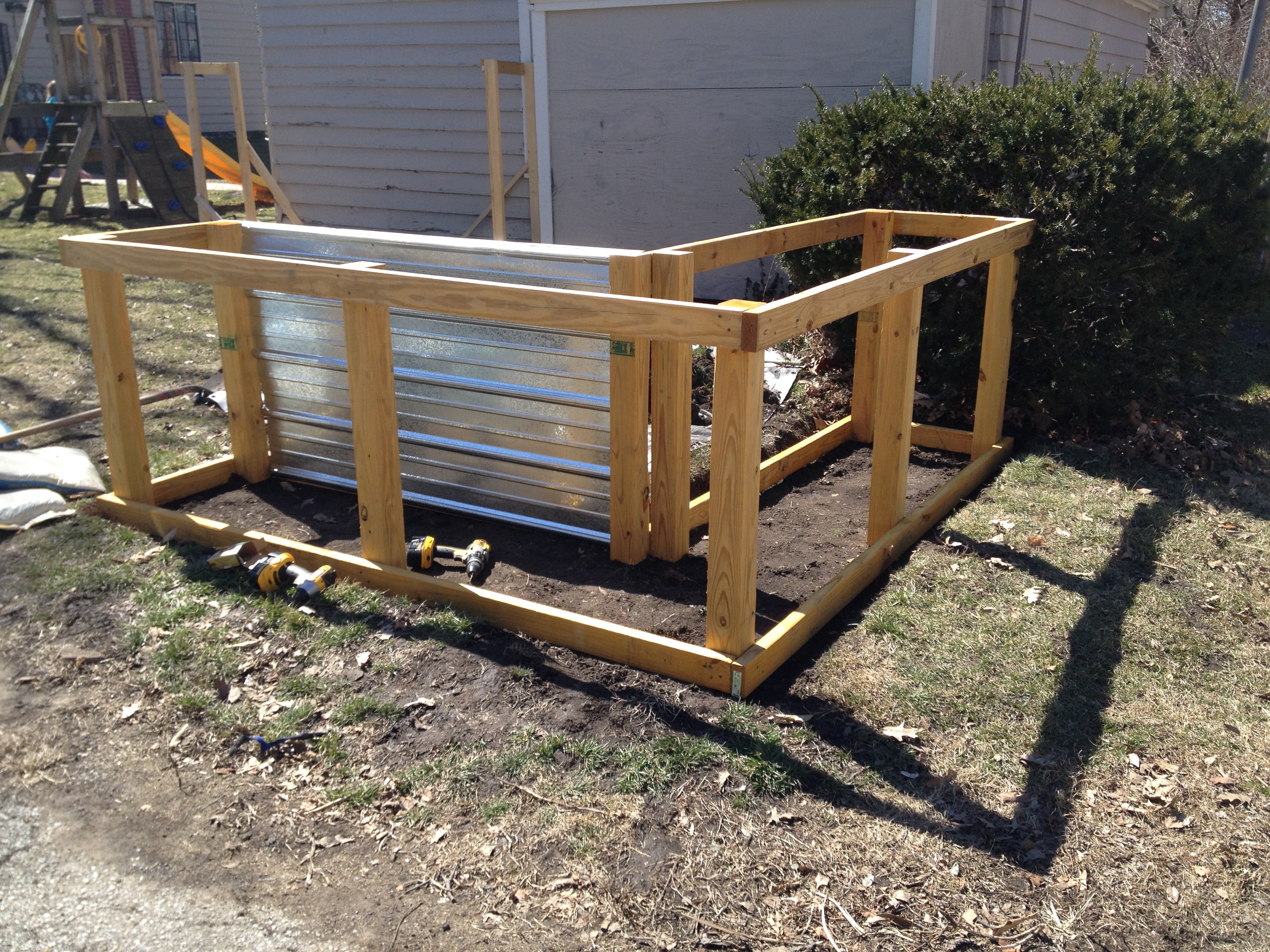
After dragging the skeleton into place and leveling it, I started fitting the metal panels.
After fitting the first panel, I instantly knew there was a serious design flaw. My intention was to have the panel hold the dirt in, but with it only being secured at the top and bottom, it was far too ‘bendy’ and easily bowed in and out with the slightest amount of pressure. To resolve this, I bought three additional stained and treated 2x4s to brace the panels on the outside. I also had to buy an additional four regular treated 2x4s to replace the ones that had to be used for bracing.
Being able to screw the sides of each panel added much needed rigidity.
With the panels in place, I turned my attention to the inside of the planter. Instead of filling the entire planter with dirt, an expensive and back breaking proposition, we opted to instead build a raised internal floor. I secured treated 2×4 joists to the vertical 4x4s.
Treated 1x6s were cut to size and installed as planking. Frugal Boy enjoyed cruising along the inside.
Once all of the floorboards were installed, I grabbed some left over heavy duty plastic from when we lined one of our crawlspaces and carefully placed it into the planter to make a liner.
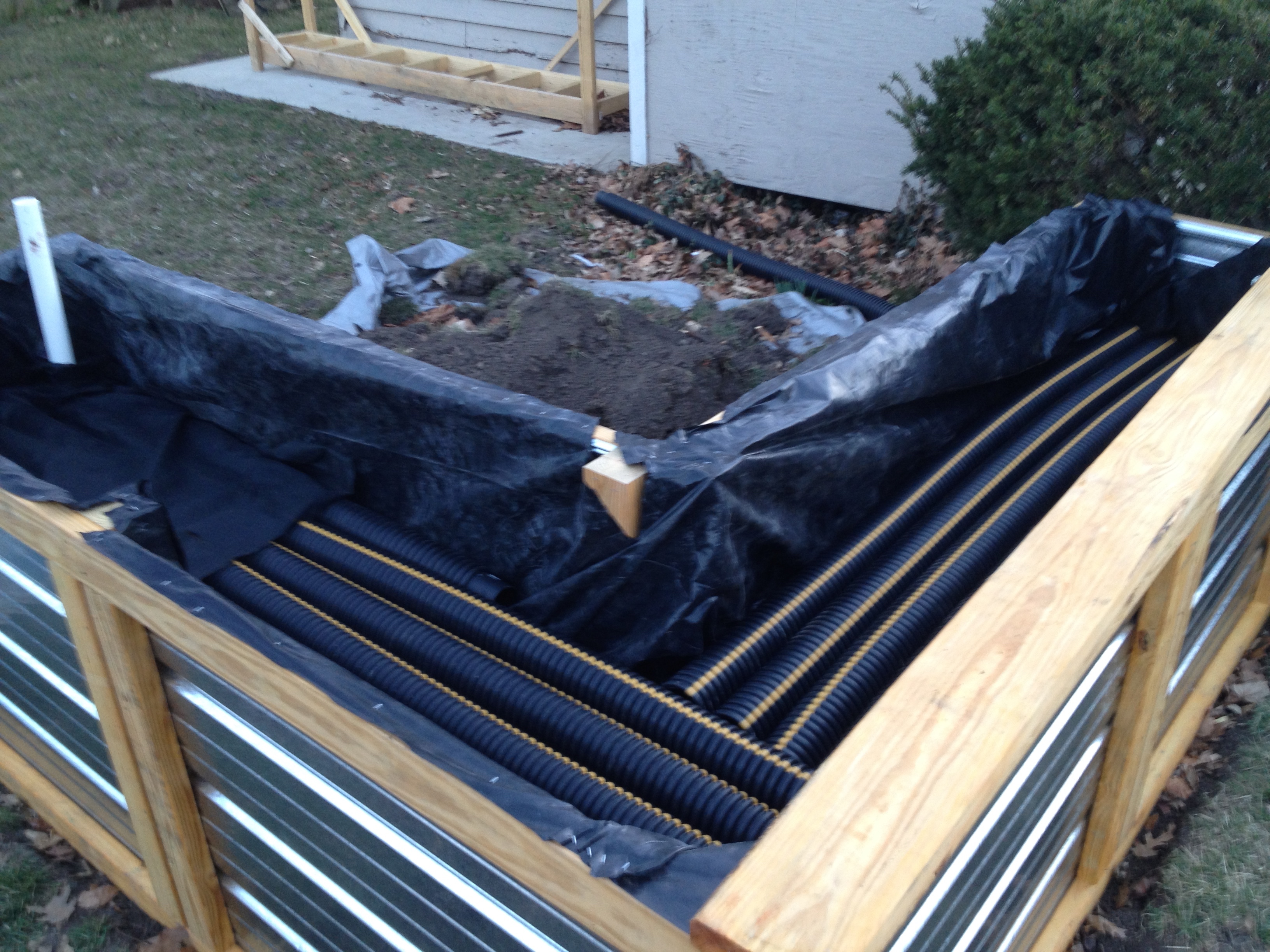
With the liner stapled to the top of the planter, I cut 3″ corrugated, perforated drainage tube to fit the bottom.
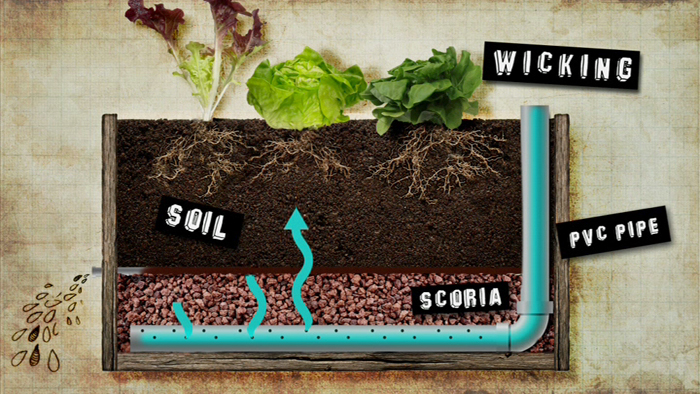
These tubes act as a water reservoir and form a critical part of the ‘self watering’ aspect of the planter. Of course, you need a way to add water to the reservoir and that is where this handy fill tube comes into play.
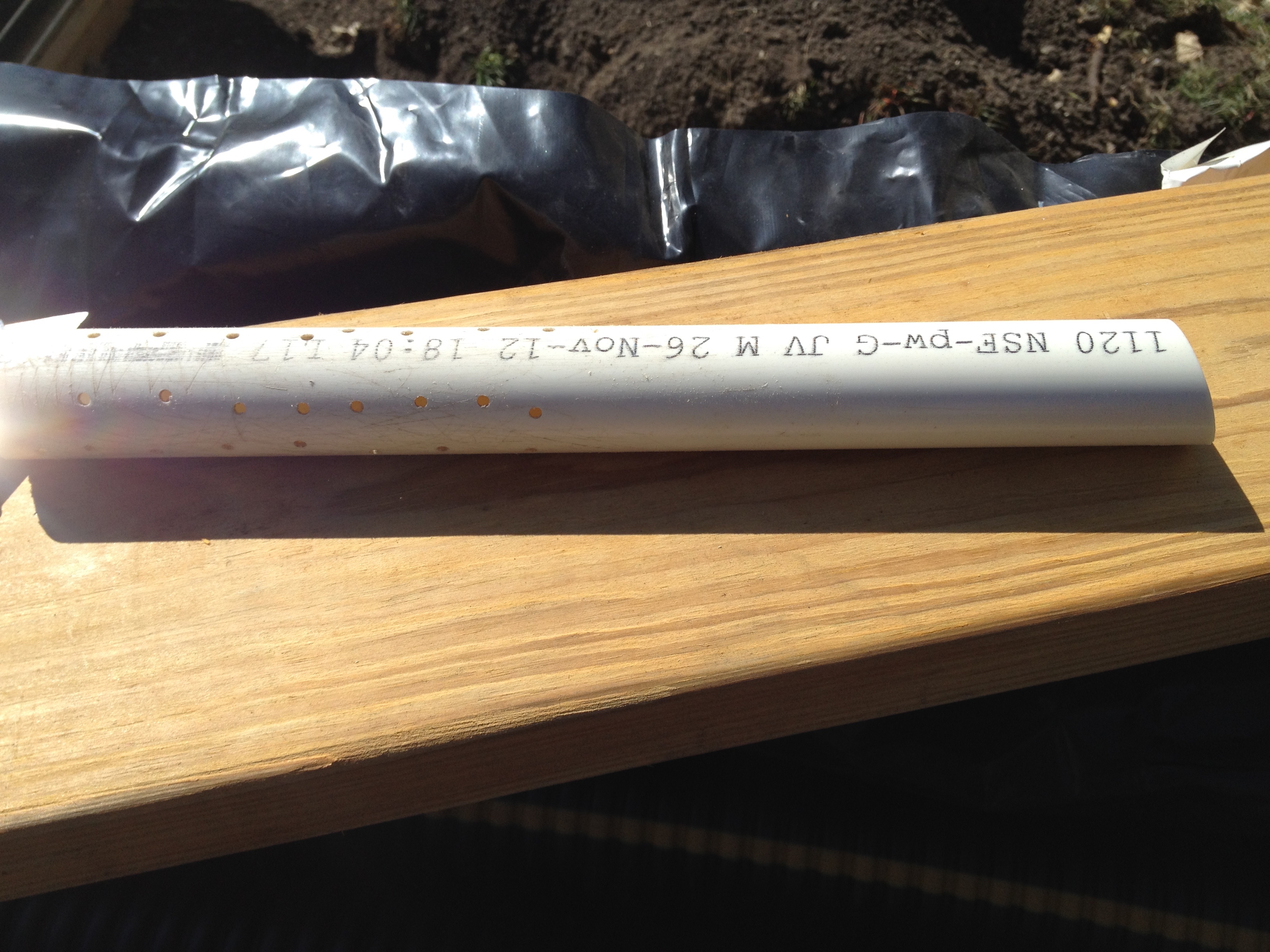
We also needed an overflow drainage pipe. I used a scrap piece of pvc and drilled a bunch of holes into it.
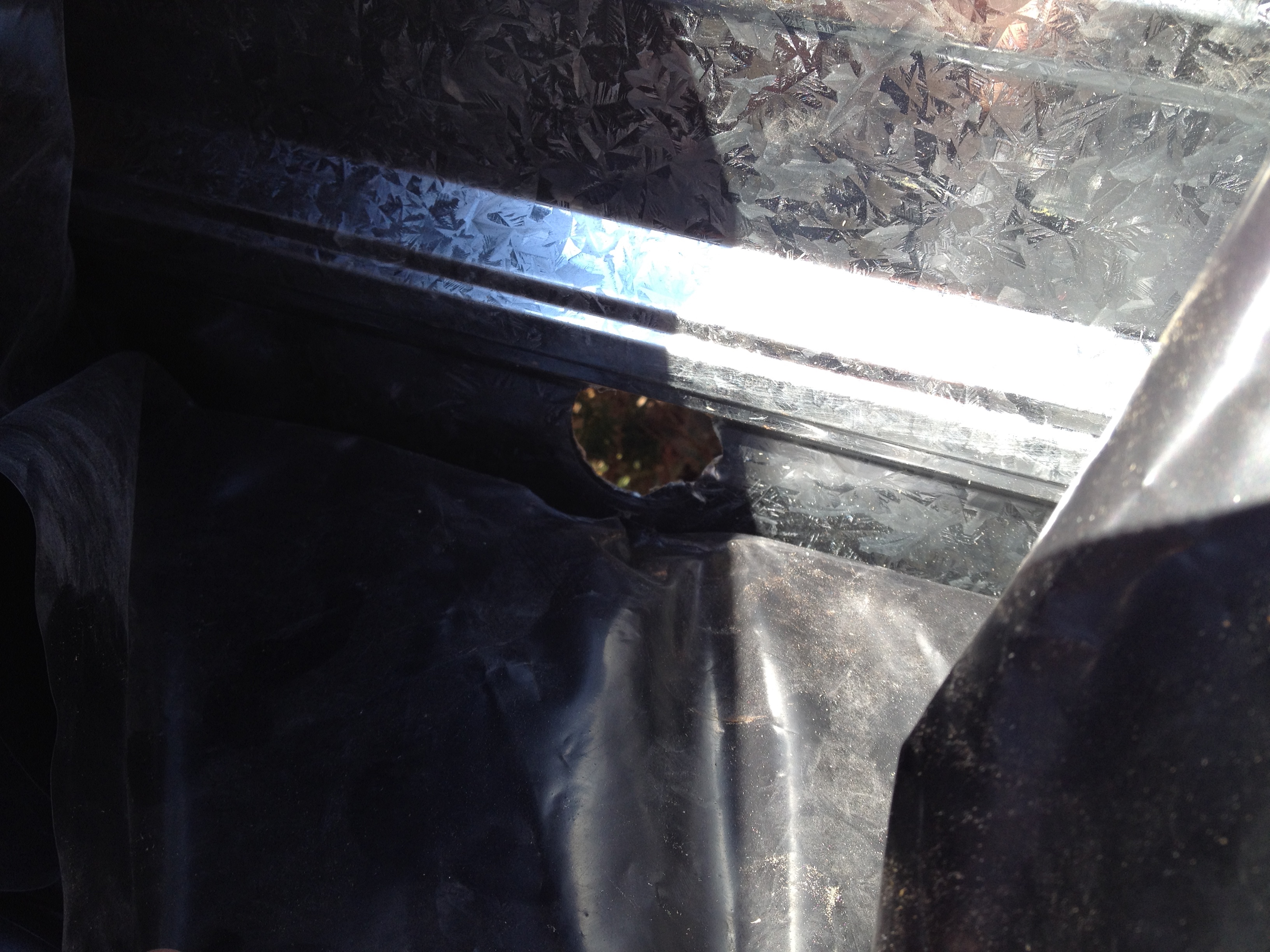
I cut a hole in the planter side just above the corrugated pipe
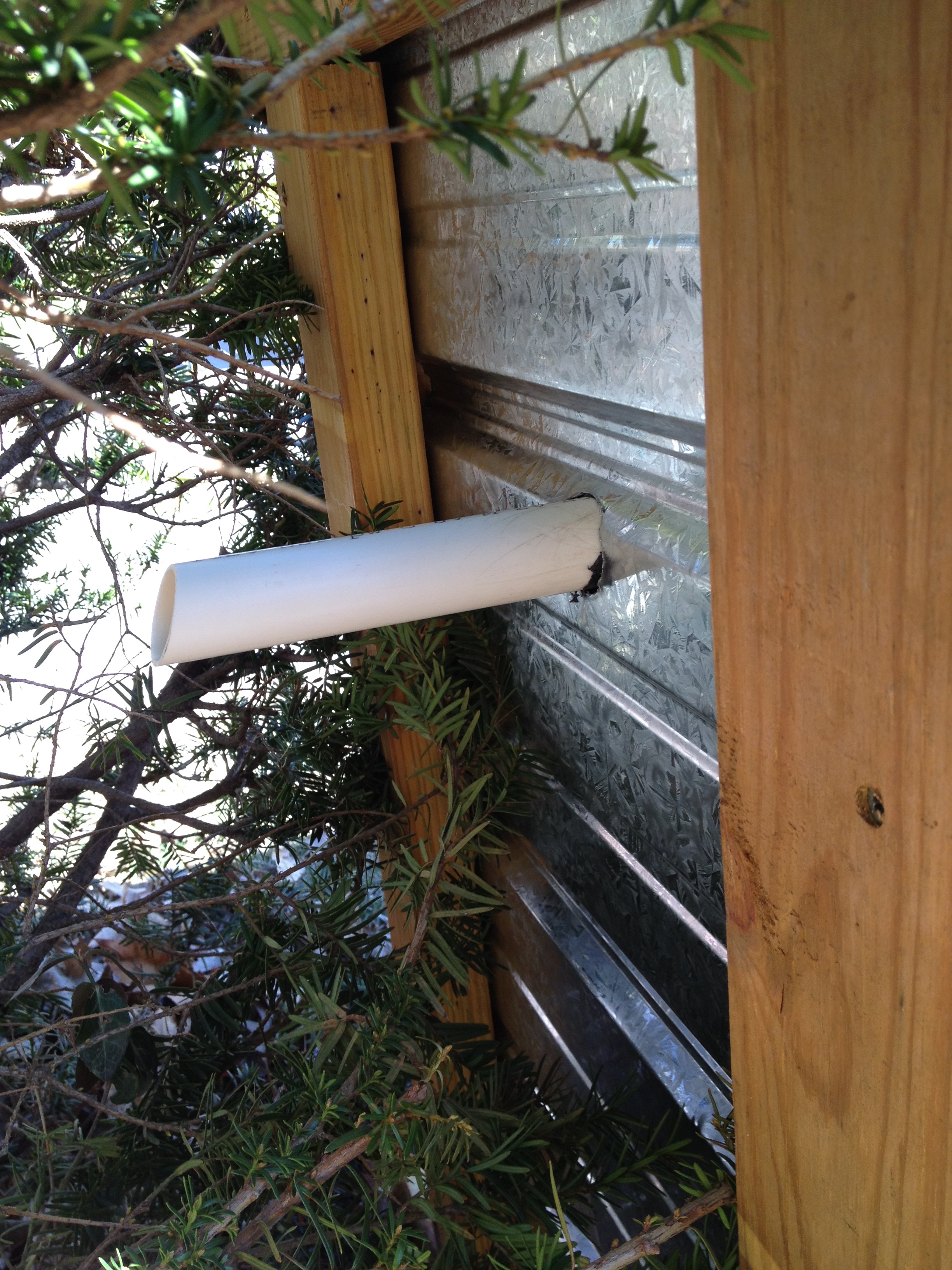
and inserted the overflow pipe.
The overflow is on the far side of the fill tube.
All of the piping gets wrapped in landscape fabric to prevent dirt from falling in and filling/clogging up the watering system.
Then it was time to add dirt! I started with some sand along the sides of the corrugated piping. I read somewhere that top dirt sitting in water will begin to stink as anaerobic bacteria goes to town.
With the dirt added, the only major thing left was to add the edge cap. I used treated and stained 2x6s and secured them with screws from the underside to leave an unmarred top surface.
What’s Left?
Besides sowing seeds, something that will have to wait until it gets a bit warmer, the only big item left to complete the project is to add gravel along the perimeter like so.
I am putting down landscape fabric to keep weeds from popping up next to the planter. Holding that in place is river rock because it is cheap and attractive. I have to go back to the store for a few more bags of rock. I also need a PVC cap for the supply tube so mosquitos cannot breed in the underground reservoir.
So there you have it! Hopefully the self watering system will work by wicking moisture from the reservoir to the root systems. We should only have to water once a week even during the hottest days of summer.
Shae has been deciding what she wants to plant and already has a few ideas.
Leave a comment with what you would plant! Who knows, maybe we’ll try it out ourselves.
Increasing your spending when your income goes up. Lifestyle inflation tends to continue each time someone gets a raise, making it perpetually difficult to get out of debt, save for retirement or meet other big-picture financial goals. Lifestyle inflation is what causes people to get stuck in the rat race of working just to pay the bills.
Not too long ago we were broke college students with hardly any income and student loan debt. The only places we could afford to live were dumps. Dumps with roommates to be more precise.
The first place that we lived outside of the college dormitories was a rented house with four other housemates. The rent was divided six ways for a five bedroom house (a love triangle of suicidal lesbians lived together in a very unpredictable fashion). The small arts and crafts bungalow was an improvement in many ways from the dorms in terms of both space, e.g. a full sized kitchen, and financially. We each paid $250/mo in rent and took a share in the $300-500/mo outrageous utility bill. Our housemates were very wasteful. Even so, it was a cheap place to live for the six months that I was there and the twelve that Shae resided.
Determined to keep my living expenses low and remain close to my sweetheart, I rented my first solo apartment a few blocks away until Shae could finish up her college degree.
This had to have been the worst place that I have ever lived. The single bedroom, garden level, apartment cost $300/mo plus utilities. Now that I was on my own, utilities were quite a bit cheaper as I could control the thermostat and the laundry was coin operated (aka not run constantly by housemates washing A pair of pants or A shirt).
I did not have cable, a landline, internet service, smart phone, or satellite tv. I walked to work and only drove to buy groceries. Shae and I only ate out when her parents visited. The lifestyle inflation was small if at all present. If homelessness was rock bottom, the months spent here were akin to resting on a pad of paper that sat on the rock.
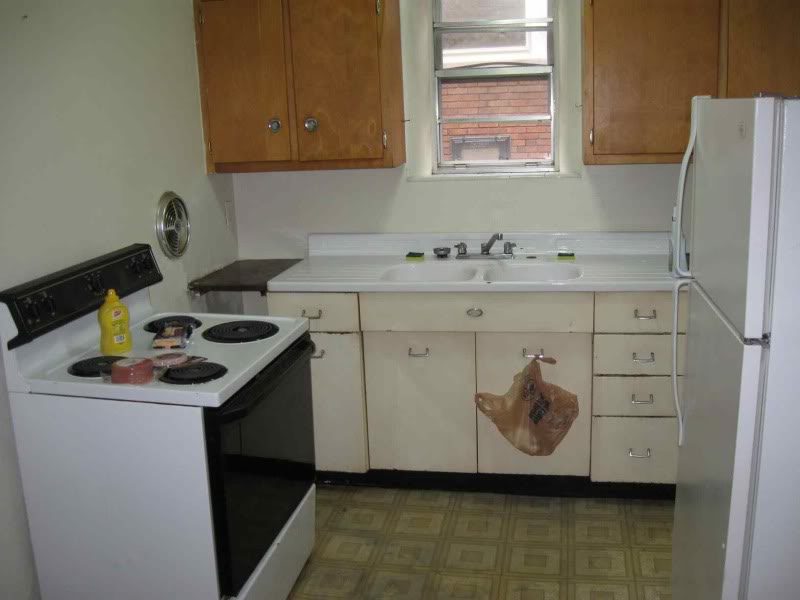
That first apartment is the source of most of my horror stories. The entire place was infested with cockroaches and the landlord, a real scum ball, was too cheap to pay for an exterminator. On more than one occasion, I would wake up at night to feel one running across my bare torso. It took several years to undo that complex.
My bedroom had an “exterior” door that opened to the utility/laundry room communal area. It was not uncommon for other tenants to start laundry at 11pm.
The kitchen had cracks in the floor that seeped water when it rained (probably why the roaches loved the place so much). Yes, that is a typical lunch laid out on the stove (bologna, cheese, and mustard).
The living room had a window that was busted out and a piece of plywood had been wedged in. I plastic’d the window up in the winter time and it would bellow in and out as the wind whipped around outside.
As part of living on the ground floor in a locked building, strangers would often ring my doorbell or knock on my window to be let into the building. If I tried to ignore them, they would become belligerent and if I told them to ring the proper doorbell they would become belligerent. The police would often use me as the doorman whenever they came to check in on someone upstairs. I felt more inclined to helping them.
My office was only two blocks away and I would often walk out my backdoor and take the alley to get there. In the warmer months, a bum could often be spotted sleeping in the alley bushes in old army fatigues. Another example of the fine living establishments that I was enjoying was when the mailman joked to me that I was living in the terrorist apartment. It turned out it wasn’t a joke. The former tenant was a convicted terrorist and tried to blow up the state capitol building. I received a large box from a prison one day with random ratty possessions including some shower sandals, handwritten notes, and a grungy wife beater. I chucked it all in the dumpster.
So why in the world did I live in such a shitbox? Primarily for love, it kept me close to Shae, but also for money. The place was magnitudes cheaper than anywhere else that I could have rented.
Moving Up In the World
Shae eventually graduated and we hightailed it out of our respective housing situations to find greener pastures. Since my work could easily follow me around, we moved to a city that hosted employers looking for Shae’s talents and skill set. It was 2010 and the impact of the recession was still being felt by the cautious hiring of the time. Shae could not get into her dream job right away and had to start applying to 2nd and 3rd tier companies. As a result of being unemployed, landlords would not rent to her and she had to temporarily move back in with her folks.
With my still fledgling business and even smaller income I was able to rent a ‘nice’ two bedroom apartment. The neighborhood had several other rentals operated by the property management company, and when Shae secured a menial grunt job a couple of weeks later she was able to move into her own two bedroom apartment across the street.
I paid $525/mo plus electric and she paid $545 plus electric. Our apartments were close enough that we could share an internet connection with a powerful wireless router. Each of us rented out our second bedrooms to graduate students to cut our housing expenses to about $262.50 + 1/2 electric + 1/4 internet. The neighborhood provided plenty of characters with one that expanded our vocabulary and another that sat out all day in a lawn chair to break change for ‘friends’.
It didn’t take an overqualified Shae long to move on from her gruntling GED requirement job to an associates job. Along with the safer, non physical labor, job came a bump in pay. Uh oh, here comes the lifestyle inflation!
It’s true, as my business grew and Shae moved up the job ladder/pay scale we did experience lifestyle inflation. Those bologna, cheese, mustard lunches turned into turkey, cheese, lettuce, tomato, pickle, and mustard sandwiches. Dinners transformed from chicken to beef. Fruits and vegetables could be found in our pantries and going out to eat was not just when parents visited.
Triple Life Changes
For the next year, life continued on with both of us paying half rent and working our respective jobs. We even scrounged up enough spare money to take a cruise in the Bahamas.
The summer of 2011 was a perfect storm for lifestyle changes. Shae started a new job with her target company, I landed a lucrative contracting job, and we got married. Without looking at the numbers I would guess that our combined income doubled.
We decided that I would move into her place as it was slightly nicer and had coin laundry in the building, working AC, and a dishwasher. Gone were the days of roommates and being able to split our internet bill four ways. As a newly married couple we *needed* some nice pots and pans, those plastic cups *had* to be replaced with glass, and pyrex containers replaced leftover lunch meat containers to pack lunch in. Too tired to make dinner that night, let’s just order take out. We bought his and hers smartphones on contract and shelled out over $100 a month because that’s what well earning married people do! Right?
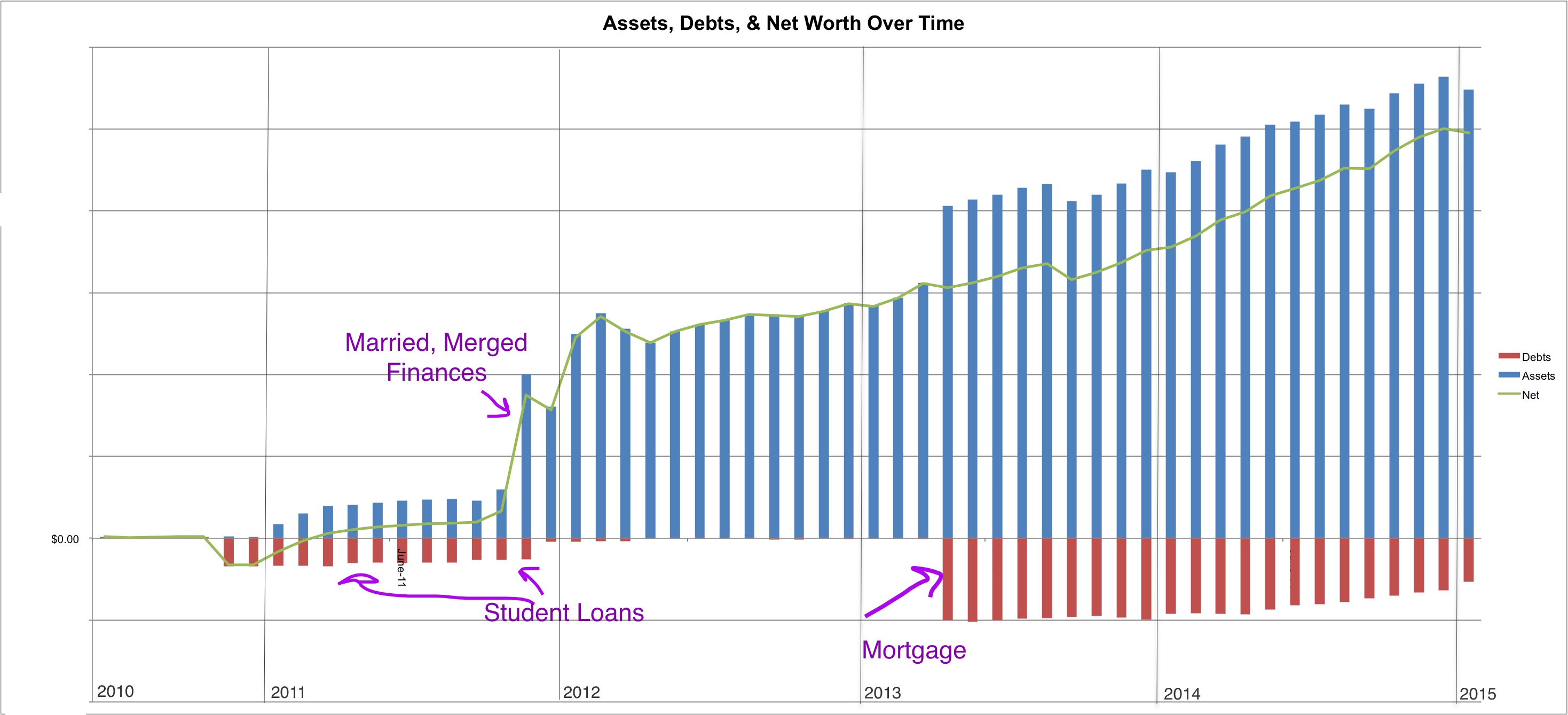
Looking back at it and seeing the relatively minor bump in net worth in 2012, I cannot help but think of the song And the Money Kept Rolling In (And Out) in the hit musical Evita.
When the money keeps rolling out you don’t keep books
You can tell you’ve done well by the happy grateful looks
Accountants only slow things down, figures get in
the way
The song describes wealth redistribution and corruption in 1950s Argentina but I think it can also apply to poor personal finance.
Part of the problem was that we were busy house searching at the time and held almost all of our wealth in negligible interest rate savings and checking accounts. What money we did have saved up was not working for us. It was lazy money.
First Time Homebuyers
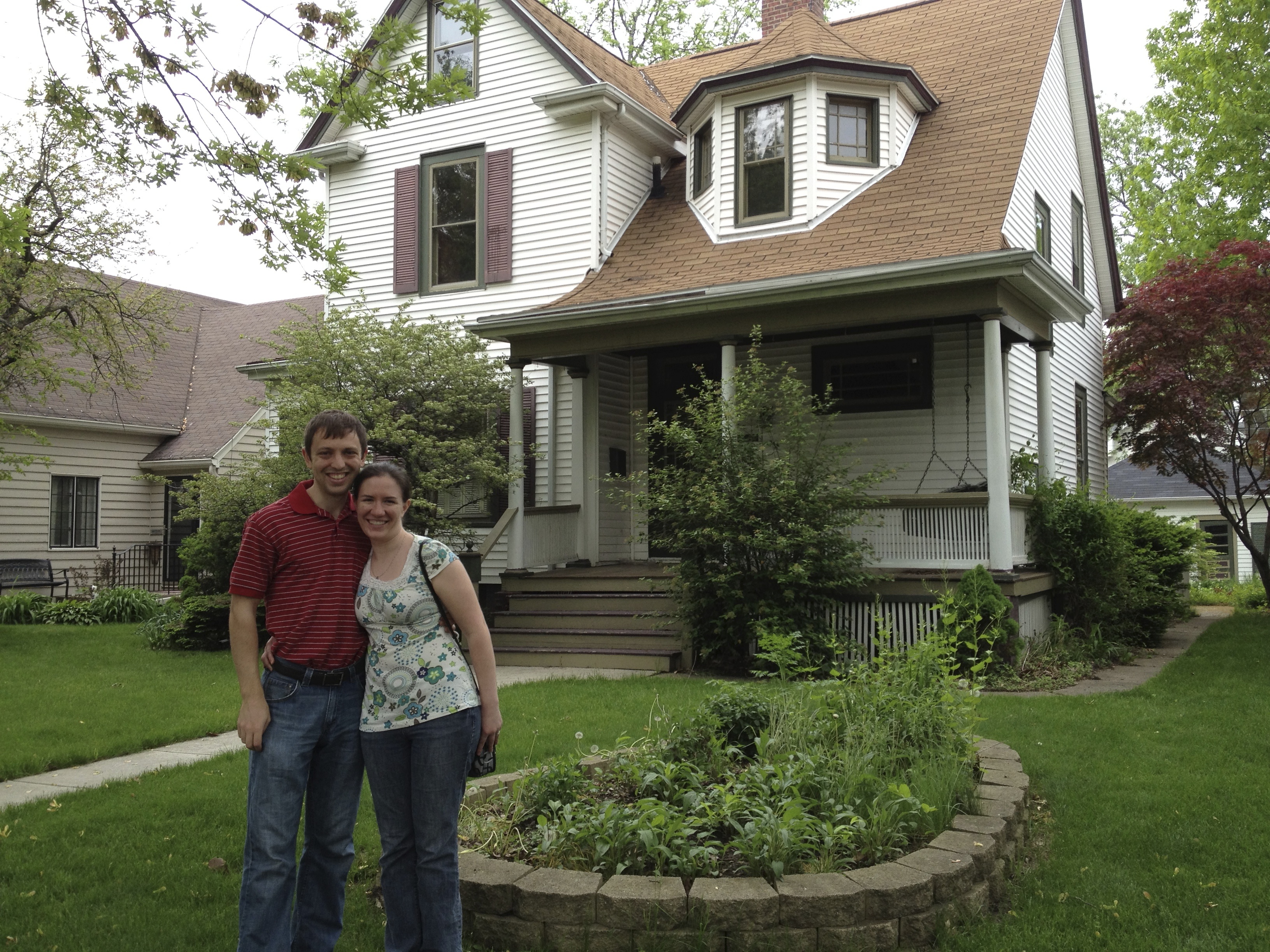
In 2013, after two years or searching, we found a house and moved.
Our cheap rent was replaced with a mortgage, property tax, homeowners insurance, repairs, all utilities, and furnishings. Mortgage + PTax + Utilities + insurance run about $850/mo. An increase of approximately 50% from our renting days, but with the advantage that the principal of our mortgage payments come back to us as equity in the house.
2013 we also started to get serious about retirement, investing, and trimming expenditures. All three helped us get ahead of the rat race that is lifestyle inflation.
Pay Yourself First
One of the best actions we took and I wish we started doing it earlier was diverting 25% of gross pay to tax advantaged retirement accounts. After 401k contributions, tax withholding, health insurance, and automatic taxable investments our take home pay was/is only about half our gross income. From there we skim off quadruple mortgage payments (paying ourselves in house equity). That leaves about 25% of our income to cover all other expenses (groceries, auto insurance, childcare, eating out, utilities, property taxes, entertainment, etc.).
Paying yourself first, especially with a % 401k contribution helps directly fight lifestyle inflation. If we get a raise a chunk of that raise never makes the paycheck. It is hard to miss something that isn’t there.
A Look Back
In 2012 our net worth increased 16%.
In 2013 it went up by 24%
2014 saw a whopping 41% gain (thanks in large part to the stock market)
While a 16% increase in 2012 isn’t bad, it could have been much more if we had been more cautious about lifestyle inflation. Mobile phone contracts alone wasted over $1200 that year. Leaving money sit around in 0.01% interest accounts also hindered growth. While it was likely the most prudent way to keep our down payment safe, you can see how the following years benefitted from aggressive investments and keeping a bare minimum in anemic checking accounts.
Should we go back to eating plain bologna, cheese, and mustard sandwiches or living in a roach infested apartment to save money? No. Lifestyle inflation per the definition is when your net worth (the green line) remains flat. As long as your net worth is trending upwards, you are beating lifestyle inflation. How much it is trending up is probably a good indication of how much LI is in your life. With that said, it is far easier to go up the lifestyle ladder than go down. Starting in the dump gave us plenty of room to grow.
Remember, a dollar saved is a dollar earned. The next time you get a raise, consider paying yourself first. Your future self will thank you.
 I sold 1/2 items listed on Craigslist. I had picked up a pair of end tables off the curb while walking around our neighborhood. I sold them for $35 to a woman who was ecstatic to get them at that price. The folding tv tray table has not sold yet, but Shae might have found a buyer through a different classifieds website.