My photo library has a bunch of pictures that don’t warrant individual posts, so today is a potpourri day.
The weather here has finally gotten above freezing. Frugal Boy only had a brief encounter with snow this winter (fingers crossed we don’t get slugged with a giant blizzard in the last 1.5 months of winter).
Shae tried her hand at making and freezing breakfast sandwiches. It is nice to have a quick hot breakfast on cold mornings. Aldi is the cheapest grocer that we have found for pre-made sandwiches, 75¢/sandwich. Ours are about equal in price.
Shae also managed to sell Frugal Boy’s Bumbo chair for $14. We paid $5 for it at a garage sale.
The grandparents visited for a few days. It is always nice to have extra hands and eyes to corral youngins.
Yesterday we did some Spring cleaning. If I call it that, will it make it Spring? Living with 24 pounds of curiosity is a great motivator to declutter and clean.
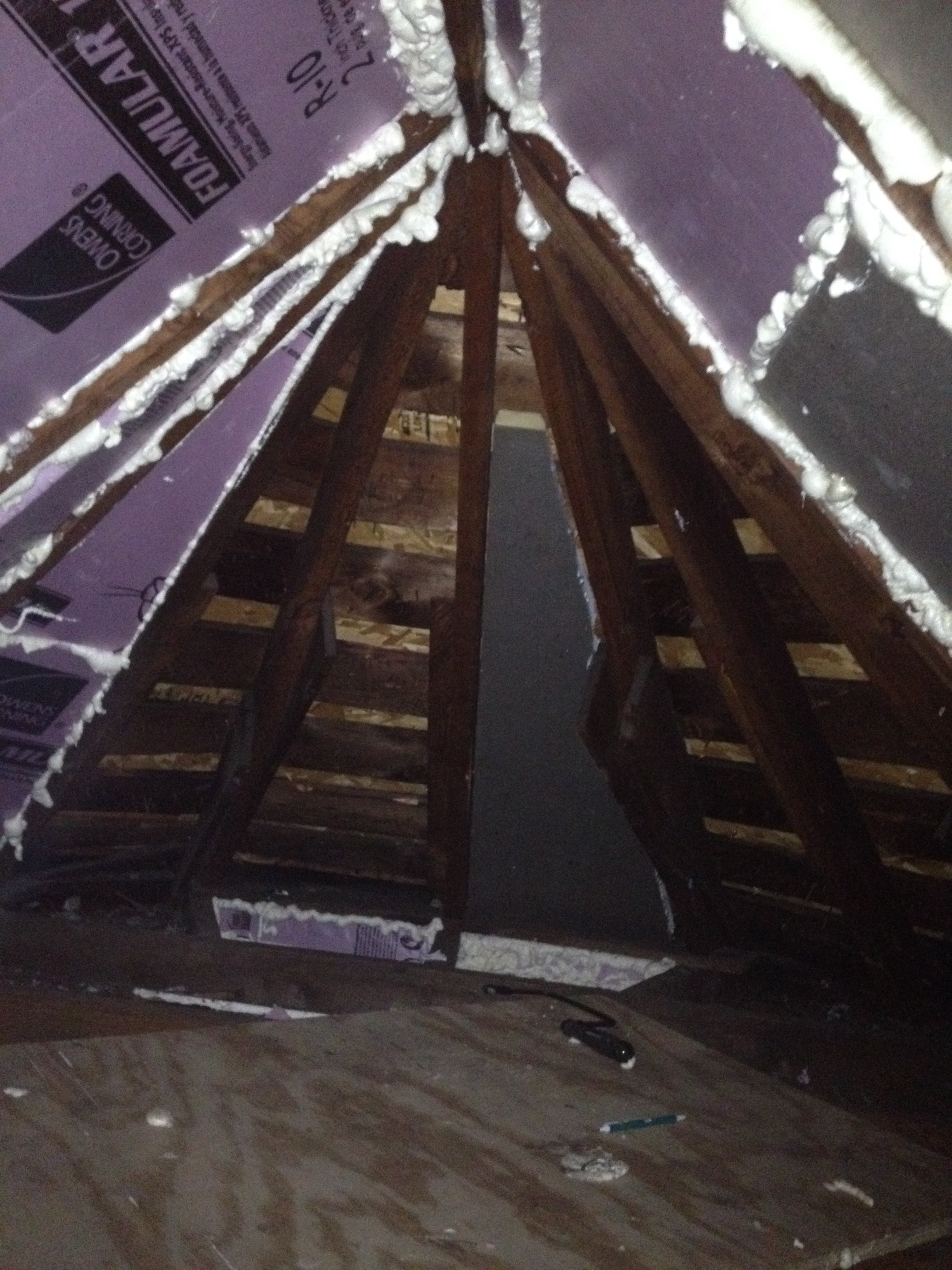
I was very relieved to finish insulating the dormer/turret because it was a very labor intensive job. Not only were the rafter cavities oddly shaped, you also had to crawl through a narrow hole on your hands and knees, and then sit or lay in an uncomfortable position while you worked. With that said, I am satisfied with the end result.
The bathroom below feels noticeably warmer. It use to be one of the coldest rooms in the house and down right miserable to visit at 4 or 5 in the morning.
With the dormer finished and a pile of extra foam board I decided to expand the scope of the project and redo the insulation of the spare attic room (connected to the dormer). The previous wall/ceiling assembly was this:
Where the black line was the roof deck (plywood), the gray line below that were battens (1×6) for the original cedar shingles, then the brown 2x4s with the lavender being the old rock wool insulation. Finally the blue layer was some type of sheet rock shown in the picture below and covering all of that up was a flimsy panel veneer (pink layer – bottom).
After clearing away all of the old material I had a clean palette to work with.
Along the walls I insulated between the joists.
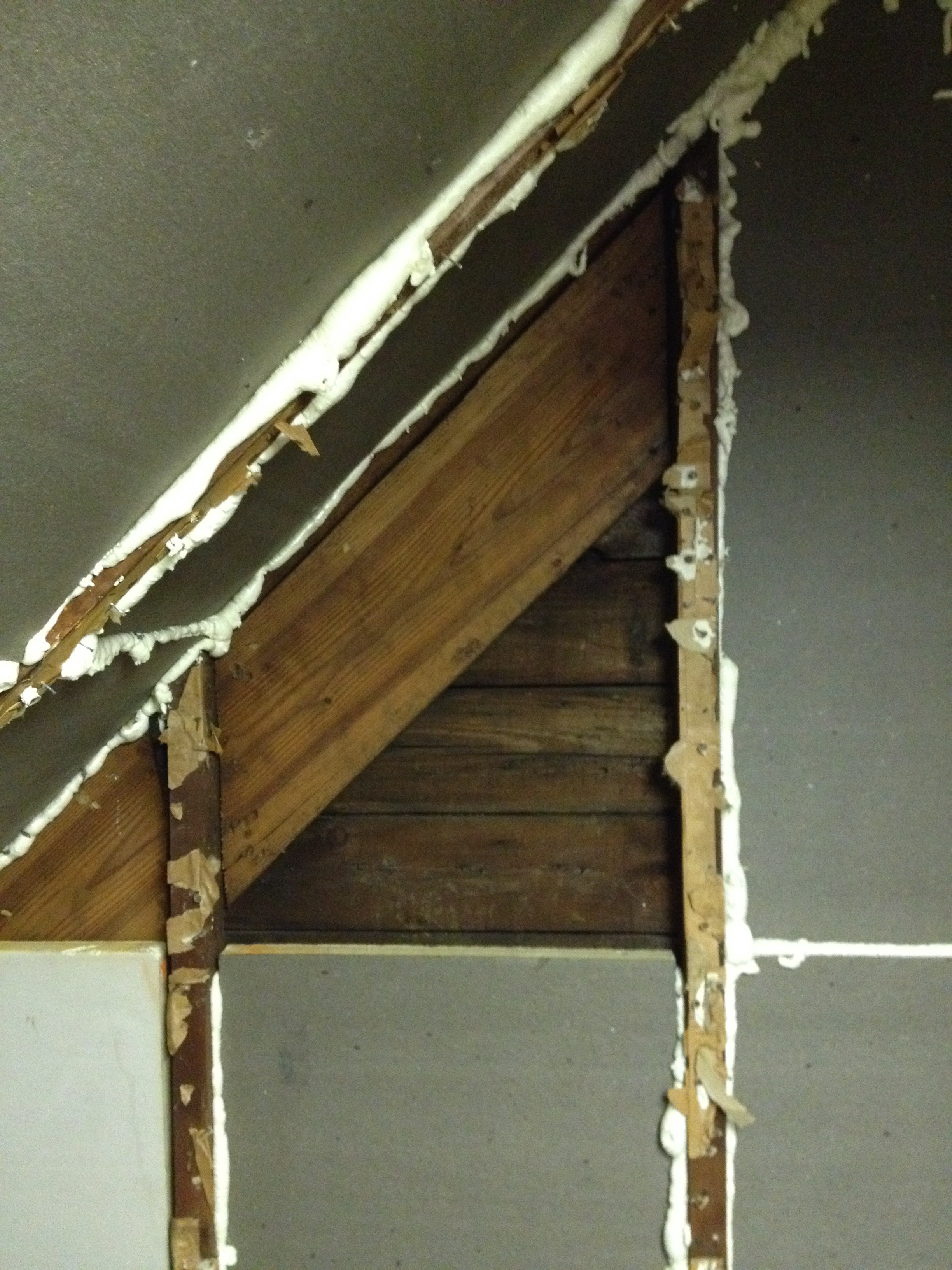
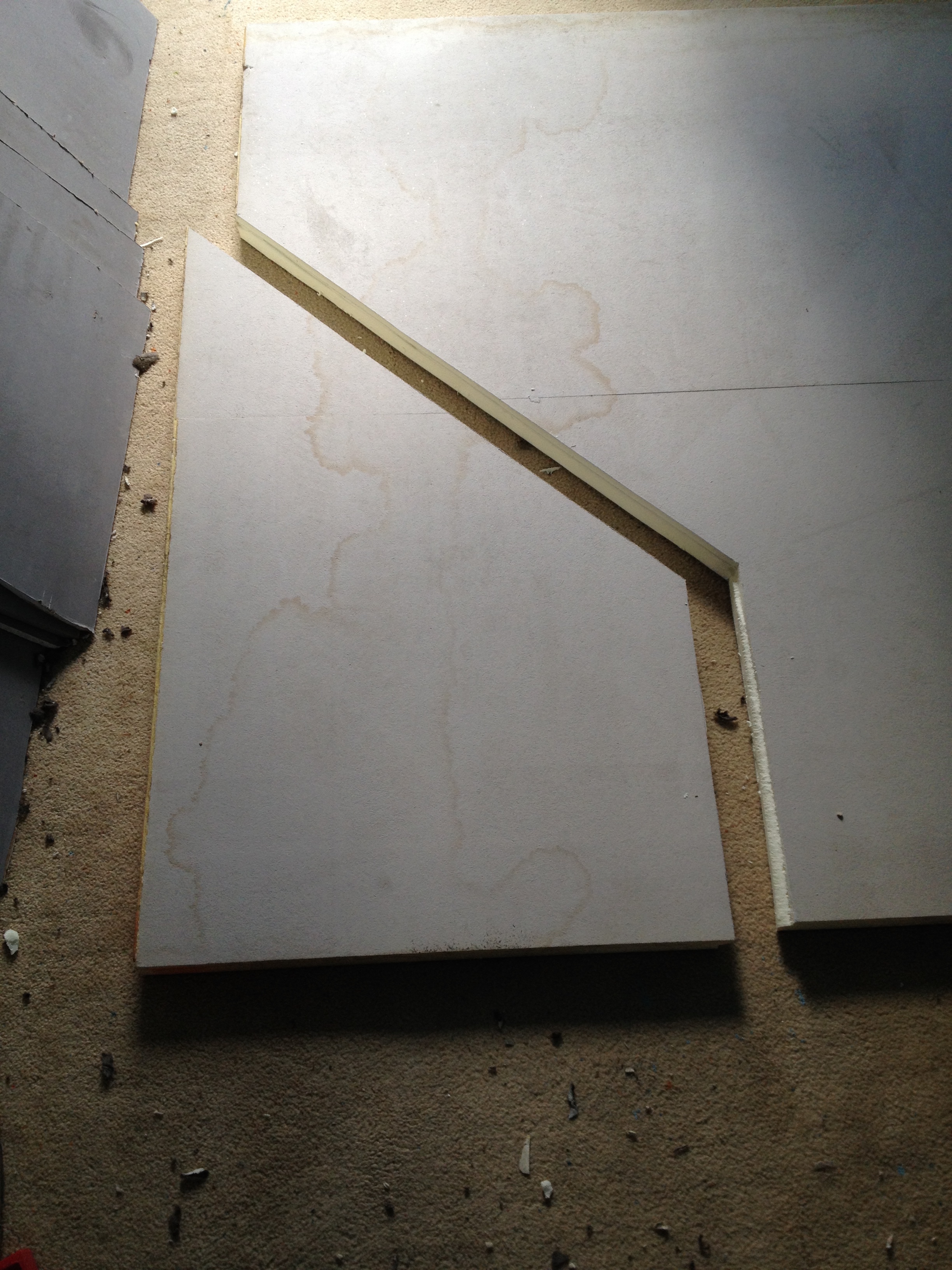
Filling the cavities between studs and rafters was simply a matter of measuring
Cutting
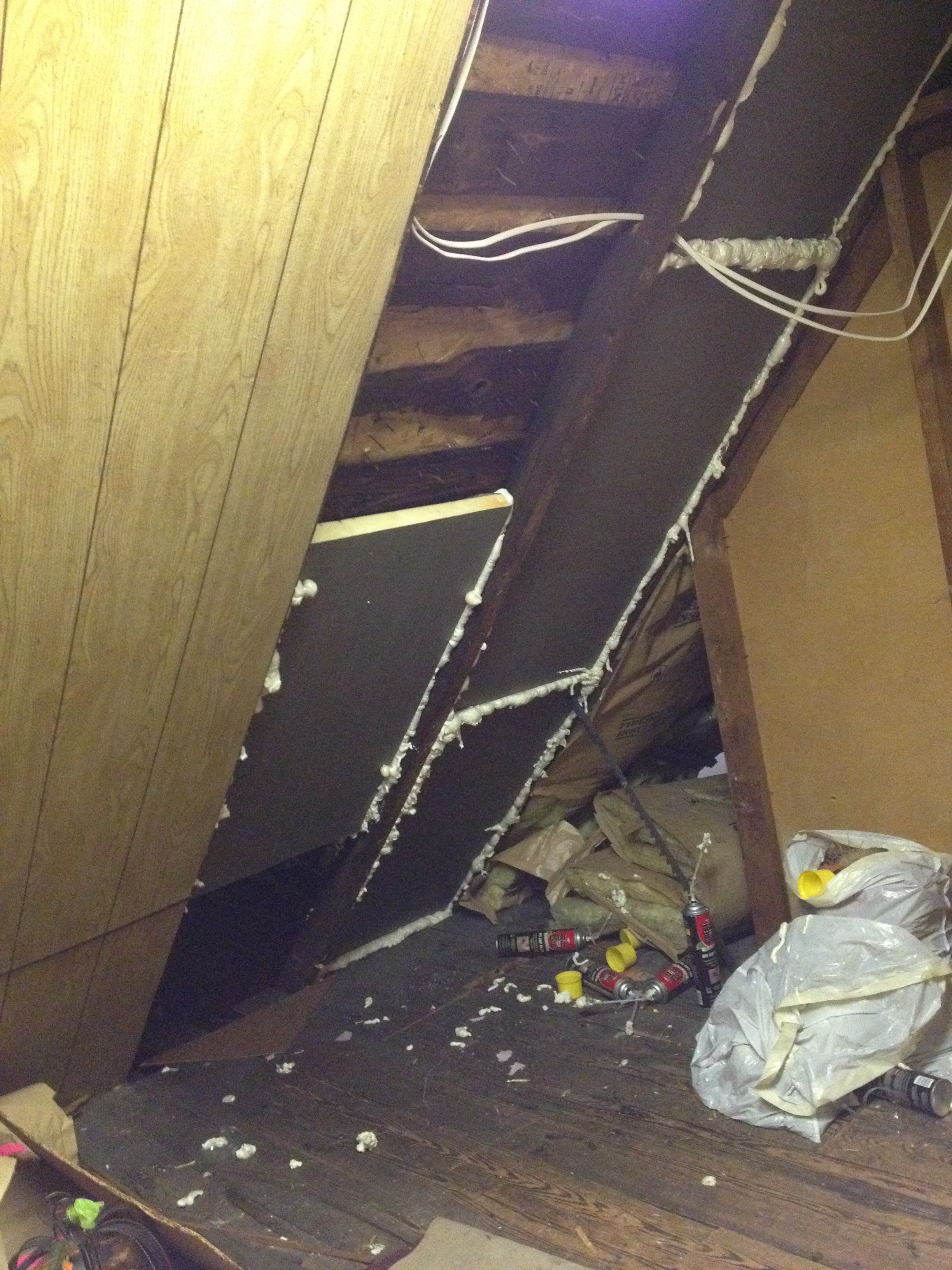
Fitting into place and foaming along the edges.
Here is the end result.
This room went much faster than the dormer. I spent a few mornings and a Saturday working on it. I had just enough foam board to do this room. Eventually, I would like to double the R value of this room by installing an additional 2″ of foam board on the underside of the rafters. That would bring this room up to an R 20-25, still well below the recommend value of 30-38 for a cathedral ceiling in zone 5.
Materials cost around $220. Assuming it will cost $700/year to heat our house (based off last years bills) we can make some predictions about the payback period. If we save 5% a year, $700 x 0.05 = $35, then it will take about 6 years to make up the material cost.
A different way to think about it is that we may be able to raise our thermostat by 5% and pay the same amount per year. Last year we kept the temperature at 62°. This year we have raised it up to 65° (about a 5% increase). I do not think that temperature and bills scale linearly though because a larger difference in internal/external temperatures would likely result in a nonlinear amount of heat loss. Anyway, in six months time, I will have another set of bills to add as a second data point in this little experiment.
It is hard to believe that it is almost Thanksgiving. What happened to 2014? I haven’t done any big home improvement projects for some time so there was an itch that needed scratching.
Secret Entrance
That looks like a rather innocuous attic wall. I wonder if there is something behind it? It would be a dull blog post if there wasn’t!
Our 2nd floor bathroom is part of a dormer/turret and this is the unfinished attic portion. Some sort of rodent had made a nest up here but I didn’t find any signs of recent activity.
I had several goals for this space.
Clean out all of the nests and old soiled insulation
Uncover all electrical wiring so I could assess its condition and possibly replace
Insulate the space to be air tight
#1 wasn’t very difficult. Wearing a respirator, long sleeves, and gloves I carted out seven trash bags full of crud. Whenever you are working in an unfinished attic, you will want to pay special attention not to step through the ceiling. To that end, I laid down a scrap piece of plywood so I could crawl around without falling through into the bathroom.
With the space ‘cleaned’ up I was able to inspect the exposed electrical.
109 year old wiring
Given its age, it looked to be in good shape. There are some spots that I may want to address in the future (receptacle wired in with a light switch). Eventually we will hire out an electrician to redo the whole house, but until then the plan is to leave well enough alone.
#3 goal of re-insulating the space took some consideration. Fiberglass rolls and blown in cellulose would not make the space air tight (both of these types of insulation are air permeable). I knew that I wanted to insulate against the rafters, not along the floor joists because the existing electrical was in the floor joists and because the finished attic space connected with this unfinished space.
The only insulating products that I know of that are air impermeable are foam based. You can either go with a spray foam or a rigid foam board product. Spray foam is not for DIYers. There are kits that are sold for DIYers but they start at around $600. Foam board is best applied in continuous sheets on the underside of rafters or even better yet on the roof deck itself (outside of house). Seeing as we just had a new roof put on, and a curved turret makes it almost impossible to hang straight boards, I chose to use a hybrid approach.
Cut & Cobble is an insulating technique where you cut pieces of rigid foam board to fit in-between joists or rafters. Then you use canned spray foam to seal the edges. Here is an example of where I have insulated using cut and cobble.
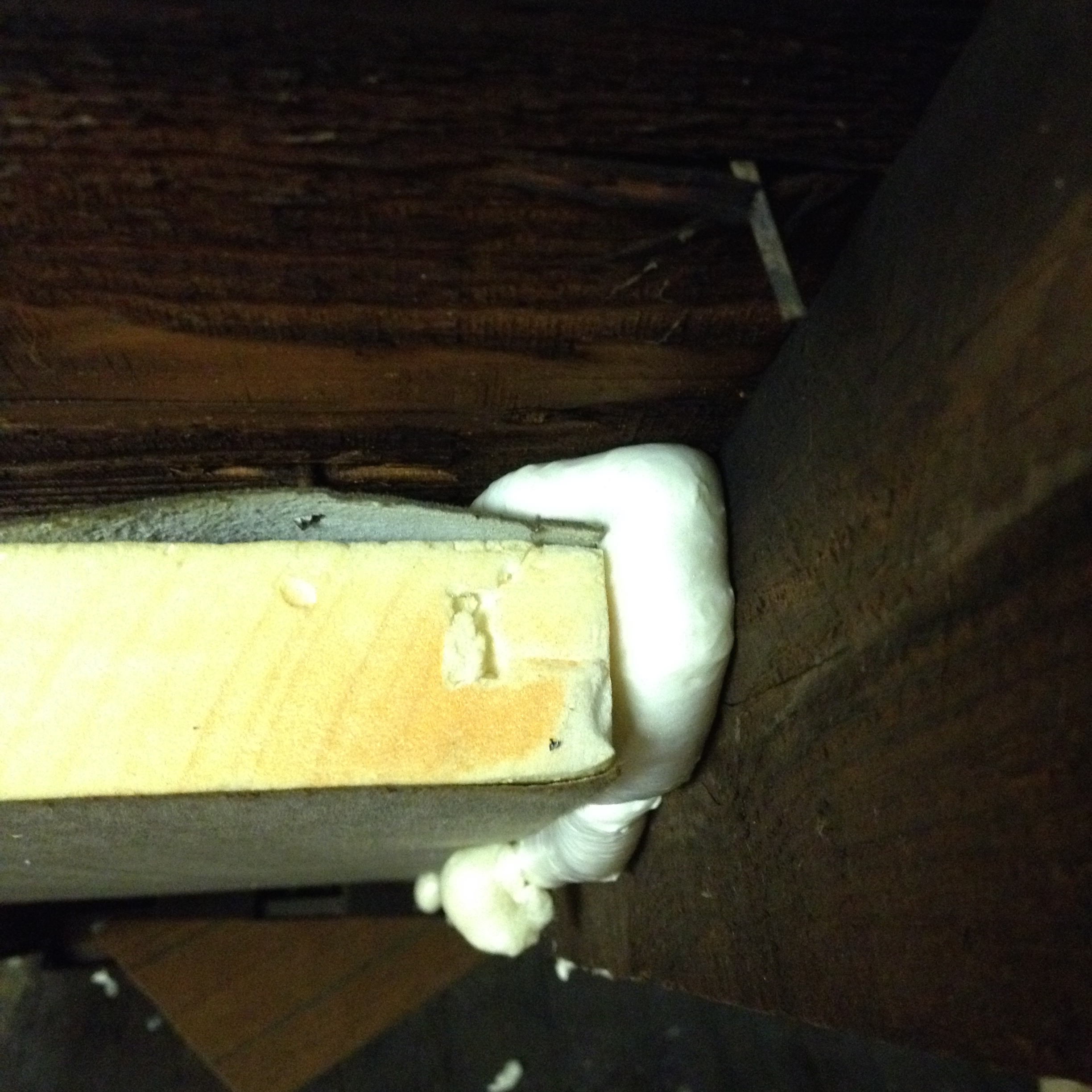
The foam board should have about a half an inch gap to allow the spray foam nozzle to fit. While you could fit the boards snugly against the wood you would have a hard time sealing the edges because you would either have to caulk or tape them.
Ideally, an air gap would be left between the insulation and roof deck to allow air to circulate from the soffits to the ridge vent. This helps keep the roof cool in the winter and prevents ice dams from forming.
Yet another reason why I wanted to redo the insulation in the attic is because last year when our roof was redone, the roofers correctly installed a ridge vent. The pre-existing fiberglass bats did very little to keep air from moving from the ridge vent/soffit system to the conditioned space. In fact, in some spaces you can see the ridge vent while standing in the attic!
nada insulation 🙁
Cut & Cobble is meant as derogatory name because it has many critics. For starters, it isn’t exactly pretty to look at.
About 60% done with dormer
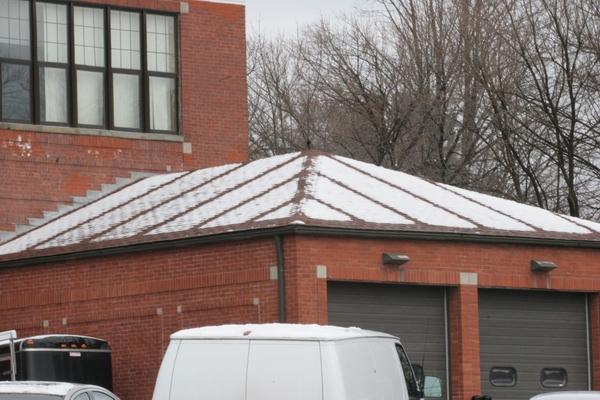
The process of measuring, cutting, fitting, and installing tens or even hundreds of panels is very time consuming. C&C allows thermal bridging. Thermal bridging is where heat moves through a less insulating material, such as a 2×4. After a frost or light snowfall, thermal bridging may be visible from the outside.
guess where the rafters are
Not many studies have been done on C&C, but there are many anecdotal stories of premature failure where the edge sealing fails either immediately or after some time has passed. Finally, the cost of C&C is questionable compared to hiring out a professional spray foam contractor.
I have thought about these negatives and believe that C&C is still the right option in our circumstance.
I am not interested in how it looks. The areas that I am insulating are not living spaces.
I am doing the work myself so it is not like I am paying an hourly wage to someone to install a tedious product.
Fiberglass also allows thermal bridging and that is what we have installed right now
premature failure *might* be an issue. Then again, it might not. This is a gamble.
I got an awesome deal on factory seconds insulation meaning that the material cost for this project is well below what the alternatives would be.
For $80 + $20 delivery I bought approximately 25 panels of 4’x4′ x assorted thickness (between 1 1/2″ to 4″) of polyisocyanurate (polyiso) rigid foam board off a guy on craigslist.
If I had to guess, I would say the retail value of this insulation would be around $500. Polyiso has one of the highest R values per inch of any insulation at 6.5.
I only need a small fraction of that bundle to finish the dormer. In the meantime, I moved the extra from the garage to the attic so it can ‘work’ while it is being stored.
When I get this project wrapped up I’ll post a followup with pictures and any final thoughts that I had on doing the project. So far, I can attest to the length of time required to C&C. It will be interesting if there are any noticeable differences in temperatures when it is all done.


 Yesterday we did some Spring cleaning. If I call it that, will it make it Spring? Living with 24 pounds of curiosity is a great motivator to declutter and clean.
 The bathroom below feels noticeably warmer. It use to be one of the coldest rooms in the house and down right miserable to visit at 4 or 5 in the morning.