• About Me
  • Contact Me

Frugal Living

Indulging in life, financially responsible

Finance

Lazy One Fund Investing

January 8, 2015 by Andrew Leave a Comment

Today we simplified our investments.  You may remember that we were contemplating making this move a while back (see here), but due to capital gains and taxes we had to wait until 2015 to avoid getting hit with a big tax bill.

Recap

We have condensed our portfolio from 6 mutual funds and an individual stock to a single mutual fund, Vanguard Total Stock Market Index Fund Admiral Shares (VTSAX).  This switch will give us broader diversification, VTSAX holds every publicly traded stock in America, and it lowers our expense ratio.  The new lower expense ratio of 0.05% means that if you hold $10k for a year, Vanguard only skims off $5 to keep the lights on over in Valley Forge (their headquarters).  Can you imagine walking up to a stock broker and saying “Hey buddy, I’ll give you $5 to invest my money in every company in the United States”.

Investing Made Simple

We’re not trailblazers by any means.  You can read more about this strategy in more depth on other blogs.

  • ThirftyGal’s Money Strategy (Nice simple explanation)
  • Budgets Are Sexy
  • JLCollinsNH

I love the simplicity of the whole deal.  Set up an automatic monthly investment and walk away.  There is zero mental load associated with this plan.  In fact, the less you think about it and worry about the market ups and downs the better.  Fidgeting around with it is the biggest risk of losing money.  So if you have 20+ years to kill time with and want to be set for retirement, consider setting up a lazy one fund portfolio.

Posted in: Finance Tagged: Index Fund, investing, Taxes, vanguard

Frugal Book Club #4 – John Bogle on Investing: The First 50 Years

December 22, 2014 by Andrew Leave a Comment

You probably know who Warren Buffet is, but do you know about John Bogle?  If you invest through Vanguard then you should, because John Bogle was the pioneer of low cost index funds.  In his book, John Bogle on Investing: The First 50 Years, he presents a collection of essays and speeches that discuss the founding principles of Vanguard and why those principles are just as important today as they were 50 years ago.Unknown

Simplicity

Bogle argues again and again that simplicity is favorable over complex investing strategies time and time again.  The more complicated you make investing, the harder it is to understand and the easier it is to get caught up and make a mistake.  Why go to the trouble of sorting through a haystack to find a needle when you can just buy the entire haystack.  In his opinion, instead of trying to pick winners (needles) out of the stock market, just buy the entire stock market (the haystack).  The simple goal of enjoying the entire market return in aggregate will statistically beat the complicated goal of trying to outperform the market by identifying the best stocks.

Long Term Investing

The longer the time horizon is for the investment, the better it will do.  While stocks are more volatile than bonds, over a 25 year horizon that increased volatility drops to a standard deviation of just 2% of a 6.7% median return (meaning that you could expect returns between 4.7% and 8.7% with a degree of confidence).  Compare that to the one year deviation of 18.1% on 7% median return (-11.1% to 25.1%) and you can see how the longer you hold an equity the more the peaks and valleys are smoothed out.  Just like Buffet, Bogle takes a buy and hold mentality.

Costs Matter

Vanguard is unique among brokerages because it is a mutual company.  When you buy a Vanguard fund, you become a part owner of the company.  The advantage of this over a private company, is that Vanguard wants to better serve its masters, and those masters are fund holders.  What do fund holders want, lower costs!

Consider the two scenarios below.  One portfolio has a 1.2% expense ratio, the second has a 0.2% expense ratio.

Screen Shot 2014-12-22 at 10.29.04 AMScreen Shot 2014-12-22 at 10.29.19 AM

Now which expense ratio would you rather have?  Cost is one parameter that investors can control!

Index vs Actively Managed Funds

An actively managed fund has a human being or a whole team of humans that are trying to pick winners for a fund.  They eat, sleep, and breath financial markets.  Why try and choose winners yourself when you can let a team of experts do it for you?  The answer is that you shouldn’t let the ‘experts’ do it for you because historically they have been outperformed time and time again by index funds.  Index funds are passively organized to track a benchmark.  A common example would be an index fund that recreates the S&P 500.  Index funds can pass cost savings, by not having to pay a salary to an expert, to you, the person who is risking their hard earned money.

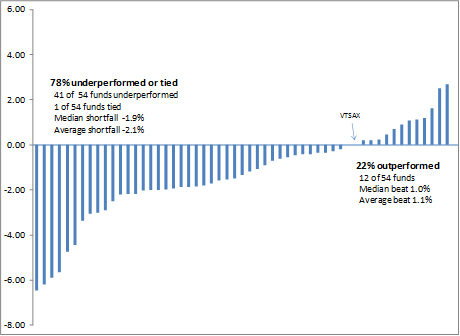
Bogle loves to tear apart actively managed funds in his book by showing cold hard numbers again and again.  The numbers don’t lie, actively managed funds underperform.  Just take a look at this analysis done by Forbes.

USStocks-Fig11


Using VTSAX, Vanguard Total Stock Market Index Fund, as the baseline, they compared 54 actively managed funds that had the same investment objective.  78% of those actively managed funds posted returns less than the passive index fund.  Only 22% outperformed VTSAX.  If I approached you and said you had a one in five chance of beating the market, would you bet the farm on it?  If so, please don’t go to Vegas, they’d love you.

Conclusion

The book is quite long and not for the new investor.  If you are interested in getting started in investing (you should be!) then I would recommend that you check out Vanguard’s 4 Principles for Investing Success on their website.  Then use Vanguard’s Portfolio builder to get a recommendation that is personalized to your situation.

We will be reorganizing our taxable investment account in January to better align with Bogle’s and by extension Vanguard’s philosophies.  For starters, we will be simplifying our positions from:

  • VCR – Vanguard Consumer Discretionary ETF (expense ratio 0.14%)
  • VDC – Vanguard Consumer Staples ETF (expense ratio 0.14%)
  • VWO – Vanguard FTSE Emerging Markets ETF (expense ratio 0.15%)
  • VYM – Vanguard High Dividend Yield ETF (expense ratio 0.10%)
  • VCSH – Vanguard Short Term Corp Bond ETF (expense ratio 0.12%)
  • VBK – Vanguard Small Cap Growth ETF (expense ratio 0.09%)
  • AAPL

To:

  • VTSAX – Vanguard Total Stock Market Index Fund Admiral Shares (expense ratio 0.05%)

By switching from ETFs to a mutual fund, we are simplifying our contributions.  In the future we will be able to setup a monthly direct deposit directly into VTSAX instead of transferring money into our account and manually placing buy orders for each ETF.

We will also be reducing our cost.  0.05% expense ratio is an incredible value!

You may be wondering about diversification.  Well, VTSAX, with 3804 holdings, gives us ownership in virtually every publicly traded company in America.  We’re buying the haystack.  Our prepayments on our mortgage serve as our ‘bond’ replacement, and I am not convinced that in our investment horizon (20+ years), foreign equity or bonds are needed at this time.

So there you have it.  Our low cost, indexed, long term, and easy to understand investment portfolio.  It consists of buying and holding a single mutual fund.  What could be easier than that?

If you are just getting started VTSMX is the same thing as VTSAX except it has a lower initial investment requirement and a slightly higher expense ratio.  VTI is the etf version.
Posted in: Finance, Reading Tagged: etf, index, investing, vanguard

Last Minute Christmas Shopping

December 20, 2014 by Andrew 1 Comment

This is the last weekend before Christmas and because it was a bit chilly to walk outside with Frugal Boy I braved the mall.  No, I’m not a masochist, I just know that Frugal Boy loves people watching and what better place is there to people watch than the mall before Christmas.

As I was unloading the stroller back at home, one of our neighbors came by and asked if I had finished my Christmas shopping.  I told him no, I had never even started.  He offered me luck on a seemingly impossible task, to save Christmas in less than a week.  What I didn’t tell him, was that while I hadn’t done any traditional shopping, I was in fact done with gift giving.

The Frugal Gift For Your Spouse

Shae and I have always had an aversion to trying to find the ‘perfect’ gift for one another.  The hassle of it all, shopping, buying, wrapping, keeping the secret, and hoping for a genuine positive reaction during the unveiling is all a bit more work than either of us would like to do.  In something of a growing tradition, the goto token gift has become new pairs of socks, simple, practical, and fairly cheap.

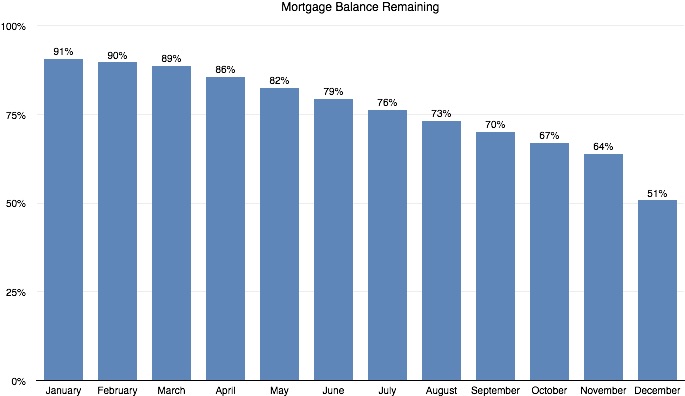
Our unconventional gifts to one another are both easy to give and a joy to receive.  This year we both paid off a chunk of our mortgage for a combined extra prepayment of 10%.  All told, in 2014 by living frugally, we have been able to shave off 40% of our mortgage this year alone.

Mortgage Balance Remaining

10% Christmas Gift to Ourselves


The quadruple mortgage payments that we started making in April have set us on track to be mortgage free in about 12 months (assuming we give ourselves the same present next year)!  Yippee!

The Frugal Gift For Your Child(ren)

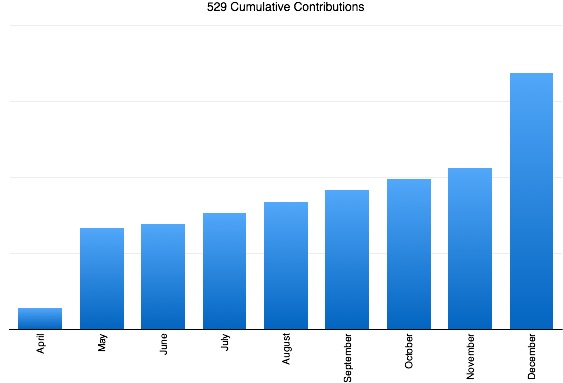
Frugal Boy isn’t old enough to really appreciate presents, so this year we just made a contribution to his 529, college savings, plan.

Merry Christmas Son

Merry Christmas Son

You can see two jumps in the chart.  The first in May when we put inheritance money towards future education and another in December when we gave him his present early.

While a 100% monetary gift works well for babies, because they don’t understand the concept of a gift, it probably won’t be a smash hit with older children.  In the future we will continue to spend a substantial amount of Frugal Boy’s gift budget on 529/savings contributions while spending a bit of money on a token toy.  After all, as parents, it is our job to take care of the needs and necessities first.  We can let his relatives spoil him with the ‘fun’ stuff. If our Christmas tree is any indication, that is exactly what is happening (100% of the presents are to Frugal Boy).

The Frugal Gift For Your Nieces and Nephews

We basically followed our standard method of operation for our own children.  Babies received all cash gifts and should their parents choose to invest that money in an account that compounds that niece or nephew will receive the advantage of time.  Older nieces and nephews received trinkets and a supplement of cash to round out their presents.  As an uncle and an aunt, we tend to be more prone to spoiling than with our own child.  Plus, what kid doesn’t want 1,000 stickers for Christmas?  😀

Wrapping Up

While we haven’t done the traditional gift giving this year, we have done a frugal edition of it.  A grand total of zero items were purchased at the mall, and most gifts came from our checkbook.  Sure it isn’t the picturesque Christmas that you see in the films, but then again is that even the meaning of Christmas in the first place?  With that said, are you done with your Christmas shopping?

Posted in: Finance, Frugal Boy, Parenting, Savings Tagged: 529, gift, mortgage

Harvest Time!

November 14, 2014 by Andrew Leave a Comment

It is time to harvest!  No, not agricultural harvesting, that is almost done.  I am talking about capital gains harvesting.  What is gains harvesting you ask?  Well, I am glad you asked.

Normally when you invest money in the stock market through a brokerage company such as Vanguard, Sharebuilder, E*Trade, Fidelity, etc. you will end up paying taxes on any extra money you get out.  How much you pay depends on a number of factors including how long you held onto the security (stock, mutual fund, index fund, bond, etc), how much of a gain you had, and your ordinary tax rate.

Generally you will want to hold onto securities for at least one year.  By doing so they will be classified as “long term” capital gains and be taxed at 15%.  Any profit you make by selling a stock before the first year of ownership is a “short” term capital gain and is taxed at your ordinary tax rate.  For most married single income families that will also be 15%, but it may be higher as the next tax bracket starts at around $72k of income and jumps to 25% tax rate.

Making a profit on a stock sale will count towards your taxable income.  For example, if you owned XYZ for 9 months and made $5k by selling it and your day job brings in $68k after exemptions and deductions then you would fall into the 25% tax bracket.

A common misconception with taxes is that moving up in tax brackets because of an increased income will result in less take home money.  That is completely false.  If your boss offers you a raise, TAKE THE RAISE!  Even if it puts you into a higher tax bracket.  The United States uses a marginal tax rate system, meaning if you move into a higher tax bracket, only the money in the higher bracket is taxed at the higher rate.  Investopedia explains the system well.

Getting back to the topic on hand, there exists a ‘loop hole’ of sorts that lets you sell long term capital gains and pay NO tax on it!  There are of course some rules.

  1. It must be a long term capital gain (owned for over a year and in the positive)
  2. You must be in or below the 15% tax bracket with the gain included in that

This is the first year that we are taking advantage of gains harvesting.  We’ve been in the stock market for about eight years now and we have a buy and hold mentality, so the field is ripe for harvesting.

The first step is to do some back of the envelope calculations and figure out how much wiggle room we have in the 15% tax bracket.  With the end of the year close by, you should have a pretty good idea of what your 2014 numbers will be.  We used Turbo Tax’s free Taxcaster website to come up with some rough calculations.

Once you know your taxable income, you can figure out your current tax bracket.  If you are above 15% you may be able to squeeze down by contributing to a 401k, IRA, HSA, or other tax advantaged account.  If you are in or below the 15% tax bracket you can figure out how much capital gains you can reap while staying in the 15% bracket.

Knowing the above information, we sold and then immediately repurchased shares of stocks that had long term capital gains.  We spent:

$7 to sell stock (brokerage commission fee)

$7 to buy stock (brokerage commission fee)

and there was a price difference from when we sold to when we bought (within a minute) that ended up costing us $15.

So for about $29 we harvested long term capital gains and saved around $1500 in taxes.

Besides saving taxes, this strategy also pays off down the road.  Two examples would be.

1.) Next year the stock market tanks.  Our cost basis, what we paid for the stock, would be more than what the stock is worth and it would be a loss.  We could sell that loss and count it against our income, lowering our tax bill.  This is called loss harvesting and has some extra rules that apply to it.

OR

2.) Next year the stock market goes up and we want to sell and lock in our gains.  Instead of a giant gain that could easily bump us up into a higher tax bracket, it would be smaller because we have already harvested some of those gains.

For another explanation of Gains Harvesting, check out this blog.

If you haven’t started investing in the stock market yet and don’t know where to start, then Betterment.com might be a good place to get going.  They offer plenty of hand holding (I haven’t personally used them and don’t benefit from promoting them).

If you want more control over your investments and haven’t started yet, then Vanguard.com is a safe bet.  Betterment just uses Vanguard funds and charges a little extra on top to cover their middle man status.

Posted in: Finance Tagged: stock, Taxes
« Previous 1 … 7 8

Recent Posts

  • Min/Maxing Car Sale for Highest Value and Lowest Headache
  • Buying a Car with Data Driven Decision Making
  • Hot Lunch
  • Baking with Dad
  • Winter Nights

Financial Goals

Recent Comments

  • suwaidi online on Building a New Desktop Computer
  • James Spurr on Building a Self Watering Raised Garden Bed
  • suwaidi online on Total Cost of Ownership – Inkjet vs Laser Printers
  • bcimechanical on Troubleshooting a Gas Furnace
  • g on Troubleshooting a Leaking Whirlpool Dishwasher [UPDATED]

Archives

  • December 2020
  • December 2018
  • July 2018
  • May 2018
  • April 2018
  • March 2018
  • February 2018
  • January 2018
  • December 2017
  • November 2017
  • October 2017
  • September 2017
  • August 2017
  • July 2017
  • June 2017
  • May 2017
  • April 2017
  • March 2017
  • February 2017
  • January 2017
  • December 2016
  • November 2016
  • October 2016
  • September 2016
  • August 2016
  • July 2016
  • June 2016
  • May 2016
  • April 2016
  • March 2016
  • February 2016
  • January 2016
  • December 2015
  • November 2015
  • October 2015
  • September 2015
  • August 2015
  • July 2015
  • June 2015
  • May 2015
  • April 2015
  • March 2015
  • February 2015
  • January 2015
  • December 2014
  • November 2014
  • October 2014
  • September 2014
  • August 2014
  • July 2014
  • June 2014
  • May 2014
  • April 2014
  • March 2014
  • February 2014
  • January 2014
  • December 2013
  • November 2013
  • October 2013
  • September 2013
  • August 2013

Categories

  • Business
  • DIY
  • Finance
  • Frugal Boy
  • Frugal Girl
  • House
  • Misc.
  • Parenting
  • Reading
  • Recipes
  • Savings
  • Technology
  • Travel
  • Uncategorized

Meta

  • Log in
  • Entries feed
  • Comments feed
  • WordPress.org

Copyright © 2026 Frugal Living.

Omega WordPress Theme by ThemeHall