• About Me
  • Contact Me

Frugal Living

Indulging in life, financially responsible

Finance

Adjusting Auto Insurance

September 9, 2015 by Andrew Leave a Comment

Yesterday the auto insurance bill came in the mail.  It is one of only a handful of bills that is not auto paid in our house.  The reasoning is pretty simple.  First off, it is not a monthly bill but a semi annual bill.  Secondly, it is wise to reevaluate the type and amount of coverage from time to time.

Our 2006 Pontiac G6 is getting close to the 10 year old mark so we were looking to drop certain coverages.

Comprehensive

One of the easiest changes we made (in my opinion) was dropping comprehensive coverage with a thousand dollar deductible.  Comprehensive covers damages to your car from wind, hail, flood, fire, theft, vandalism, or hitting an animal.  By keeping our car stored in a locked garage and driving predominantly in town, most of these events are unlikely to happen.

Savings: $24

Liability

In Illinois, motorists are required by law to have insurance and they are required to carry at least 25/50 liability.  What does that mean though?  25/50 coverage means that in the event of an accident, a single occupant of the other vehicle is covered for 25 thousand worth of expenses.  The second number, 50, means that if more than one person is injured in the second vehicle then the insurance will pay out up to 50 thousand.  Liability insurance protects you from having to pay the other party for damages they received because of an accident involving your car.  While the minimums sound high, they really aren’t.  If you consider the cost of medical treatment and legal battles a small fender bender could easily blow past the minimums in no time.

The general rule of thumb is to carry enough liability coverage to cover your net assets.  The last thing you want is to have a lien placed on your house or your wages garnished to pay the helivac bill of someone else.

We increased our liability from 100/300 to 250/500.

Cost: $14

Medical Payments

Medical payments cover your own hospital expenses.  One of the nice things about auto medical versus your personal health insurance is that auto medical will pay out for accident related injuries up to three years after the incident.  We increased our medical coverage from 5000 to 25000.

Cost: $11

Collision

Our existing policy had a $1000 deductible collision coverage and even though it made up 1/3 of our total bill we decided to keep it.  The math did not work out to increase the deductible to 2000 or to drop it entirely. Assuming our car has a fair market value of five thousand dollars, it would take 100 years of no accidents at the higher deductible/lower premium to pay the 1000 dollar difference.  Dropping coverage completely would save us $450 assuming we had no accidents for the next five years.  A single fender bender would likely cost over $1k in repairs.  Perhaps in a couple more years when the car has depreciated more we will drop collision.

Change: $0

In Summary

Our semi annual premiums will increase by $1.23.  We have less coverage to cover damage to our car, but quite a bit more to cover personal medical bills and to protect our nest eggs from lawsuits.  There is a saying that I read somewhere on the internet, “young people are underinsured, old people are overinsured”.  Insurance of all kinds is a gamble and it is helpful to reevaluate what kinds you need and how much as your life circumstances change.

Posted in: Finance Tagged: auto, Bill, Car, insurance

Personal Finance 401

May 17, 2015 by Andrew Leave a Comment

School is almost out for the summer, but you should always be learning new things in life.  Today we’ll cover an advanced personal finance topic.  It may sound like goobly gook, but the payoff is worth it!  So break out the notebook and pay attention.

Roth Conversion Ladders

What if I told you that you could retire earlier or with substantially more money and you didn’t need to earn more or spend less.  Does that sound too good to be true?  Well, it is true thanks to a little strategy called roth conversion ladder.

What is it?

During your working years that you are saving up for retirement you have three options as to how you can save your money.

The first option is to use a traditional 401k or IRA (individual retirement account).  With this type of savings account, your contribution gets to grow tax free.  Then when you reach retirement age (59.5) any withdrawals that you make are taxed.

The second option is to use a Roth 401k or IRA.  Your contributions are taxed going in and then at retirement age you can withdrawal the principle and interest tax free.

The third option is to invest in a taxable account.  Generally the contributions to a taxable account are post tax and any gains (withdrawals) are also taxed.  It is kind of the worst of both worlds.  The one bonus is that you do not have to wait until retirement age to access the funds.

To sum it up, you can either pay the tax man when you retire, when you earn, or both.

A Roth conversion ladder is a strategy where you use a traditional IRA as your primary savings vehicle and then over time you convert the balance over to a Roth IRA.  In doing so, you get the best of both worlds.  Your initial contribution is tax free and can grow for many years and your eventual withdrawal is also tax free.  The tax man can be removed from the equation and the best part is that it is perfectly legal!

How does it work?

To start the process, upon retiring any traditional 401k funds will need to be rolled over to an IRA.  This is pretty straightforward and according to Vanguard, it involves 3 simple steps that should take you less than 30 minutes.

Now the real fun begins.  The IRS allows you to transfer IRA funds to a Roth IRA as long as the transferred money is considered income and taxed as such. Also transferred money is not accessible for a period of five years.  Uncle Sam gets his cut during the transfer and is happy.  You are also happy because you realize that being a newly retired individual your taxable income is basically whatever you transfer between accounts.  You also know that income tax doesn’t kick in until you cross a certain threshold (exemptions + standard or itemized deduction).  For example, since we are married and have one dependent we could convert up to $24,600 a year without paying a single penny in taxes.

$12,600 (standard deduction) + $12,000 (three times personal exemption of 4,000)

Obviously when Frugal Boy strikes out on his own, we will lose a dependent, but we would still be able to convert $20,600 a year tax free.

Roth Conversion Ladders are awesome because you get to grow money relatively tax free.

Perhaps the easiest way to understand the strategy is to see an example.  Thankfully, Root of Good, has already packaged together some easy to read tables that show how it works.

Screen Shot 2015-05-17 at 8.12.38 PM

[credit] http://rootofgood.com/roth-ira-conversion-ladder-early-retirement/

Root of Good also explains some intricacies nicely, such as how to handle inflation during the five year waiting period, how to best cover the five year gap, and their own personal conversion plan.

Why Bother?

If this sounds like a lot of work or is overly confusing you may be asking yourself why should I bother.  JL Collins, an early retirement advocate, crunched the numbers and determined that by using this strategy to minimize taxes, the test case individual could retire two years earlier than just sticking to the conventional script.  You don’t have to earn more or spend less, just plan ahead and you can retire sooner!

When should I consider it?

Roth conversion ladders are best suited to those planning on an early retirement.  The conversion takes time (the more time you have, the less taxes you’ll have to pay).

In Summary

If you are just starting out and the prospect of early retirement is appealing to you then you should utilize a traditional 401k and/or IRA.  Having some money in a taxable account will help you cover the first five years of converting, but your primary goal should be to stuff as much money as possible into the tax advantaged retirement account.  Later on in life, you can figure out the specifics of how you are going to access that money in a tax minimal way.

Posted in: Finance, Savings Tagged: 401k, conversion ladder, early retirement, retirement, roth

Planning for (Early) Retirement

April 30, 2015 by Andrew Leave a Comment

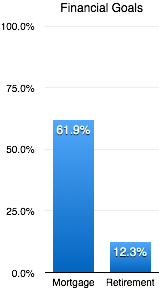
You may have noticed an addition to the sidebar.  It is this little chart graphic that I try to update once a month.

pf goals 5-1

May 2015

It is our yard stick for two major financial goals in life.  The first is to pay off our mortgage and be completely debt free.  The second is to have enough interest earning assets socked away to be able to live indefinitely without having to work (aka retirement).

We currently have 62% of our mortgage paid off.  Our extra payments help to chip away about 3% every month.

The retirement bar rises more slowly and could even decrease if the stock market goes down.  We are currently at 12.3% of our retirement goal, but what is the goal number?  More importantly, how do you find out your own goal number?

Planning for Retirement

There are only a couple of numbers that you need to know in order to plan for retirement.  The most important number is your annual expenses.  Ya, ya, I know what you are thinking.  All of those retirement calculators and financial gurus on the internet talk about retirement in terms of income.  “You need to be able to replace 80% of your working income in order to retire.”  Let me tell you, that’s a load of crap.

What you really need, is to be able to cover 100% of your expenses.  You track those, right?  If not, now’s a great time to get started with Mint.

The great thing about basing your retirement goal off your expenses is that if you want to retire sooner, you just have to lower your expenses!  Man, I knew this frugal thing was going to pay off.  🙂

Before you rush off to figure out your annual expenses keep in mind that they should be adjusted for retirement.  If you are going to be mortgage free before you retire, you can drop those mortgage payments from your total.  The same goes for items such as daycare, estimated income tax (you’ll be retired), and any debts that you have paid off (student loans, credit card, car, etc…).

Okay, so do you have your annual expenses number?  Let’s use $30,000 as an example.

4% Rule

Here comes the second number.  If you guessed 4 you’re wrong.  The second number is 25.  Multiple your annual expenses by 25.

$30,000 x 25 = $750,000

There you go, that is how much money you need to save in interest earning assets (like stocks and bonds) in order to retire.  Do you see what I did there.  I said “retire”, I didn’t say “retire at 67”.  That’s right, once you have your nest egg you should be able to retire at any age and live indefinitely off your nest egg.

Suuuurre… say the skeptics.

Don’t believe me?  Let’s start with exhibit A, the Trinity Study.  The study, done by a group of professors in the 90s, and later updated with recent historical data, looked at rolling 30 year periods to see how stock portfolios (50/50 stocks to bonds) would have fared since as early as 1926.  The authors concluded that given a withdrawal rate of 4% per year, the likelihood of a portfolio surviving for 30 years was 96%.

It’s at this point that you look over to your SO, if you’re single you can skip this step, and you find out who among you is the more cautious.  The cautious partner will probably say that number is too small, and want to use a 3% withdrawal rate just to be safe.  So we really have two retirement numbers, the 4% and the ‘rock solid’.

If you’d like to read more about the Trinity Study and the 4% rule, Go Curry Cracker has a great write up on the topic.

Going back to our example, 4% of $750,000 is $30,000.  Yay, the math works!

But $750,000 is SOO much money.  Who could ever save up that amount of dough.

If you are close to the ‘normal’ retirement age, you may not have to.  Social Security and any pensions may be able to subsidize your annual expenses.  Instead of needing 30,000 from your portfolio a year, you may only need $10,000.  That shaves off a cool half million right there.  If you are still young and want to pursue early retirement then Social Security and pensions are too far away to be much of a serious help.  Instead you’ll have to focus on two things, cutting expenses and raising income.

Early Retirement

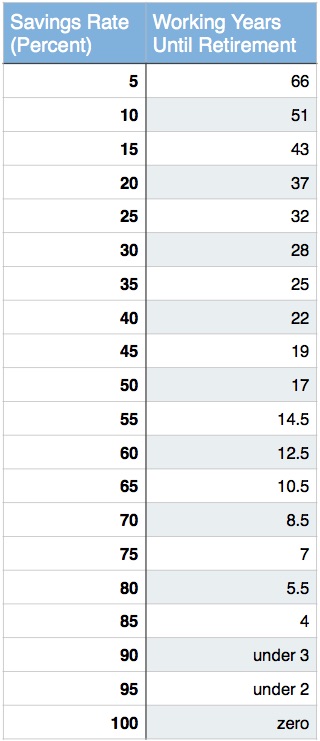
Mr Money Moustache (MMM), an avid early retirement blogger, has put together a simple table to correlate savings rate to years till retirement.

Savings Percent Years of Work

Saving 10-15% of your income for retirement will put you on track for retiring in your 60s or 70s, assuming you start in your early 20s.  We are currently putting aside 25% of our income, and even that amount of savings only puts us on track for late 50s.  Our goal is to increase our savings percent to 40 or 50 so we can retire early.  Preferably before we turn 40.  That may be possible if we are disciplined enough to pay off our mortgage early and save that freed up cash flow instead of spending it on lifestyle creep.

Some Final Thoughts

I use the word retirement, but what we are actually pursuing is early partial retirement.  The flexibility of working when, where, and on what we want is incredibly appealing.  It may not be necessary to reach 100% of our retirement number if we offset our annual expenses with partial working income.

The second thought, is that no where in here have I mentioned financial windfalls.  That could include  winning a lottery, or receiving an inheritance.  The reason for their omission is simple, you shouldn’t count on them or rely on them.

Finally, the 4% rule has been getting a lot of flak in the past few years saying it is obsolete and no longer valid. The arguments generally go that bond rates have plummeted in recent history and yield close to zero.  The 2008 crash and subsequent depression hit close to home and rattled a lot of 401k holders.  The 4% rule works if you remain flexible.  Should you buy a new car the year that the stock market drops 50%?  Probably not, maybe you can make do with what you have until your portfolio recovers in a year or two.  Is the market up 15% this year?  Maybe you should withdraw more than 4% to build up cash reserves for down years.

Posted in: Finance, Savings Tagged: early retirement, mortgage

Frugal Book Club #5 – Deflation

January 26, 2015 by Andrew Leave a Comment

Deflation

Deflation, by Chris Farrell, covers a topic that is almost unheard of in present day America, what happens when prices fall?  We are so accustomed to inflation, the opposite of deflation, where prices rise over time and a dollar is worth less tomorrow than it is today that we hardly even think about deflation.

In his book, Mr Farrell argues that the next century will be ruled by deflation.  He pins the trend reversal on increasing globalization, the spread of capitalism, and the internet.  I can attest to the internet’s deflationary power because I experience it first hand with my software business.  Not only can I sell to customers around the world, I also have to compete with other companies around the world.  Some of those companies reside in 2nd or 3rd world countries with lower costs of living and lower income needs.  That means they can drag my prices down.  To remain competitive, companies including my own lose pricing power and the customer gains it.

It sounds like deflation is a great thing for John and Jane Doe consumer right?  Well, as companies lower prices to remain competitive, they bring in less revenue.  Why should I buy a car today when it will be cheaper tomorrow?  With less revenue due to slimmer margins and deferred sales, businesses cannot support their payroll expenses.  Worker wages are often referred to as “sticky”, meaning that workers are resistant to lowering wages.  Who *wants* to have their income cut?!  When a business cannot lower wages across the board, they resort to laying off workers.  Sure, a carton of eggs in deflationary times might only cost 50¢ but that doesn’t help the unemployed person very much.

The biggest losers in a prolonged deflation are debt holders.  The “Buy it now, pay for it later” mentality of inflationary times does not transition well to a deflationary setting.  Consider this scenario.  John Doe buys a house with a $250,000 30 year mortgage at 4%.  At the time he buys the house, he is making the median American income of $50,000.  The monthly mortgage payment is around $1200.  That would peg his yearly housing costs around 29%, a number that falls into the popular rule of thumb to keep housing costs below 30% of gross income.  Fifteen years later amidst constant deflation and his income may have been reduced to $30,000, but his mortgage has not deflated.  It now consumes 48% of his gross income.  Everything else that John buys costs less due to deflation, but his mortgage payment has not decreased.

Is Mr. Farrell a doomsday sayer or is there some merit to his predictions?  According to Vanguard’s 2015 Global Economic and Investment Outlook deflation is a concern of well learned economists.

A deflationary threat will likely continue to hover over the world. In aggregate, reflationary monetary policies will continue to counteract the disinflationary drag of post-financial crisis global deleveraging. As suggested in Vanguard’s past outlooks, recent consumer price inflation remains near generational lows and, in several major economies, is below the targeted inflation rate.

Key drivers of U.S. consumer inflation generally point to price stability, with core inflation in the 1%–3% range over the next several years. Nascent wage pressures should build in the United States in 2015 and beyond, but low commodity prices and the prospects of a strong U.S. dollar should keep inflation expectations anchored. In Europe, deflation remains a significant risk that will not soon disappear

Some of those words might have stuck out to you, like “targeted inflation rate” and “price stability”.  After learning hard lessons over the past century, central banks have agreed that a targeted inflation rate of about 2% is ideal.  They try and control that by raising or lowering interest rates (this is what ultimately sets your mortgage rate) and adding or removing money from circulation (liquidity).

I wouldn’t recommend the book Deflation to anyone unless they were die hard monetary fans.  The book reads a lot like a term paper or thesis and tends to take its time snaking around various historic examples and anecdotes to make its points.  I had to check it out of the library twice and still gave up before finishing it.  You can read more about macro economics (what inflation and deflation are categorized under) on this website.

Posted in: Finance, Reading Tagged: book, library, reading

Calculating 529 Performance

January 9, 2015 by Andrew Leave a Comment

With the first year of 529 contributions under our belt, it was high time to take a look back and see how they did.  The first thing I did was log into the online account and see the rate of return posted in big bold letters.

3.4%

Wow, that is terrible, especially considering that the fund we invested in returned a healthy 9.9% in 2014.  Obviously something else is going on and you may have already guessed it.

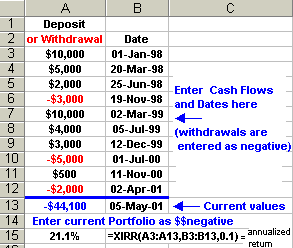
That’s right, we didn’t invest everything on January 1st, instead we made contributions throughout the year.  By giving Frugal Boy a big Christmas present/contribution, it effectively killed our rate of return because of the sudden influx of fresh cash that diluted previous gains.  To properly calculate your return, weighted for irregular contributions, you will need to open up Microsoft Excel and use the XIRR function.

Here’s how to use the XIRR function.

In column A, enter positive contributions and negative withdrawals (or fees).  In column B, use the Date function to enter in the date of that contribution.  At the end of each column, enter the ending balance and date.  Multiply your ending balance by (-1).  So a positive ending balance would be displayed as negative (it’s just how the XIRR function works).

Finally, use XIRR(colA, colB, guess) where guess is your expected percentage return (e.g. 8%).

Here is an example:

RR-4b

Properly weighted, Frugal Boy’s 529 had a rate of return of 10.33%.  Not too shabby 😀

IMG_5318

Like our taxable investment account, we selected a low cost indexed fund that consists of:

  • 70% VIIIX – Vanguard Institutional Index Fund
  • 20% VDMIX – Vanguard Developed Markets Index Fund
  • 10% VEXMX – Vanguard Extended Market Index Fund

The heavy equity exposure and associated risk seems appropriate for his age.

Posted in: Finance, Frugal Boy, Parenting Tagged: 529, investing
« Previous 1 … 6 7 8 Next »

Recent Posts

  • Min/Maxing Car Sale for Highest Value and Lowest Headache
  • Buying a Car with Data Driven Decision Making
  • Hot Lunch
  • Baking with Dad
  • Winter Nights

Financial Goals

Recent Comments

  • suwaidi online on Building a New Desktop Computer
  • James Spurr on Building a Self Watering Raised Garden Bed
  • suwaidi online on Total Cost of Ownership – Inkjet vs Laser Printers
  • bcimechanical on Troubleshooting a Gas Furnace
  • g on Troubleshooting a Leaking Whirlpool Dishwasher [UPDATED]

Archives

  • December 2020
  • December 2018
  • July 2018
  • May 2018
  • April 2018
  • March 2018
  • February 2018
  • January 2018
  • December 2017
  • November 2017
  • October 2017
  • September 2017
  • August 2017
  • July 2017
  • June 2017
  • May 2017
  • April 2017
  • March 2017
  • February 2017
  • January 2017
  • December 2016
  • November 2016
  • October 2016
  • September 2016
  • August 2016
  • July 2016
  • June 2016
  • May 2016
  • April 2016
  • March 2016
  • February 2016
  • January 2016
  • December 2015
  • November 2015
  • October 2015
  • September 2015
  • August 2015
  • July 2015
  • June 2015
  • May 2015
  • April 2015
  • March 2015
  • February 2015
  • January 2015
  • December 2014
  • November 2014
  • October 2014
  • September 2014
  • August 2014
  • July 2014
  • June 2014
  • May 2014
  • April 2014
  • March 2014
  • February 2014
  • January 2014
  • December 2013
  • November 2013
  • October 2013
  • September 2013
  • August 2013

Categories

  • Business
  • DIY
  • Finance
  • Frugal Boy
  • Frugal Girl
  • House
  • Misc.
  • Parenting
  • Reading
  • Recipes
  • Savings
  • Technology
  • Travel
  • Uncategorized

Meta

  • Log in
  • Entries feed
  • Comments feed
  • WordPress.org

Copyright © 2026 Frugal Living.

Omega WordPress Theme by ThemeHall