• About Me
  • Contact Me

Frugal Living

Indulging in life, financially responsible

Budget

Picking an Energy Supplier

March 23, 2015 by Andrew Leave a Comment

Do you want to save $50-$100 bucks in five minutes?  Of course you do!  Keep reading to learn how.

Did you know that you can shop around and choose what company you buy energy from?  That’s right, you don’t have to purchase your electricity or gas from the company that pipes it to your door.  Our municipality just negotiated a new two year contract on behalf of residents for electric and after seeing the results of said negotiations I was left with more questions than answers.

The new two year fixed opt-out rate is for 5.6¢ per kilowatt hour (kWh) plus an additional 0.1¢ city imposed fee on top of that for managing the aggregation program.  That rate is for raw energy, and that energy still has to get from where it is generated to your house, and that is the distribution charge that you pay to your electric company.  In our case, we have Ameren.  Ameren’s website has a list of suppliers that you can purchase from so I did what any good nerd would do and opened up a blank spreadsheet and got to work.

Here is the result of a lunch break’s worth of internet sleuthing (click on it for a PDF version).

Electric Suppliers

Most of the suppliers were more costly than the negotiated aggregate rate.  I would kind of hope that the collective bargaining power of 30,000+ households could beat an anonymous internet quote.  With that said, there were two suppliers that offered better one year fixed rates than the default Homefield Energy.

MidAmerican Energy offers a 4.54¢/kWh one year fixed rate with no cancellation fee.  Viridian Energy offers a slightly higher 5.49¢/kWh one year fixed rate with a cancellation fee.  Both options beat the city negotiated rate.

Apples to Oranges

I hear you saying, “Okay Andrew, this isn’t a very good comparison.”  These lower rates are one year vs two year, and that is true.  In order for it to balance out, rates in the second year would have to increase to 6.7¢/kWh for MidAmerican Energy.  A number that is hardly even seen on the price matrix as of today.  I would peg the probability of such a rate increase in one year’s time as very small.

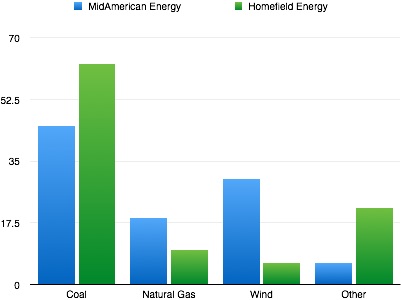
“Well, what about the environment Mr. Smart Guy?!”  Each energy supplier has their own breakdown of how their energy is generated (MidAmerican, Homefield Energy).  Coal, one of the worst polluters is also one of the cheapest forms of electric generation.  So how do Homefield Energy and MidAmerican Energy compete in terms of ‘greenness’?
Energy Supplier Greenness


Taking coal and natural gas together (arguably the two worst polluters) pins Homefield Energy as the dirtier supplier with 72.33% of their electrical generation coming from those two sources.  So in this case, it is not a matter of paying more to Homefield because they offer cleaner electrons.  In fact, MidAmerican has about 30% renewable energy (in the form of wind) compared to Homefield’s dismal 6%.

A Penny or Two Matters

So MidAmerican is cheaper and cleaner, but does it really matter to John and Jane Doe consumer?  I mean, it is only 1.06¢ difference per kWh.  According to U.S. Energy Information Administration, EIA, the average U.S. residential utility customer used 10,908 kWh in 2013.  Multiply that usage by the cost difference between these two suppliers (.0106) and you end up with $115.62 in savings per year.  Not too shabby for spending 5 minutes on an enrollment website.  We personally stand to save about $58 based off our usage (5514 kWh) in 2014.  Alternatively, we could spend an extra $50 and go with Viridian’s 100% renewable one year rate at 6.49¢/kWh.

Aggregate Contract?

At the end of my hour traipse through different electric supplier’s websites I am still left with the question of why our municipality agreed to the contract that they did.  There are cheaper options available and there are greener options as well.  Heck, for a cash strapped city that is always claiming to look for more revenue, it doesn’t take much creativity to set the opt-out rate at MidAmerican’s low price of 4.54¢/kWh and then add on a surcharge of 1.06¢/kWh to bring it up to their current contract rate.  The city would pocket about 3.9 million dollars!!

34,131 households * 10,908 kWh (average annual usage) * $0.0106

The precedent for adding a surcharge is already there, they currently add one and nobody has raised a fuss.  A spokesperson for one energy supplier said that less than 10% of customers opt out of aggregate contracts.  Most people simply don’t care.

Perhaps MidAmerican couldn’t generate enough electricity for 30,000 households.  That still leaves the possibility of using Viridian’s one year fixed rate @ 5.49¢/kWh.  Not only is it 50% renewable, quite an improvement over 6%, but if the same money raking strategy was employed here the city would still be able to generate over $400k in revenue.

34,131 households * 10,908 kWh (average annual usage) * $0.0011

I may be missing a piece of the puzzle, but it seems to me that there is a drastically better solution available than the one that has been presented to the public.  The current 0.1¢ surcharge to manage the aggregate program is estimated to generate about $370,000.  I spent a lunch break and found a better rate.
Posted in: Savings Tagged: Budget, tips, Utilities

2014 In Numbers

December 31, 2014 by Andrew Leave a Comment

Happy New Years!  Here is a recap of our 2014 in numbers

1,224 GB Data Used

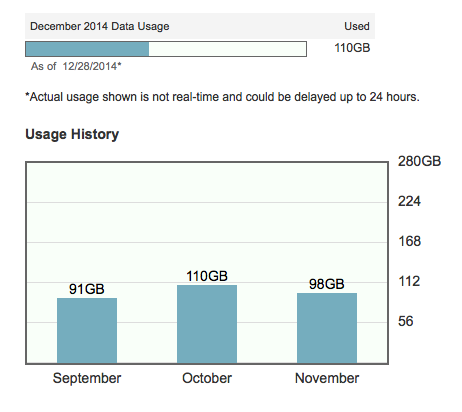
While I don’t have full usage history for our internet connection, I do have the past four months.  If I extrapolate that data then I can summarize that we have used on average about 102 GB of bandwidth each month in 2014.  Most of that is probably Netflix related.  In total we spent $399.78 for internet in 2014, or 32¢/GB.  You can read more about trimming your bill here and here.

data usage

1,140 CCFs (852,000 gallons) of Natural Gas

Our furnace, water heater, and oven all use natural gas.  Heating continues to be the number one demand for gas in our household.  1 CCF is 100 cubic feet or the equivalent of 748 US gallons.  An olympic swimming pool holds 660,000 gallons.  We couldn’t quite trap all of the natural gas we used this year in an olympic sized swimming pool.

CCF Usage 2014Insulating (part 1 and part 2) our house will hopefully conserve more resources in the future.  Our main enemy are our leaky windows (temporary fix).

40%

Is the amount that we have trimmed off our mortgage principal.  We started making quadruple payments in April and are motivated to be mortgage free by the end of next year.  Living frugally and skimping on gifts to ourselves has helped (see frugal gift ideas here).  Debt is an emergency!

Mortgage Balance Remaining


18,700 Gallons of Water (2,500 cf)

That is about three milk tankers.

Fair-Oaks-A

According to the EPA, the average American uses between 80-100 gallons of water a day.  Thanks to the installation of low flow faucet aerators (here) and low flow toilets (here and here), we averaged about 25 gallons per person (with Frugal Boy included it would be about 17 gallons).

5,514 kWh of Electricity

2014 electric usageAccording to the US Energy Information Administration, the average household uses 10,837 kWh a year.  We came in about half of that thanks to using CFL and LED lightbulbs instead of incandescent.  We also use the low heat setting for our dishwasher and try to turn off lights and other energy suckers when they are not in use.  Our total electric bill for the year came out to be $652.92.  $49 of that was just to have service provided.

$36,757.30 in Medical Bills

Having a baby is expensive, especially when things don’t go according to plan.  Having good insurance and understanding what it covers means that we only paid $387.98 out of pocket.  That was even with the highest deductible plan.  Health Savings Accounts, HSAs, are awesome (especially when it is employer money)!

7

The number of states we visited this year.  Read more about it here, here, and here.

6 months, 6 states

I was too lazy to make a new map showing Wisconsin as visited, just take my word for it

8

The number of teeth that Frugal Boy has.  Aye aye aye!!!

IMG_5147

96

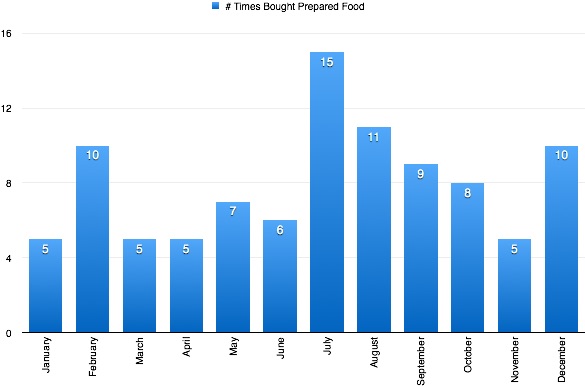
The number of times we bought prepared food (restaurants, take out, forgot to pack a lunch, anything except the grocery store).  February we had a baby and grabbed more than one lunch/dinner from the sandwich shop.  July and September we went on semi long road trips.  Maybe a good challenge for 2015 would be to go a month without going out.

2014 Prepared Food


1,320 Minutes Talking on the Phone (Andrew)

According to the little statistics screen on my phone, I blabbed for about 22 hours in 2014.

1,083 Blog Visits

Google Analytics tells me that is how many sessions (not to be confused with page views) that this blog has had in 2014.  90% of those visitors are from the good ole United State of America.  7.5% are from Russia (hey leave a message, assuming you aren’t a bot), and the rest are scattered about.

2014 blog visitors

2,157 Spam Comments Blocked

You may have noticed that you can no longer comment on older articles.  That is my attempt to cut down on spam.  Thankfully I have to do virtually no work to manually eliminate the junk because of the wonderful Akismet wordpress plugin.

2015

The number of roads a man must walk down or maybe just another good year.  Enjoy and live frugally!

Posted in: Misc. Tagged: Budget, Holiday, Utilities

Trimming the Phone Bill, Part 1

August 29, 2013 by Andrew 2 Comments

Keeping a budget is almost a necessity for living a responsible financial lifestyle, but looking for ways to cut some expenditures is a great way to live more frugally.

I like to look at recurring monthly expenses because while they often seem small, over time they add up to a large amount.  A great example of a monthly expense is the cell phone bill.  Not only are there many options available for consumers in this day and age, but there is also the multiplication effect from households often having more than one phone.  Shae and I each have our own cell phones so each dollar we can shave off the monthly plan actually saves us two dollars.

In this two parter series, I will share how we have saved hundreds of dollars by not accepting the status quo.

In The Beginning…

A couple of years ago we made a financial mistake.  We bought brand new phones on a two year postpaid contract.  Telecoms such as AT&T, Verizon, and T-Mobile incentivize contract plans because they are proven money makers.  Customers buy a new heavily subsidized phone (some are even subsidized down to $0) and then over the next 24 months they pay a higher monthly bill to pay off the original phone cost.  In our case we had purchased the cheapest iPhone 4S models and went with AT&T’s cheapest contract plan.

iphone4_att1

iPhone 4s on AT&T

This set us back $200/per phone upfront and $56.62(with taxes and fees)/mo per phone.  Yep… not very frugal. Surely, we must have been getting exceptional services for a combined monthly phone bill of $113 per month.  Each plan came with 450 talk minutes, unlimited SMS (text messages), unlimited nights/weekends/mobile-to-mobile, and a paltry 200 mb of data (used for connecting to the internet).  Suffice it to say, there were better options out there.

Spending Money to Save Money…

Yes, it is true.  Sometimes you have to spend money to make/save money.  Part of every postpaid cell phone contract is an early termination fee, etf.  Should you decide to prematurely end your two year bondage with the telecom you will face a penalty.  AT&T calculates this penalty based on how many months are left on your contract.  If I recall correctly, it started in the $300 range and decreased by $10 for every month you had fulfilled.  Details can be found on your own telecoms website.

After finding a compatible prepaid plan, more on that in a second, we set up a spreadsheet and calculated if we would save enough on the new plans to offset the cost of the etf.  It just so happened that it would.

GoPhone GoPhone is AT&T’s prepaid option.  It works a lot like their postpaid with several key differences.  Here are a list of similarities:

  1. They both use the same cell network, if you have coverage on one, you’ll have coverage with the other type of plan.
  2. They both can use your existing SIM card (SIM cards are small chips that identify your phone to the cell network.  Your number is associated with your SIM).
  3. You can keep your same phone number.
  4. You can access the internet with the same speed.

The differences mainly come down to billing.

  1. GoPhone you pay for the month that is about to start, PostPaid you pay for the month that just ended.
  2. GoPhone has some cheaper options for infrequent talkers/texters.
  3. You use a different website to manage your prepaid or postpaid accounts even though the money ultimately goes to the same company.

Out of all of the prepaid GoPhone plans, we felt that the $25/mo per phone plan best met our needs.  It offered 250 minutes of voice and unlimited texting.  Any data usage would cost us an additional $5 for 50mb (about enough to check your email for a month).  Since there is an abundance of free WiFi in the places we frequent during our daily schedules we skipped the added data package and cost.  The total monthly cost per phone was now $27.32 with taxes and fees.  When you add up both phones in the household our new monthly phone bill was $54.64, a whopping 51% savings.

You can start to see my obsession with cutting recurring monthly costs.  In just one year, the savings of switching from a contract plan to a pay as you go plan has saved us over $700 a year. Those 200mb of data and 200 minutes of voice data aren’t missed either because we were never using them in the first place.  We made a mistake early on by buying new phones on contract.  If I was to do it over again, I would buy used phones that were off contract.  The upfront cost might have been more, but we wouldn’t have had to pay the hefty early termination fee.

I will conclude Part 1 here.  Stick around for Part 2 where we will go deeper into the rabbit hole of frugality and you’ll be amazed at how much more we have trimmed off our phone bill.  Until then, leave a comment about how much you are paying for your phone, with whom, and if you are using everything that you are paying for.

Posted in: Savings, Technology Tagged: AT&T, Budget, Phone, Utilities
« Previous 1 2

Recent Posts

  • Min/Maxing Car Sale for Highest Value and Lowest Headache
  • Buying a Car with Data Driven Decision Making
  • Hot Lunch
  • Baking with Dad
  • Winter Nights

Financial Goals

Recent Comments

  • suwaidi online on Building a New Desktop Computer
  • James Spurr on Building a Self Watering Raised Garden Bed
  • suwaidi online on Total Cost of Ownership – Inkjet vs Laser Printers
  • bcimechanical on Troubleshooting a Gas Furnace
  • g on Troubleshooting a Leaking Whirlpool Dishwasher [UPDATED]

Archives

  • December 2020
  • December 2018
  • July 2018
  • May 2018
  • April 2018
  • March 2018
  • February 2018
  • January 2018
  • December 2017
  • November 2017
  • October 2017
  • September 2017
  • August 2017
  • July 2017
  • June 2017
  • May 2017
  • April 2017
  • March 2017
  • February 2017
  • January 2017
  • December 2016
  • November 2016
  • October 2016
  • September 2016
  • August 2016
  • July 2016
  • June 2016
  • May 2016
  • April 2016
  • March 2016
  • February 2016
  • January 2016
  • December 2015
  • November 2015
  • October 2015
  • September 2015
  • August 2015
  • July 2015
  • June 2015
  • May 2015
  • April 2015
  • March 2015
  • February 2015
  • January 2015
  • December 2014
  • November 2014
  • October 2014
  • September 2014
  • August 2014
  • July 2014
  • June 2014
  • May 2014
  • April 2014
  • March 2014
  • February 2014
  • January 2014
  • December 2013
  • November 2013
  • October 2013
  • September 2013
  • August 2013

Categories

  • Business
  • DIY
  • Finance
  • Frugal Boy
  • Frugal Girl
  • House
  • Misc.
  • Parenting
  • Reading
  • Recipes
  • Savings
  • Technology
  • Travel
  • Uncategorized

Meta

  • Log in
  • Entries feed
  • Comments feed
  • WordPress.org

Copyright © 2026 Frugal Living.

Omega WordPress Theme by ThemeHall