I’ve been periodically checking Comcast’s website for internet service deals and today I found out that they were running one of their better offers.
For those of you just tuning in, I’ve played this game many times (here and here). The last time I wasn’t able to get a very good deal and we were paying $55 a month for 25 Mpbs internet and digital phone. We never used the phone but it was cheaper to have it than to pay for just internet. Yay bundles </sarcasm>.
Anyway, after a frustrating phone call of repeatedly saying “no, I don’t want phone service. no I don’t want cable tv.” I got the new deal for $30/mo for 25 Mbps internet only. This will be good for 12 months, so I am pretty happy that I won’t have to bother with this again for another year.
Putting up with sales agents working on commission is worth saving $300!
Happy Mother’s Day! If you are looking for an exemplary mother, besides your own of course, then the book and movie, The Prize Winner of Defiance, Ohio is a great place to start. We just watched the film on Netflix and it was truly remarkable the amount of love, perseverance, and frugality that the mother possessed.
Summer seems to be here to stay and the house has been warming up. Shae and I talked again about getting air conditioning (our 1984 unit has never worked since we moved in). The conversation only took about 5 seconds as we both understood that the choice was to either get AC or pay off the house this year. The needs have once again trumped the wants.
The cheaper and lengthier option is to plant some shade trees in our yard. Our yard is very spartan of trees with only a silver maple along the street and an ornamental by the front of the house. Last fall we planted a Japanese dogwood in the front to replace the neighbors tree that fell over in heavy rains. We also planted a silver linden in the far backyard.
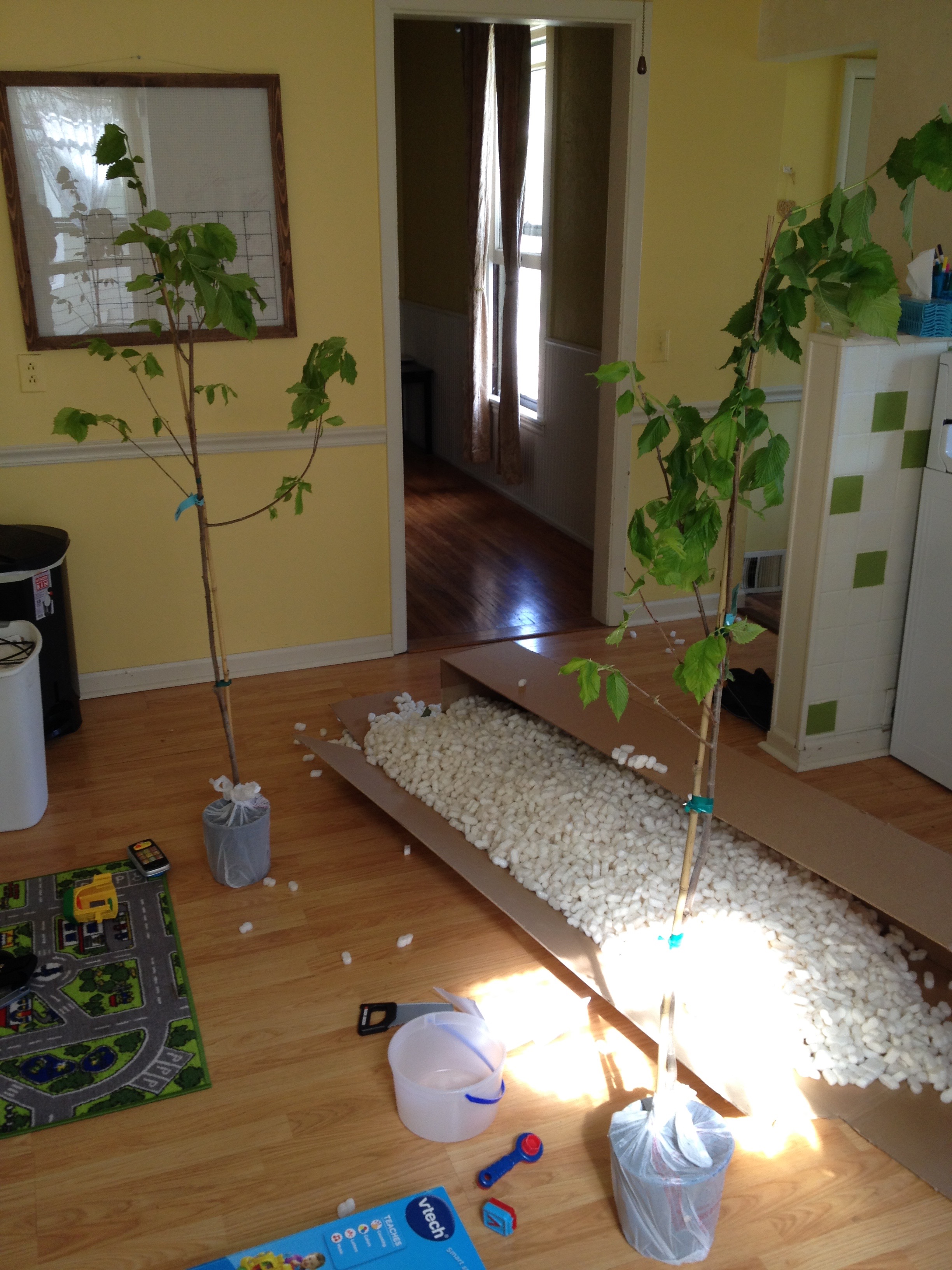
Yesterday my order of two Princeton American Elm trees arrived in the mail from a nursery in Joplin, Missouri.
Some Tree History
American elm trees were THE street boulevard tree in the United States. The vase like shape made great cathedral canopies that formed aesthetically pleasing shaded passageways for horse drawn carriages and early automobiles.
Then in the 1920s, disaster struck. Lumber imported from Europe contained an invasive beetle and the beetle carried spores for a deadly fungus. The beetles ate the bark from the American elm trees and spread the spores of the fungus from tree to tree. The fungus would cause necrosis and was the source of what came to be known as Dutch Elm Disease, or DED. DED wiped out millions of elm trees in America and the once beloved tree that inspired more Elm streets than Main streets was largely forgotten or shunned.
Municipalities, looking for a new streetscape tree to take the place of elms turned to the attractive ash tree. Of course, you know what happened to ash trees. Once again an invasive beetle, the emerald ash borer came into the ecosystem and devastated the ash tree population.
For the third time, municipalities had to search for replacement trees to line the streets with. This time silver maples, ornamental pears, lindens, and oaks were selected. Each has its own set of problems but so far none has been massacred like the elms and ashes before them.
Then something kind of miraculous happened. In the 1990s the USDA began research on hybridized elm trees with resistance to DED. Several new cultivars were developed including, Valley Forge, Jefferson, and New Harmony. Princeton was an old cultivar that was found to have natural DED resistance and cuttings (clones) of these old surviving trees were propagated after testing well against DED infection. The USDA testing for DED resistance found that the new cultivars had 86% to up to 95% survival rates (depending on the cultivar) when injected with two to three million spores. The typical beetle will carry around 100 spores.
Planting Steps
Shae and I measured and staked the locations for the two trees a few days ago. Princeton elms grow to 60-80′ tall and a crown diameter of 30-40′. In favorable conditions they can grow 3-6′ a year and can live between 100-300 years.
To plant our new trees, I dug a hole about three times the width of the pot and about the same depth as the pot. I removed all of the grass and mixed in some potting soil. The tree should be planted at the same height or slightly higher than the surrounding terrain. Planting too deep is detrimental to the tree because the roots need oxygen from the surface and the trunk doesn’t like to be covered up with soil or mulch.
Both trees were root bound. Root binding happens when a tree or shrub outgrows its container size. The roots will hit the edge of the container and then start circling around. The best way to deal with root bound plants is to cut an X in the bottom and four vertical slits on the sides to free up the roots. If the roots aren’t freed and pointed outwards, they will continue to grow around in circles and eventually strangle themselves.
I finished up the planting by adding a layer of triple shredded hardwood bark mulch to help keep moisture from evaporating. I also added a plastic guard to protect the trunk from animals, little boys, and the lawn mower. The mulch should not be touching the trunk and the sapling trees will need daily watering for the first couple of months until their roots are established.
Additional Care
Like a small human child, elm trees need the most care in the first 5-10 years of their lives. Annual pruning to develop a strong central leader (trunk) is recommended to keep the iconic vase like shape that elms are known for. Pruning should be done in the early spring or late fall when the tree is dormant. Bugs are not active yet and the risk of infection is lower at these times.
Conclusion
If all goes well, these trees should grow to be about 25-30 feet tall in 8-10 years. That should provide us with a nice shady backyard and a cooler house. Even if we have installed a new AC unit, we should still benefit with lower electricity bills because of the added shade.
It’s been a while since I have posted a bunch of pictures of Frugal Boy. The grandparents are probably getting itchy, so I better remedy that.
We transplanted a patch of creeping phlox from our backyard to a flower bed in the front yard. The resulting bare dirt patch has since been claimed by Frugal Boy.
We tried out a ‘dress yourself’ day. After he ran to Shae’s closet and grabbed a dress we reverted to picking his attire for him.
He has made great strides in potty training.
just kidding!
Wagon rides are pretty fun. You can sit, kneel, and lay down in the wagon. Frugal Boy still likes to test boundaries and try standing and straddling the side of the wagon.
Big hats help to keep the sun off that buttery smooth baby skin.
We learned that Frugal Boy’s attention span is better than we thought. He sat like this for almost 30 minutes.
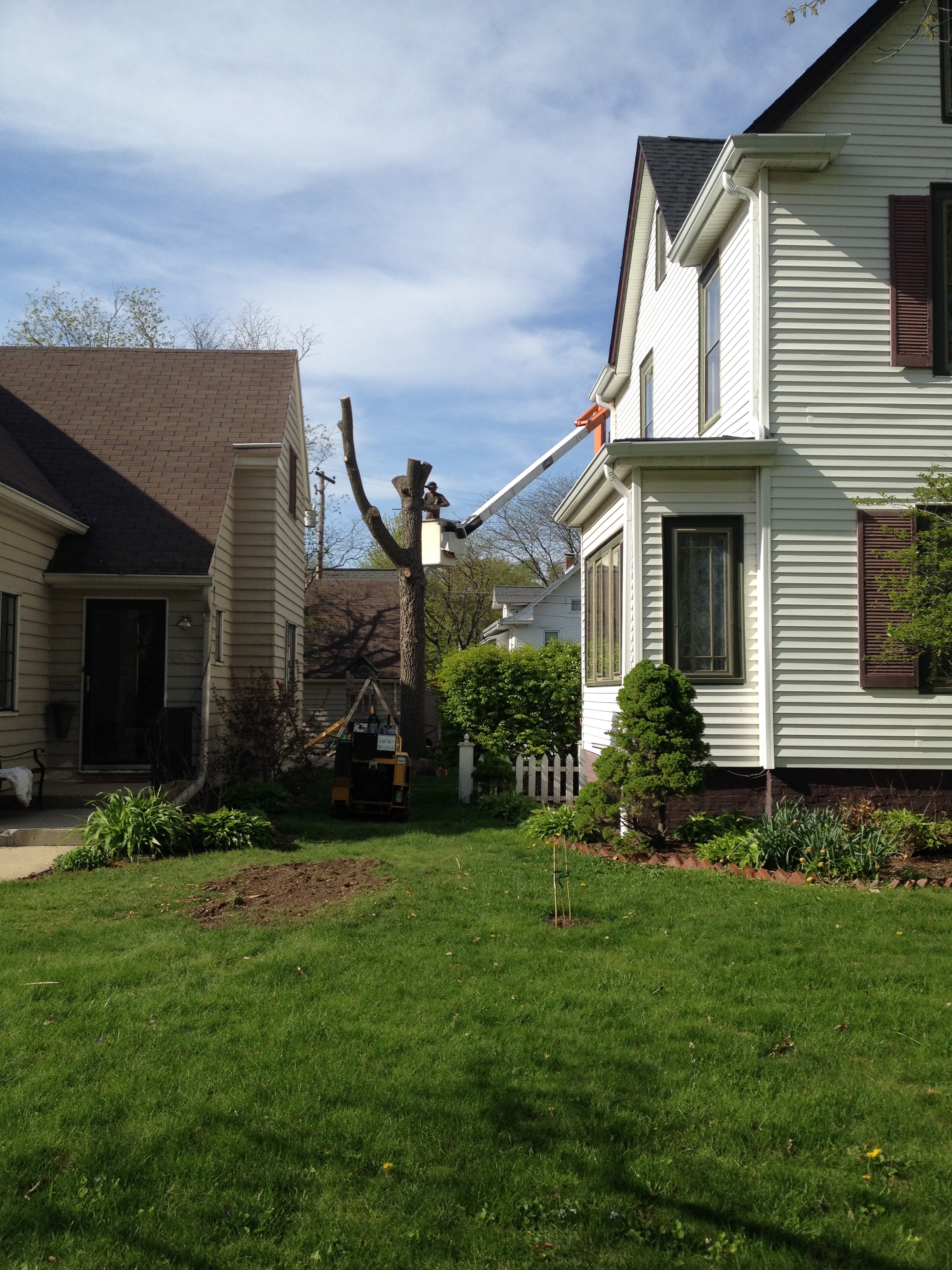
He was watching a tree being cut down.
He has a new adventure friend.
The neighbor girl had a lot of fun playing with him one evening.
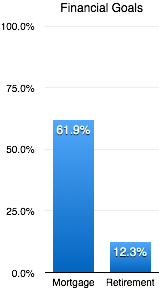
You may have noticed an addition to the sidebar. It is this little chart graphic that I try to update once a month.
May 2015
It is our yard stick for two major financial goals in life. The first is to pay off our mortgage and be completely debt free. The second is to have enough interest earning assets socked away to be able to live indefinitely without having to work (aka retirement).
We currently have 62% of our mortgage paid off. Our extra payments help to chip away about 3% every month.
The retirement bar rises more slowly and could even decrease if the stock market goes down. We are currently at 12.3% of our retirement goal, but what is the goal number? More importantly, how do you find out your own goal number?
Planning for Retirement
There are only a couple of numbers that you need to know in order to plan for retirement. The most important number is your annual expenses. Ya, ya, I know what you are thinking. All of those retirement calculators and financial gurus on the internet talk about retirement in terms of income. “You need to be able to replace 80% of your working income in order to retire.” Let me tell you, that’s a load of crap.
What you really need, is to be able to cover 100% of your expenses. You track those, right? If not, now’s a great time to get started with Mint.
The great thing about basing your retirement goal off your expenses is that if you want to retire sooner, you just have to lower your expenses! Man, I knew this frugal thing was going to pay off. 🙂
Before you rush off to figure out your annual expenses keep in mind that they should be adjusted for retirement. If you are going to be mortgage free before you retire, you can drop those mortgage payments from your total. The same goes for items such as daycare, estimated income tax (you’ll be retired), and any debts that you have paid off (student loans, credit card, car, etc…).
Okay, so do you have your annual expenses number? Let’s use $30,000 as an example.
4% Rule
Here comes the second number. If you guessed 4 you’re wrong. The second number is 25. Multiple your annual expenses by 25.
$30,000 x 25 = $750,000
There you go, that is how much money you need to save in interest earning assets (like stocks and bonds) in order to retire. Do you see what I did there. I said “retire”, I didn’t say “retire at 67”. That’s right, once you have your nest egg you should be able to retire at any age and live indefinitely off your nest egg.
Suuuurre… say the skeptics.
Don’t believe me? Let’s start with exhibit A, the Trinity Study. The study, done by a group of professors in the 90s, and later updated with recent historical data, looked at rolling 30 year periods to see how stock portfolios (50/50 stocks to bonds) would have fared since as early as 1926. The authors concluded that given a withdrawal rate of 4% per year, the likelihood of a portfolio surviving for 30 years was 96%.
It’s at this point that you look over to your SO, if you’re single you can skip this step, and you find out who among you is the more cautious. The cautious partner will probably say that number is too small, and want to use a 3% withdrawal rate just to be safe. So we really have two retirement numbers, the 4% and the ‘rock solid’.
If you’d like to read more about the Trinity Study and the 4% rule, Go Curry Cracker has a great write up on the topic.
Going back to our example, 4% of $750,000 is $30,000. Yay, the math works!
But $750,000 is SOO much money. Who could ever save up that amount of dough.
If you are close to the ‘normal’ retirement age, you may not have to. Social Security and any pensions may be able to subsidize your annual expenses. Instead of needing 30,000 from your portfolio a year, you may only need $10,000. That shaves off a cool half million right there. If you are still young and want to pursue early retirement then Social Security and pensions are too far away to be much of a serious help. Instead you’ll have to focus on two things, cutting expenses and raising income.
Early Retirement
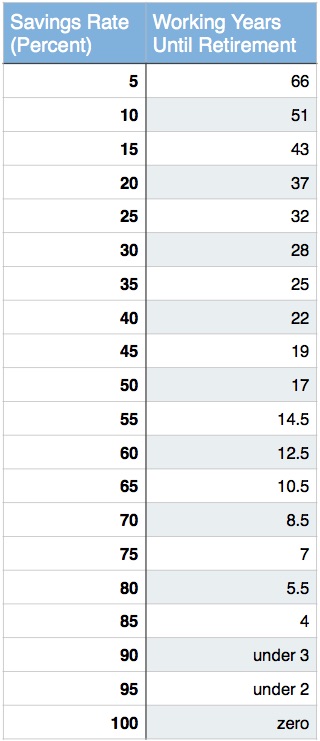
Mr Money Moustache (MMM), an avid early retirement blogger, has put together a simple table to correlate savings rate to years till retirement.
Saving 10-15% of your income for retirement will put you on track for retiring in your 60s or 70s, assuming you start in your early 20s. We are currently putting aside 25% of our income, and even that amount of savings only puts us on track for late 50s. Our goal is to increase our savings percent to 40 or 50 so we can retire early. Preferably before we turn 40. That may be possible if we are disciplined enough to pay off our mortgage early and save that freed up cash flow instead of spending it on lifestyle creep.
Some Final Thoughts
I use the word retirement, but what we are actually pursuing is early partial retirement. The flexibility of working when, where, and on what we want is incredibly appealing. It may not be necessary to reach 100% of our retirement number if we offset our annual expenses with partial working income.
The second thought, is that no where in here have I mentioned financial windfalls. That could include winning a lottery, or receiving an inheritance. The reason for their omission is simple, you shouldn’t count on them or rely on them.
Finally, the 4% rule has been getting a lot of flak in the past few years saying it is obsolete and no longer valid. The arguments generally go that bond rates have plummeted in recent history and yield close to zero. The 2008 crash and subsequent depression hit close to home and rattled a lot of 401k holders. The 4% rule works if you remain flexible. Should you buy a new car the year that the stock market drops 50%? Probably not, maybe you can make do with what you have until your portfolio recovers in a year or two. Is the market up 15% this year? Maybe you should withdraw more than 4% to build up cash reserves for down years.