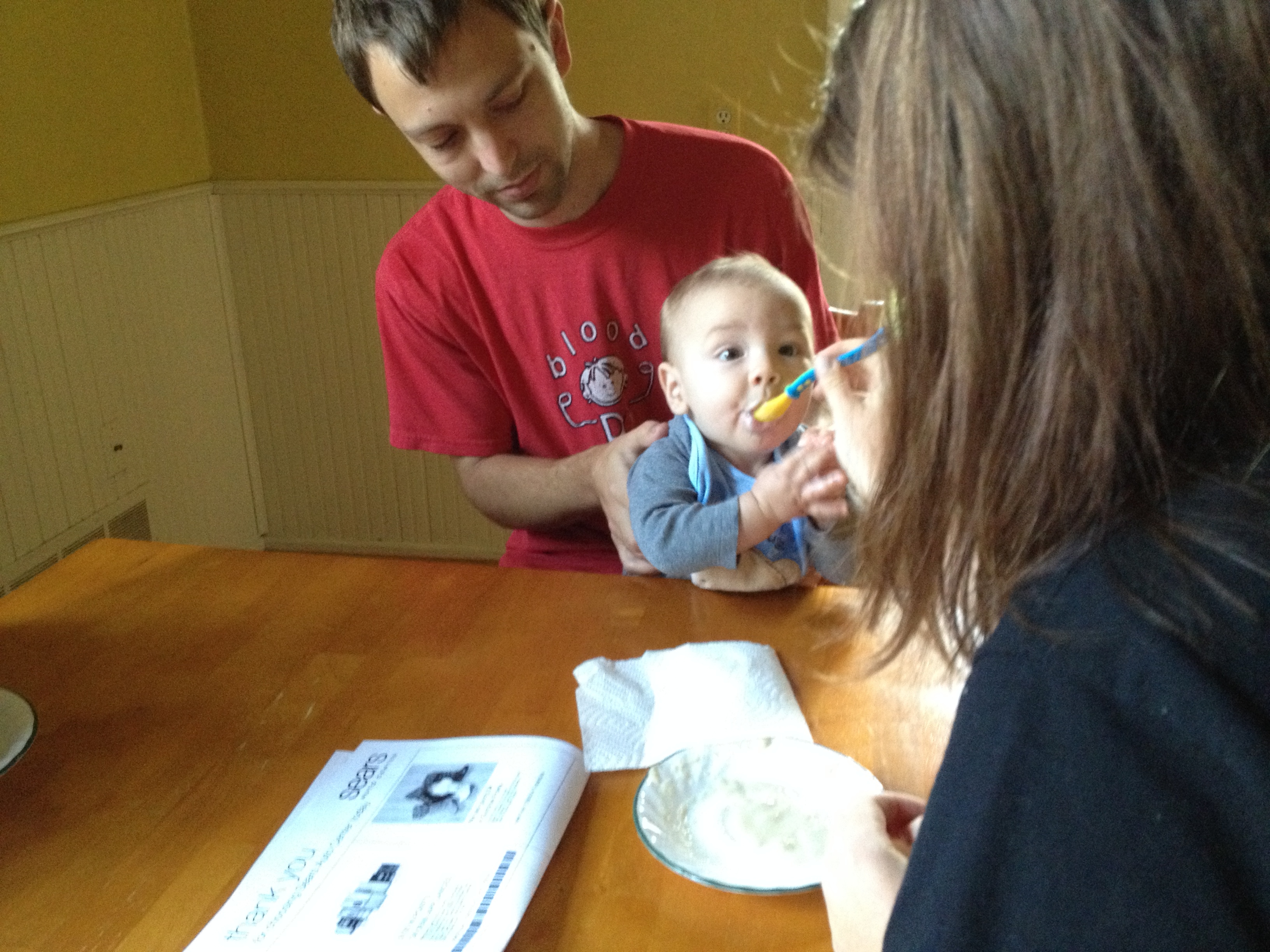
Frugal Boy had his six month checkup today and is in good health.
Mountie Frugal Boy
All of that playing has helped develop his body and mind.
thick as thieves these two are
At the doctor’s office Frugal Boy weighed in at an impressive 20 pounds and 2 oz (91%), measured 27.5″ long (86%), and had a head busting 18″ melon circumference (98%).
if it’s in my reach, I’m going to try and eat it
The main reason for doing these checkups is to get vaccinated against horrible diseases. In three months he will start a new round of vaccinations. I always thank the nurse who administers them because they are truly life saving wonders of modern medicine. Today I caught the nurse off guard, the office was crawling with people and she probably hadn’t been thanked all afternoon. Thank you’s are one area you don’t need to be frugal in!!
Just last week we were walking through Babies R Us (aka the Amazon showroom) to look at child seats because Frugal Boy has almost outgrown his infant car seat. We have also been on the lookout for a cheap high chair so that Frugal Boy can get out of our lap during dinner time and better participate in mealtime without clawing at our plates. Out of curiosity I took a cursory glance at the high chairs in the store and found the cheapest one with legs to be about $80.
The next day on our nightly walk we passed by a neighbors garage sale and there just happened to be a wooden high chair for $20. We scooped it up and carried it home to get it ready for its latest occupant.
Sans Tray
I removed the swinging tray and took it out to my little workshop in the garage. The tray had a slim piece of veneer that had been crudely glued into it and this made the perfect gaps for crumbs to sink into. I removed the veneer and the copious amounts of glue so I could repaint it.
Shae on the other hand set to work making a seatbelt system to hold Frugal Boy in place.
I really appreciate having a crafty wife. On our trip to the craft store we couldn’t help overhearing the clueless boyfriend/girlfriend couple who were attempting to make patio furniture (probably something they saw on pinterest). The poor store clerk told them that the interior fabric and padding wouldn’t work outside. Then later on they had no idea how much fabric they needed. “Enough to make five pillows.” Well how big are those pillows going to be?
Anyway, back to the point, I love a woman with a plan.
Here is a test fit of the restraint system with a live and very wiggly load.
After the paint was done drying, I was able to add the tray back on.
I don’t really care if he gets any wheat circles into his mouth. Just keeping him busy and letting us eat dinner is good enough for me.
August is National Breastfeeding month and we have our own little duo that is happily participating.
The American Academy of Pediatrics, or AAP, recommends exclusively breastfeeding for the first 6 months and then continuing to breastfeed with the possibility of supplemental foods until 12 months of age.
According to the CDC’s 2014 report card, the average number of American babies that are breastfed at any point in their lives is 79.2%. By 6 months of age, the likelihood that a baby is being put to the breast at any time of the day reduces down to 49.4%. At 6 months the number of exclusively breastfed babies, those that eat nothing but breast milk, is a little less than one out of five (18.8%).
Clearly there is a bit of a gap between the AAP recommendation of 100% for EBF, exclusively breast fed, and the actual reported number of 18.8% and that in my mind is the point of having a breastfeeding month. Formula companies have an advertising budget and can run tv spots, boobs can’t. So consider this post our advertisement for the original happy meal.
For starters, it helps to move past some of America’s prudishness. Boobs, boobs, boobs, boobs, boobs!!! There, I said it. Women have them for two reasons. 1.) to signal that they can bear and raise children, and 2.) to feed the children that they bear. Thankfully my wife has no such prudishness and will happily feed our son when he is hungry despite where we may be. Take this park bench for example!
Or how about the backseat of a car (don’t worry, it was parked)
Hike or no hike, it doesn’t matter.
What about when moms not around? Here is our stash of pumped milk before Shae’s maternity leave ended.
Three months later and that supply has been all used up so now we are toeing a fine line of pumping supply and demand. Frugal Boy hasn’t quite reached 6 months yet, so the chances that we will start giving one or two feedings a day of formula are creeping up. Will we make it into that elite club of 1/5 that EBF to the recommended age of 6 months? Not likely, but we got pretty close.
Even partial breastfeeding confers a myriad of benefits including enhanced brain development and decreased sickliness. It was very tempting to throw in the towel at the hospital when Frugal Boy was hungry and the milk supply hadn’t kicked in yet. Another period of difficulty was when maternity leave ended and we had to transition to bottle feeding breast milk. In my opinion those are probably the two biggest traps that grab 4/5 moms.
Now that Frugal Boy is closing in on 6 months and has his first tooth, we have experimented a bit with solids. Here he is having baby oatmeal for the first time.
Mmmmm
We still haven’t given him a daily feeding of solids and he doesn’t seem to mind.
A little while back one of our friends proudly stated that their one month old baby slept 7 hours straight that night. I can guarantee you that baby is formula fed. Breast milk is easily digestible and no sooner is it in that little tummy it is being processed and used up. The result is that Frugal Boy still wakes several times every night to feed. So why do we sacrifice so much sleep? For starters, Frugal Boy weighed in on the bathroom scale this morning at 19.4 pounds. That is the equivalent to an A or A+ for his age. He is a very happy and intelligent boy. Finally, we are saving a ton of money by not buying formula. Do formula fed babies score A’s on growth charts and developmental milestones, sure they do! Is that something we want to do? Absolutely not if we can avoid it.
If you breastfed your babies thank you! If you are currently breastfeeding, keep it up! If you tried and switched, thanks for giving it a go! If you weren’t considering it at all, learn more about the benefits to both mom and baby!
In this three part series, we will look at the myriad of choices that parents new and seasoned alike can choose from to keep their little one’s bums squeaky clean.
In case the title wasn’t enough to tip you off, this series will include a considerable discussion of poop. If that isn’t your thing, you should probably turn back now.
Okay, now that we have weeded out the faint of heart, let’s talk about poop. Everyone pees and poops, and if they don’t, something is seriously wrong with them and they should probably go talk to a doctor. Babies are little people too, and because they don’t have the motor skills, cognitive ability, stature, and a wide variety of other prerequisites necessary for using commodes like the rest of the civilized world, that means we need to wrap their little bottoms in something.
A long time ago..
in the 1800s parents would use squares of linen and cotton folded and safety pinned to keep solids and liquids from dribbling out. Not much changed in the following decades in diaper technology until the 1940s when the first disposable insert came along. It fitted inside the normal cloth diaper shell and reduced the amount of laundering required.
The Safe-T Di-Dee diaper was a breakthrough in 1950 due to its patented use of snaps instead of safety pins but it was too little too late. Major companies such as Procter and Gamble and Johnson and Johnson began to aggressively target the diaper market in order to expand their product and bottom lines. By the 1960s fully disposable diapers were making major head waves into the marketplace. The 70s and 80s continued this momentum until disposables held a staggering 95% of the diaper market.
Consumers loved disposable diapers for their no mess, no fuss, and time savings. I even read one analysis that claimed the rapid adoption was due in part to the burgeoning Women’s Rights movement. Mom’s that switched to disposable diapers had more free time to pursue their interests, and disposables were so easy to use that even dads could change them.
By the 1990s cloth diapers, once the de facto standard, had been sidelined to the fringe community of freegans and hippies. The occasional parent would craft his/her own stash of custom cloth diapers or use the tried and true cloth squares and safety pins.
20th Century Winner
According to WebMD, the average child potty trains between 22 and 30 months of age. For shits (hehe) and giggles let’s play with some numbers and see how much money it takes 95% of parents to diaper their child.
A short analysis
I am going to use 25 months as the age of potty training. I chose that number based on the aforementioned 22 month lower age boundary plus an additional three months for the potty training to be complete (3 was another number given by WebMD).
Another variable that I am going to cut out of the equation is the cost of wipes. You will see why later in the series.
Disposable diapers range widely in price due to three main factors:
Brand
Unit Count
Size
For this analysis, I am going to “shop” at Walmart and use the largest unit count packages in order to get the best value. For brands, I will use Pampers as my name brand and Parent’s Choice as my store brand. The last variable is the toughest, because it varies considerably from baby to baby. To (over)simplify the problem, I will use National Geographic‘s number (3796) of lifetime diapers along with the average unit cost for sizes 1-5.
Pampers cost an average of 29.2¢ per diaper
Multiply that by how many diapers a baby will use until they are potty trained (3796) and you end up with a total diaper cost of $1108
How about the store brand? That comes out to 16.8¢ a diaper and $637 overall.
Wow! That doesn’t sound so bad does it? Seriously, according to that, you can diaper your baby in name brand for only $1108. Something doesn’t smell right though, because that number is about half of what I have seen elsewhere on the internet. Let’s see, if your toddler potty trains at 25 months then that is the equivalent of 750 days. 3796 diapers divided by 750 days is equal to 5 diapers a day. YIKES! I don’t think any responsible parent changes their baby’s diaper once every 5 hours. How about once every 3 hours, then how many diapers would you go through until you made it to potty training?
6,000 diaper changes.
Pampers: Approximately $1752
Store Brand: Approximately $1008
Part 1 Conclusion
Parents who choose disposable diapers can expect to pay at least one thousand dollars in diapers. In my opinion, the store brand diapers are terrible and are about as much good as a paper sack. I’m positive some other parents agree with me, otherwise there wouldn’t be name brand diapers. In my analysis, I was very optimistic about the age of potty training. While I have no doubt that some children potty train at the age of 2 years and 1 month, I am very skeptical that many parents achieve that nirvana. I would guess that the true cost of disposable diapers for the average child is closer to $2000.
Stay tuned for Part 2 of this series where Shae talks about the resurgence of Cloth Diapers in the 21st Century!
Frugal Boy had his four month checkup this afternoon. He weighed in at 16 lbs 13 oz (88%), measured 26″ long (81%), and had a head circumference of 17″. The main objective of the visit was to administer another round of vaccinations. Here he is after he got home. Poor little guy, all tuckered out.