Now that it feels like summer time, it seems like a good point to turn back and reflect on this past winter. On the books, it was our coldest and snowiest winter ever recorded (it might have been 2nd coldest, idk). We practiced some good energy saving tips such as keeping the thermostat set low (62 for most of the winter), closing unused rooms, wearing extra clothing, and sealing up any leaks that we could find.
Below is our gas usage history. Our utility company estimates the meter every other month, that is why January, March, and May (actual readings) are high while December, February and April (estimated readings) are low.
In the summer months when we were only using gas for cooking and the water heater, our bill was about $15. If I subtract out $15 from November-May, our furnace gas consumption for the coldest winter cost us $632.83. That’s right around $90/mo for heating.
Other heating costs included one routine inspection, $99, and one furnace breakdown, $230.
How’s that compare?
I’m always looking for good quantifiable data. I suppose it is the scientist in me that wants to be able to say, “here are the facts.” This article from Chicago Business talks about what Chicago residents paid on average for heating in 2014. Most of the article discusses the stark pricing difference between Chicago gas and suburbanite gas. While we don’t live in the suburbs of Chicago, we do have the same gas company mentioned in the article. Yep, Chicagonites paid an additional 78% per therm compared to us ($1.21 vs $0.68). Ya gotta love the city that works.
On average, the not gauged folks paid $626 for heating from November through March. We paid $633 for November through May.
Conclusion
In conclusion, we paid a little bit less than the average for our area. Our circa 13 year old furnace did break down once and the repair cost put us over the average. So long winter!
This year Shae got inducted into the sorority of Mothers so naturally we had to do a little extra celebrating for Mother’s Day.
One of the popular Mother’s Day gifts are hanging baskets. A hanging basket can provide beauty for several months, fits nicely into gift spending price ranges, and coincides well with the normal growing season.
On Friday, we shopped around some of the locally owned nurseries to see what kind of hanging baskets they had.
Wow, what a lovely display of annuals. Here is another attractive arrangement.
Store prices range from $10 at big box retailers to upwards of $50 at Mom & Pop establishments. The ones shown above where 10″ plastic pots for $30.
We wanted 3 baskets to fill out our front porch and while we could have picked out 3 and called it a day we wanted a bit more of an experience. So we decided to try and make our own!
After striking out at two garden centers we finally found some nice Calibrachoas fresh off the growers truck at where of all places? Lowes. We also found Dwarf Coreopsis, a mounding perennial. To tie it all together we picked out an attractive metal and coconut lined 14″ hanging basket. In my opinion it looks far superior to the plastic bins that most pre made hangers come in. One advantage of larger basket sizes is that they hold moisture better than smaller baskets and that means less chance of the flowers drying out and wilting.
On a side note, don’t wear a red shirt and a front baby carrier to Lowes. I was asked by a gentlemen to get the forklift and load a pallet of stone into his truck. He was surprised when I informed him that I wasn’t an employee. Later, a woman asked me what time the store closed. Apparently wearing a baby screams Lowes employee to people. Who knew?
Anyway, back to the task at hand. I read that the coconut liners are prone to drying out and that a plastic liner should be used to help retain moisture. We made impromptu liners out of grocery bags and cut holes in the bottom for drainage.
Then we added a bit of enriched soil to the bottom of the pots. Container plants have to get all of their “food” from a finite amount of soil. Each time you water the plant, a little bit of the food is washed away from the roots. That is why it is important to add a time released fertilizer that will slowly leach food into the soil over the course of several months.
Here are our two Calibrachoa (mini petunias) baskets. There are 6 individual plants in each one and hopefully they will get much larger. Each basket weighs about 20 pounds when fully watered.
With the annuals all set to go it was time to work on the perennials.
The dwarf coreopsis were tightly intertwined with their neighbors and proved difficult to separate. Instead of trying to separate them at the store we just bought a carton. When we finally did get them pulled apart, we discovered that one of the pots was just dirt! A quick trip back to the store and a skeptical dirt poking clerk later we were back on track.
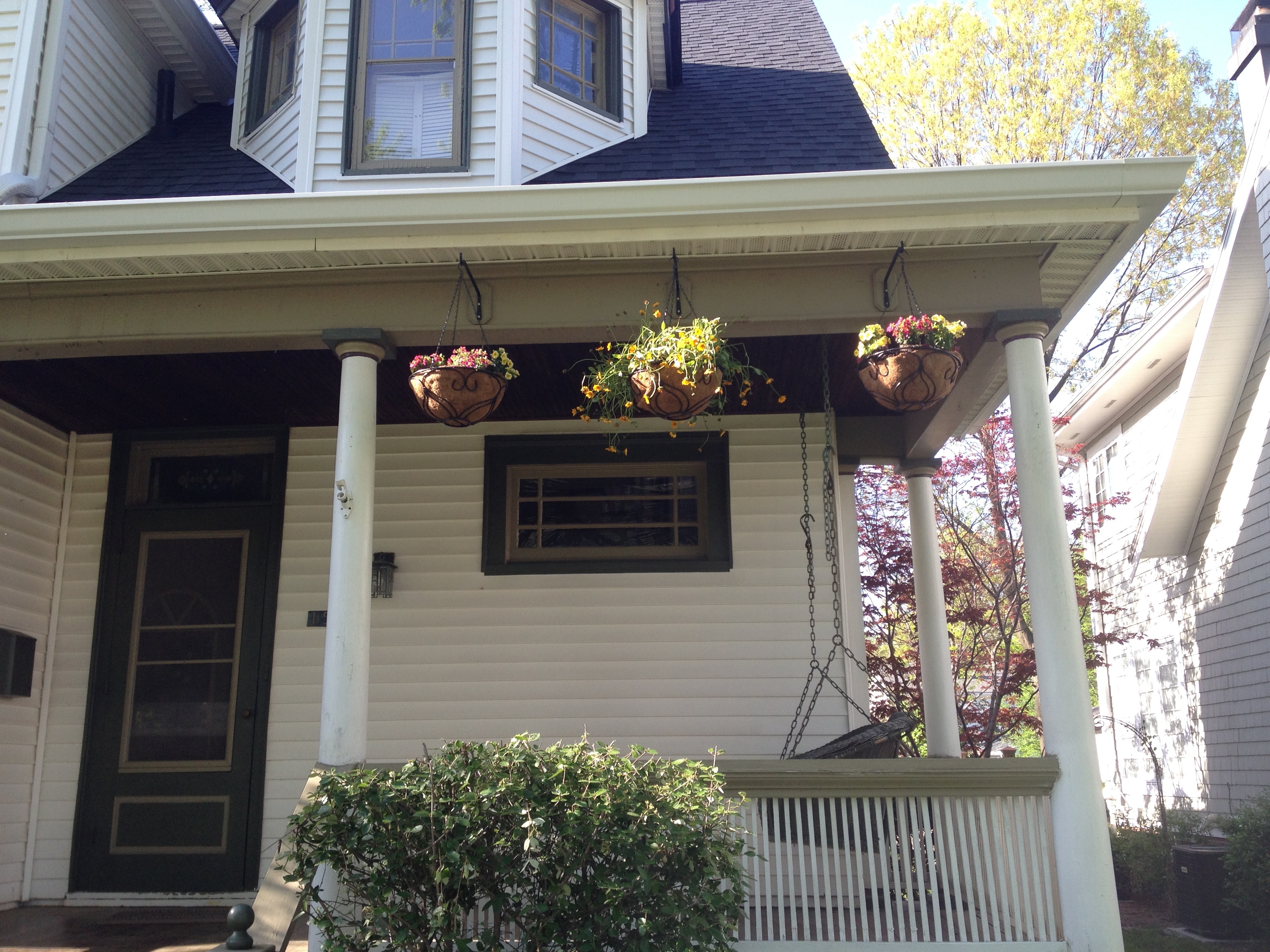
With the pots fully watered we proudly hung them up on our front porch. Aren’t they nice looking?
Huzzah!
Happy Mother’s Day.
The E… WAIT!!!
STOP THE PRESSES. There is a problem.
All of these plants are full sun but they are in the shade. We figured that we either needed to lower the baskets down to the level of the railing or extend them out further from the house in order to get full sun. The latter seemed like a better option so I set about making some base plates for the metal extension hooks. These simple octagon plates are made from some scrap 1×4 with only a miter saw and router.
Now these sun loving plants can get all the rays that they need.
I also trimmed up all of the bushes so I can check that off my honey do list.
Making our own baskets didn’t save us much money this year because we had to buy the reusable baskets and extension hooks. They also aren’t as full bodied as the store bought versions. On the plus side our baskets have many positive memories associated with them and we learned a lot by doing this project. Next year we might try to start some annuals from seed and see if we can have any success.
Finally, it wouldn’t be a complete Mother’s Day post unless I included a couple of pictures of Grandmothers and Frugal Boy.
Picking up where we left off, I decided to replace the downstairs toilet first because it gets used more and if something went wrong, I had easy access to the plumbing from the crawlspace.
The new toilet comes with everything you probably need minus tools. As you can see, the instructions are printed on the top of the box (sorry for the blurry photo).
The tools that you’ll need to remove and install a toilet are:
Adjustable wrench
Flathead screwdriver
Hacksaw
Putty Knife
Rag or Sponge
Pair of Disposable Gloves
Start by turning off the water supply valve to the toilet. Then flush the toilet and hold down the handle to empty the tank out as much as possible. Use the rag or sponge to finish emptying the tank of water. Once the tank is emptied, disconnect the supply line and then use the wrench and/or the screwdriver to disconnect the tank from the bowl.
At this point, you’ll probably want to use a plunger to get as much water out of the bowl as possible so it doesn’t go splish splosh on your bathroom floor. To remove the bowl, you’ll need to start by popping off the decorative caps and unthreading the nuts at the base. Once the nuts are removed, the entire base can be lifted away from the floor.
At this point, you will see the toilet flange (a fancy name for the drain pipe). It probably won’t look pretty and it will likely smell worse because of sewer gas escaping from the pipe. Put on those disposable gloves if you haven’t already and use the putty knife to scrape up the old (and gross) wax ring. Just remember the plumbers motto… “The more disgusting it is, the more money I make”. You can plug up the drain pipe with a rag to keep the smell at bay. Just don’t forget to remove it before installing the new toilet! With the toilet flange cleaned off, and the old closet bolts removed we can get started on installing the new toilet.
Start by doing a test fit of the new base. The new closet bolts inserted into the flange should match up with the holes in the bowl base.
Once you know the fit is good, apply the new wax ring to the bottom of the toilet base. Carefully set it down onto the flange and give it a good press down to set the entire thing in place. Thread nuts onto the closet bolts to secure the base to the floor.
The closet bolts probably have to be trimmed in order to fit the decorative caps on. Use the hacksaw to shave off everything above the nuts. I found this step to be the hardest part, most likely because I was using an old blade.
With the base firmly secured, we can go about attaching the tank. Here’s an obligatory plumber butt shot of yours truly.
Each toilet model will differ a little bit in how the connection is made. Just follow the instructions. You will probably need the wrench and screwdriver for this step.
With the tank attached, reconnect the supply line and turn on the water. If there are any leaks, tighten the connection and try again. Sometimes the supply hose is shot and needs to be replaced. They are only about $5 so it’s not worth trying to salvage a 10+ year old hose. Once the tank fills up, give it a couple of flushes and make sure everything works properly.
Finally, place the tank lid on and attach the toilet seat.
TADA! That wasn’t so hard was it? The whole job took only about two hours and that was with no previous toilet experience. Dispose of the old toilet(s) according to the rules and regulations of your municipality. In our case, that meant a trip to the city bulk waste drop off facility.
Goodbye water wasting, easily clogged, smelly toilets! By our calculations it will take about 2 years for the new water saving toilets to pay themselves off. Also, we have yet to have a single clog!
7 1/2 months ago when we moved into our house, none of the existing toilets worked. Due to the huge list of other ‘fixer upper’ projects and a lack of DIY experience, we chose to repair, instead of replace, the existing toilets and continue to use them for the time being. They weren’t great toilets and only kind of worked but it was a quick bandaid fix. This week after reviewing the numbers we decided it was time to replace the two main toilets (first floor and second floor).
Why Replace a Toilet?
We weighed several factors into our decision to replace the two toilets.
Water Usage
Ability to stay unclogged
Unusual Smells
Comfort
Water
Water usage was a big deciding factor. City water costs ¢0.536/gal, sewer costs ¢0.384/gal for a combined cost of ¢0.92/gal. While less than a penny per gallon of water sounds cheap, it does add up quickly. According to the EPA, the average person flushes a toilet 4-6 times a day. Multiply that by the number of occupants in your household and you start to get an idea of how often that toilet is flushed. Going back to our example, it would be 8-12 times a day. Both toilets were older models that used 3.5 gpf (gallons per flush). That means around 28-42 gallons or ¢26-¢39 a day was spent just for flushing the toilet. Well that doesn’t sound to bad does it? Hmm, we have made some assumptions about these toilets that don’t hold up in real life. Firstly, we’ve assumed that they don’t leak. Morning Sickness has a peculiar way of getting you up close for those leak inspections. According to an in-the-know source, both toilets leak water. Secondly, we’ve assumed that they never clog and require a second, third, fourth, etc. flush. Yep, those toilets clog, so our 8-12 flushes a day isn’t exactly accurate.
Unusual Smells
Our downstairs half bath often smelled of sewer gas. I was fairly certain it was because of the toilet and the bandaid “fix” was to leave the door open so the room could air out. The most often cause of sewer gas is a dried out water trap, but that wasn’t the case with this toilet. The second most likely cause is a bad wax seal on the closet flange. To replace the wax seal, you have to remove the toilet, and while you have the toilet removed, you might as well install a new one.
Comfort
Finally, there is the issue of comfort. All of the toilets in our house are round seats and fairly low to the ground. Our potty training niece loved the “Ruby Throne” because it was just her height and at 14 1/2 inches tall, it is one of the shortest toilets out there. I am average height for a man and let me tell you, that thing is uncomfortable. Nowadays there is a stronger preference towards chair height toilets and elongated bowls (where they can fit). Chair height or ADA compliant are a great option for older individuals because it is easier to get on and off the seat. We chose to replace the first floor half bath with another short round toilet, but the upstairs we went for an elongated and taller commode.
Shopping for a Toilet
So you’ve come to the conclusion that you want a new toilet. You also know if you want a round or elongated bowl, height of the seat, and if you’d like a 1.28 gpf or a 1.6 gpf (max allowed by law), but wait! Before you go to the home improvement store, measure the rough in dimension. What is the rough in dimension you ask? It is the distance from the back wall to the middle of the floor bolts that hold the toilet in place. Most toilets are a 12″ rough in.
For the downstairs toilet we found the Kohler Wellworth toilet. It is a 1.28 gpf, round bowl, 14 1/2″ height, 12″ rough, score 10 on flushing, and has a canister flush mechanism. I thought the last part was particularly nice. Most toilets use a flapper that you pull open in the tank (by pressing the handle) and water drains from the tank to the bowl. Kohler has switched over to canisters that lift up and let water flow in from all directions. Not only does this seem to deliver a better flush, it also makes the handle easier to actuate.
Quiz Time
Do you know how many Gpf your toilets use?
Do you know the water and sewer rates for your area?
Do the plungers in your house get used?
Stay tuned for Part 2 where I cover the removal and installation.
I do not remember where I first heard the saying, “The School of Life” but I find that it is very true. You see, the school of life charges tuition. Whether that tuition is in the form of money or time, each mistake we make or uninformed decision has the potential to enroll us in the School of Life. The best way to avoid hefty tuition charges, is to learn from other people’s mistakes and life lessons. In the School of Life series, I will be sharing some of my mistakes so that you may learn from them.
Murphy’s Law
[blockquote]Anything that can go wrong, will go wrong.[/blockquote]
Around the middle of October I decided that it would be a good idea to have our furnace tuned up. We have a forced air gas furnace that was installed circa 2001. While it did provide hot air when I turned it on, a tune-up coupon and the thought of three years of vacant house prompted me to call in a local HVAC company. On the scheduled day, the technician came out and gave the unit a once over. She made several repair suggestions such as removing the broken attached humidifier, replacing the flue exhaust pipes, and replacing a leaky drainage condensate hose. All of these repairs were in the range of my DIY capabilities so I declined the $95/hr + materials work and over the next couple of days made the repairs in my free time. I learned a bit about furnaces (tip for readers, always ask lots of questions when a tradesman visits your house) and our furnace was given a clean bill of health. In short, all was well.
Fast forward a month and Shae mentions to me that the house feels colder than usual (our programmable thermostat varies the temperature between 60-64° depending on the time of day). I look at the thermostat and it reads 57° in the middle of the day on a Saturday. Something is wrong.
I headed down into the basement to take a look at the furnace. My four years of college education basically boils down to how to take a big problem and break it up into a bunch of little problems. The big problem was that the furnace wasn’t making hot air. Commence troubleshooting.
Has the electrical breaker tripped? No. ✓
Is the electrical switch on the side of the furnace in the ‘On’ position? Yes. ✓
Is the thermostat set to “Heat”? Yes. ✓
Is the gas valve in the “On” position? Yes. ✓
Does the furnace blower start? Yes. ✓
Does gas start to flow to the furnace? Yes. ✓
Does the auto igniter light the gas? No. ✗
With very little knowledge of how a furnace actually works. I was able to deduce that the part responsible for lighting the gas on fire was not functioning properly. Some gas furnaces use a pilot light, a flame that continuously burns 24/7 and needs to be manually lit at the start of each heating season. Our furnace and most furnaces manufactured in the last decade have done away from pilot lights because they are not as energy efficient as lighting the gas on demand.
What I didn’t know, was where the igniter was located in the furnace cabinet, what the replacement part was, or where I could purchase said replacement part. It was a Saturday with about 2 hours of daylight left before the temperatures would start falling very quickly. Time to call the HVAC company and pay some tuition at the school of life.
$230 and 5 minutes of technician time later and our furnace was once again a roaring inferno.
Here is what I learned.
An ignitor can be changed in less than 5 minutes with only a screw driver and a socket wrench (to take off the burner box door).
The ignitor is located in the burner box (it usually has 1 or 2 little windows that you can see the burners firing)
The flame sensor is also located in the burner box and can be cleaned and reinstalled at the same time.
None of the big box home improvement stores (Lowes, Home Depot, or Menards) carry ignitors in stock, at least in our area.
Ignitors have a lifespan of 3-5 years, meaning that you’ll likely go through multiple during the lifespan of your furnace.
The $113 replacement part on the invoice is a markup of nearly 400%.
PexSupply.com carries a variety of ignitors at reasonable prices.
I have already ordered and received a igniter replacement part for the next time that the furnace stops working. With Murphy’s Law, that will most likely happen during a -20° ice storm right after a sharknado strikes town.
I hope my little story helps save someone else some tuition expense. What is a recent goof that you made that others could learn from?