• About Me
  • Contact Me

Frugal Living

Indulging in life, financially responsible

Author: Andrew

9 In, 9 Out

November 20, 2014 by Andrew Leave a Comment

Frugal Boy had his 9 month checkup today.  Besides a cold he is doing well and received a couple of vaccinations as well as a lead test (toe prick).

IMG_4957He weighed in at 22 lbs 6 oz (89%), measured 29.25″ long (86%), and had a head circumference of 18.25″ (82%).

Here are some more recent picts for the grandparents.

IMG_4891

IMG_4859

IMG_4921And a video:


Posted in: Frugal Boy Tagged: baby, vaccine

Cut & Cobble – Part 2

November 18, 2014 by Andrew 2 Comments

You can read part 1 here.

I was very relieved to finish insulating the dormer/turret because it was a very labor intensive job.  Not only were the rafter cavities oddly shaped, you also had to crawl through a narrow hole on your hands and knees, and then sit or lay in an uncomfortable position while you worked.  With that said, I am satisfied with the end result.

IMG_4836The bathroom below feels noticeably warmer.  It use to be one of the coldest rooms in the house and down right miserable to visit at 4 or 5 in the morning.

With the dormer finished and a pile of extra foam board I decided to expand the scope of the project and redo the insulation of the spare attic room (connected to the dormer).  The previous wall/ceiling assembly was this:

roof assembly

Where the black line was the roof deck (plywood), the gray line below that were battens (1×6) for the original cedar shingles, then the brown 2x4s with the lavender being the old rock wool insulation.  Finally the blue layer was some type of sheet rock shown in the picture below and covering all of that up was a flimsy panel veneer (pink layer – bottom).

IMG_4870

IMG_4876

After clearing away all of the old material I had a clean palette to work with.

IMG_4912

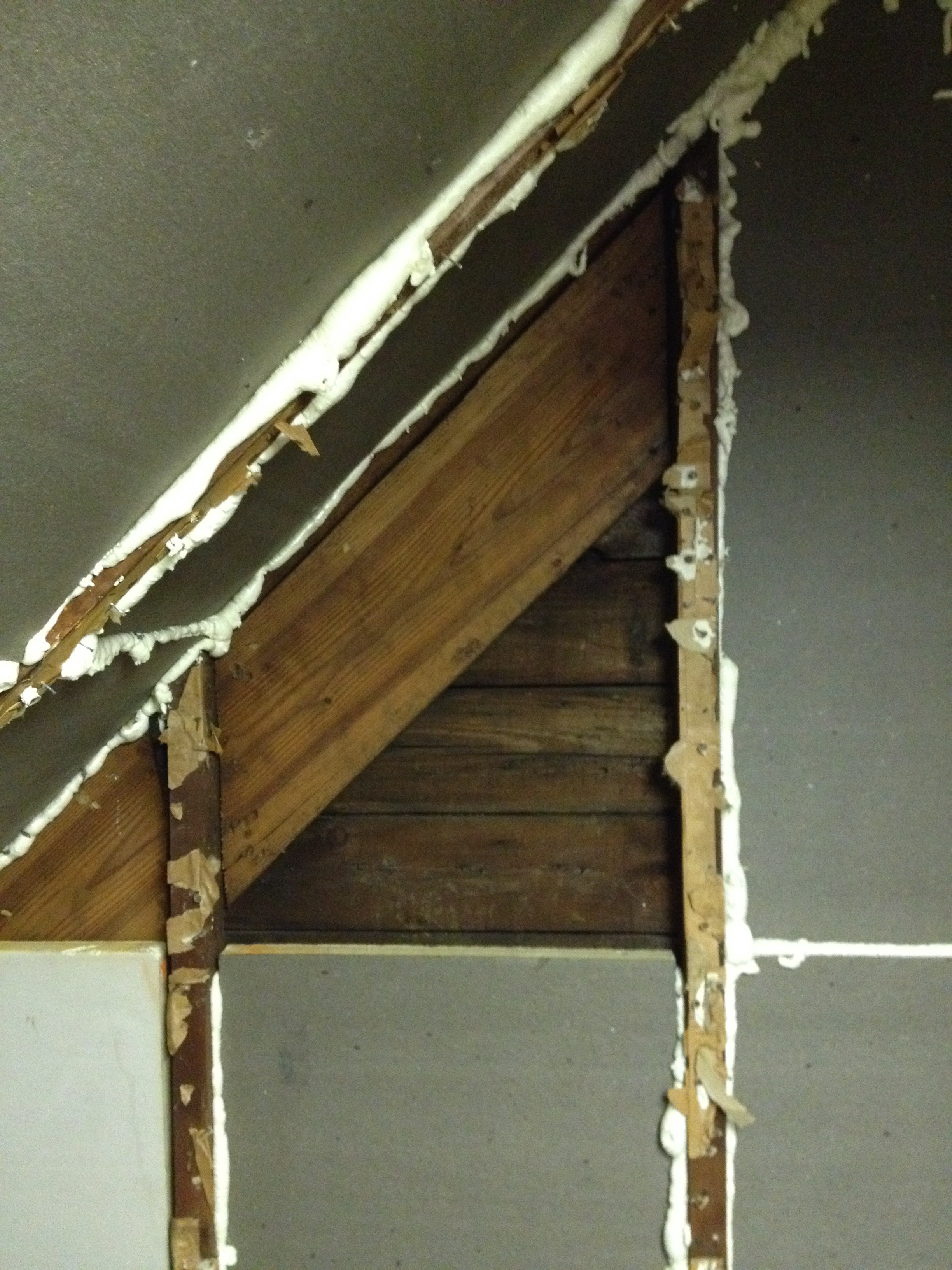
Along the walls I insulated between the joists.

IMG_4931

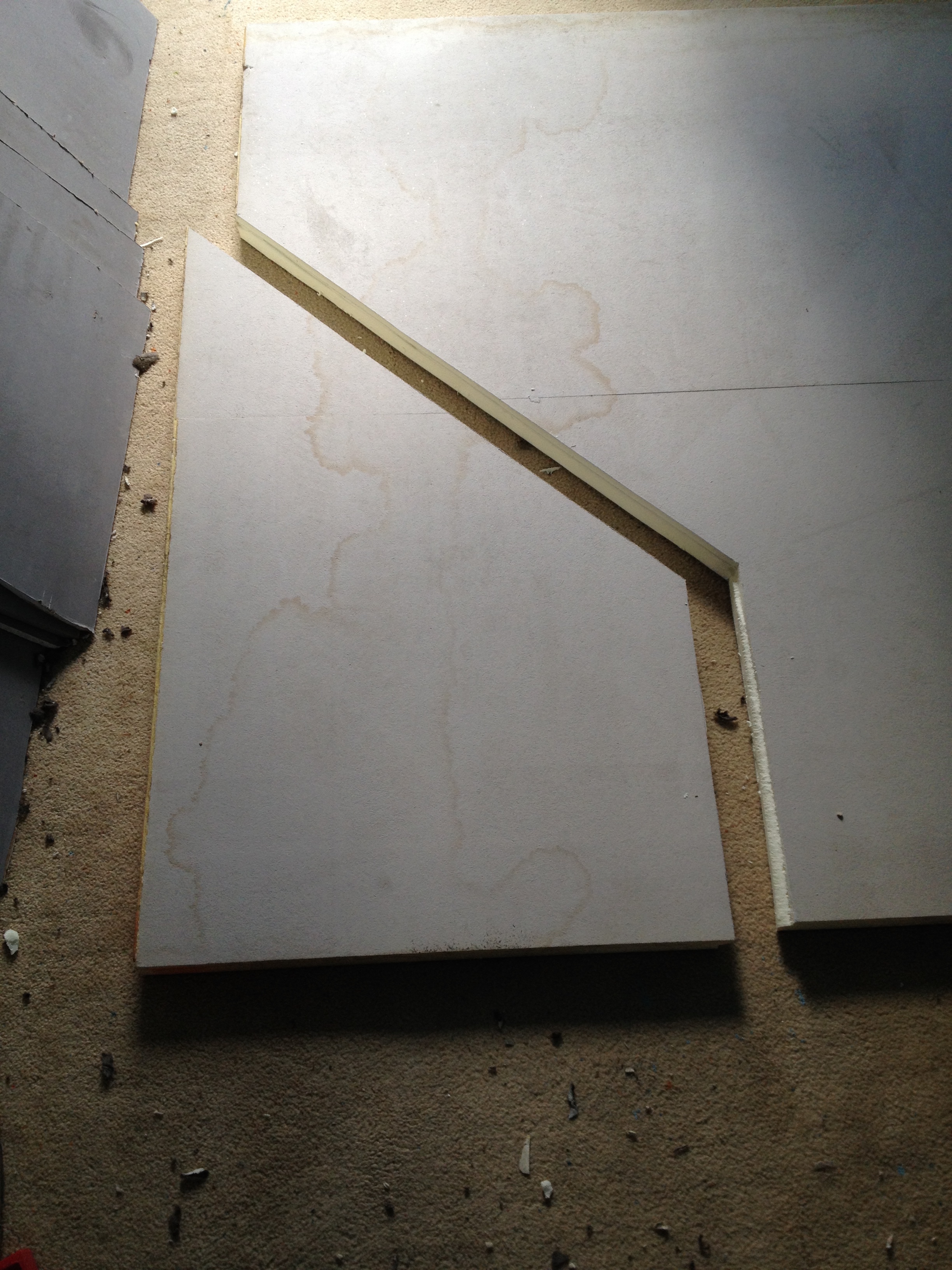
Filling the cavities between studs and rafters was simply a matter of measuringIMG_4934

Cutting

IMG_4933

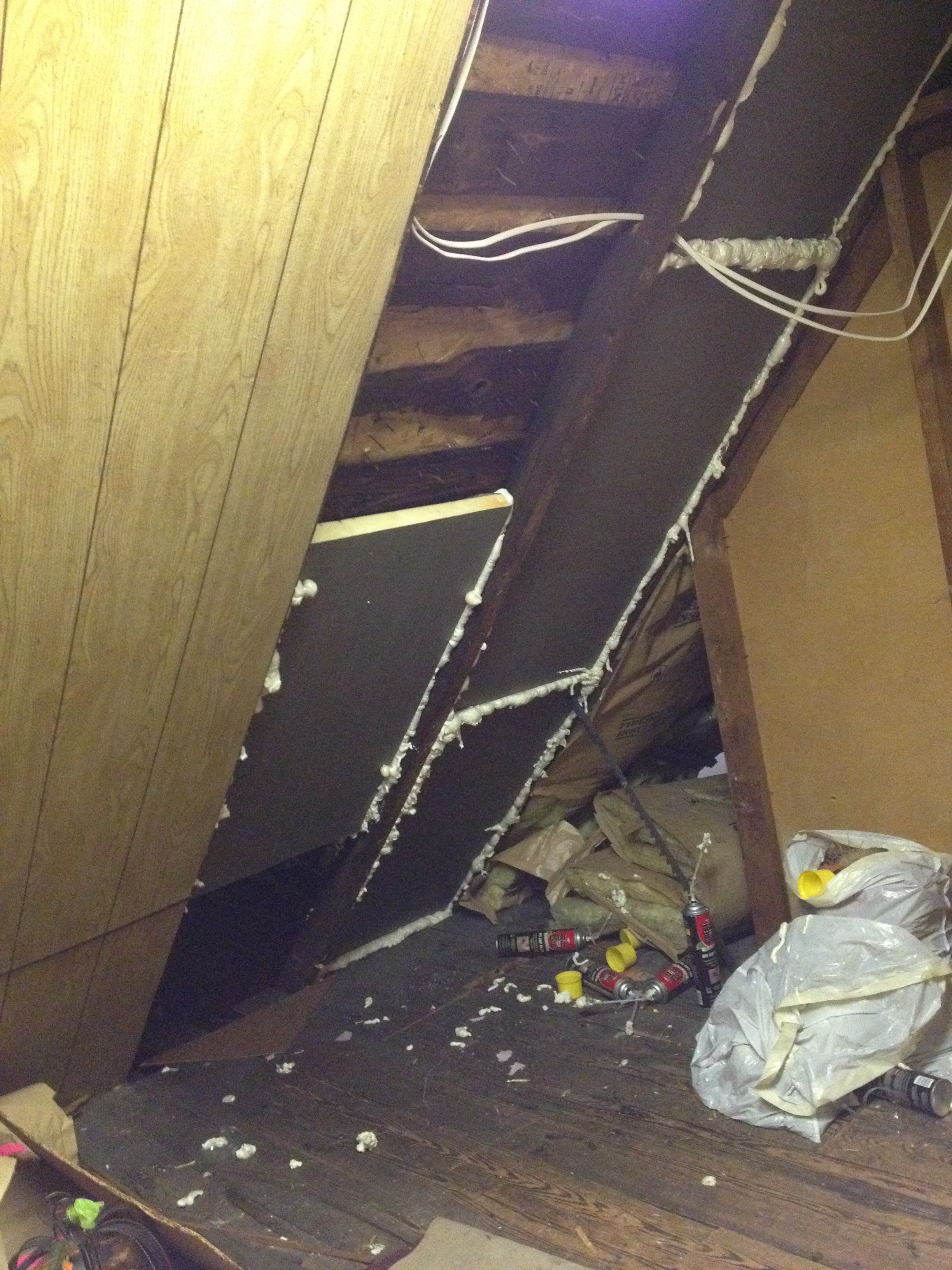
Fitting into place and foaming along the edges.

IMG_4935

Here is the end result.

IMG_4937

This room went much faster than the dormer.  I spent a few mornings and a Saturday working on it.  I had just enough foam board to do this room.  Eventually, I would like to double the R value of this room by installing an additional 2″ of foam board on the underside of the rafters.  That would bring this room up to an R 20-25, still well below the recommend value of 30-38 for a cathedral ceiling in zone 5.

Materials cost around $220.  Assuming it will cost $700/year to heat our house (based off last years bills) we can make some predictions about the payback period.  If we save 5% a year, $700 x 0.05 = $35, then it will take about 6 years to make up the material cost.

A different way to think about it is that we may be able to raise our thermostat by 5% and pay the same amount per year.  Last year we kept the temperature at 62°.  This year we have raised it up to 65° (about a 5% increase).  I do not think that temperature and bills scale linearly though because a larger difference in internal/external temperatures would likely result in a nonlinear amount of heat loss.  Anyway, in six months time, I will have another set of bills to add as a second data point in this little experiment.

Posted in: DIY, House Tagged: attic, insulation, winter

Harvest Time!

November 14, 2014 by Andrew Leave a Comment

It is time to harvest!  No, not agricultural harvesting, that is almost done.  I am talking about capital gains harvesting.  What is gains harvesting you ask?  Well, I am glad you asked.

Normally when you invest money in the stock market through a brokerage company such as Vanguard, Sharebuilder, E*Trade, Fidelity, etc. you will end up paying taxes on any extra money you get out.  How much you pay depends on a number of factors including how long you held onto the security (stock, mutual fund, index fund, bond, etc), how much of a gain you had, and your ordinary tax rate.

Generally you will want to hold onto securities for at least one year.  By doing so they will be classified as “long term” capital gains and be taxed at 15%.  Any profit you make by selling a stock before the first year of ownership is a “short” term capital gain and is taxed at your ordinary tax rate.  For most married single income families that will also be 15%, but it may be higher as the next tax bracket starts at around $72k of income and jumps to 25% tax rate.

Making a profit on a stock sale will count towards your taxable income.  For example, if you owned XYZ for 9 months and made $5k by selling it and your day job brings in $68k after exemptions and deductions then you would fall into the 25% tax bracket.

A common misconception with taxes is that moving up in tax brackets because of an increased income will result in less take home money.  That is completely false.  If your boss offers you a raise, TAKE THE RAISE!  Even if it puts you into a higher tax bracket.  The United States uses a marginal tax rate system, meaning if you move into a higher tax bracket, only the money in the higher bracket is taxed at the higher rate.  Investopedia explains the system well.

Getting back to the topic on hand, there exists a ‘loop hole’ of sorts that lets you sell long term capital gains and pay NO tax on it!  There are of course some rules.

  1. It must be a long term capital gain (owned for over a year and in the positive)
  2. You must be in or below the 15% tax bracket with the gain included in that

This is the first year that we are taking advantage of gains harvesting.  We’ve been in the stock market for about eight years now and we have a buy and hold mentality, so the field is ripe for harvesting.

The first step is to do some back of the envelope calculations and figure out how much wiggle room we have in the 15% tax bracket.  With the end of the year close by, you should have a pretty good idea of what your 2014 numbers will be.  We used Turbo Tax’s free Taxcaster website to come up with some rough calculations.

Once you know your taxable income, you can figure out your current tax bracket.  If you are above 15% you may be able to squeeze down by contributing to a 401k, IRA, HSA, or other tax advantaged account.  If you are in or below the 15% tax bracket you can figure out how much capital gains you can reap while staying in the 15% bracket.

Knowing the above information, we sold and then immediately repurchased shares of stocks that had long term capital gains.  We spent:

$7 to sell stock (brokerage commission fee)

$7 to buy stock (brokerage commission fee)

and there was a price difference from when we sold to when we bought (within a minute) that ended up costing us $15.

So for about $29 we harvested long term capital gains and saved around $1500 in taxes.

Besides saving taxes, this strategy also pays off down the road.  Two examples would be.

1.) Next year the stock market tanks.  Our cost basis, what we paid for the stock, would be more than what the stock is worth and it would be a loss.  We could sell that loss and count it against our income, lowering our tax bill.  This is called loss harvesting and has some extra rules that apply to it.

OR

2.) Next year the stock market goes up and we want to sell and lock in our gains.  Instead of a giant gain that could easily bump us up into a higher tax bracket, it would be smaller because we have already harvested some of those gains.

For another explanation of Gains Harvesting, check out this blog.

If you haven’t started investing in the stock market yet and don’t know where to start, then Betterment.com might be a good place to get going.  They offer plenty of hand holding (I haven’t personally used them and don’t benefit from promoting them).

If you want more control over your investments and haven’t started yet, then Vanguard.com is a safe bet.  Betterment just uses Vanguard funds and charges a little extra on top to cover their middle man status.

Posted in: Finance Tagged: stock, Taxes

Soylent Green

November 11, 2014 by Andrew Leave a Comment

Frugal Boy is eating more and more ‘solids’ and to keep pace we have been making our own baby food.  A recent acquisition of a $5 blender makes short work of pureeing solids down to something a six tooth digestive track can handle.

IMG_4841

We saved some of the store containers to reuse.

IMG_4842

The economics of making our own baby food varies wildly with what we use.  We try to buy what is in season as that is the cheapest.  However you can always pick up family sized bags of frozen veggies and steam them for a cheap, but nutritious meal.

IMG_4843

Ultimately we would like to get him eating what we eat, but he just isn’t ready for veal, spinach, and cheese stuffed manicotti with vodka sauce (a meal we made this past Saturday for $4/serving).

Until then, we’ll stick with simpler foods like pureed veggies and wheat circles.

IMG_4845

Posted in: DIY, Frugal Boy, Parenting, Recipes, Savings Tagged: baby food

Cut & Cobble – Part 1

November 8, 2014 by Andrew 1 Comment

It is hard to believe that it is almost Thanksgiving.  What happened to 2014?  I haven’t done any big home improvement projects for some time so there was an itch that needed scratching.

IMG_4786

Secret Entrance

That looks like a rather innocuous attic wall.  I wonder if there is something behind it? It would be a dull blog post if there wasn’t!

IMG_4787

Our 2nd floor bathroom is part of a dormer/turret and this is the unfinished attic portion.  Some sort of rodent had made a nest up here but I didn’t find any signs of recent activity.

I had several goals for this space.

  1. Clean out all of the nests and old soiled insulation
  2. Uncover all electrical wiring so I could assess its condition and possibly replace
  3. Insulate the space to be air tight

#1 wasn’t very difficult.  Wearing a respirator, long sleeves, and gloves I carted out seven trash bags full of crud.  Whenever you are working in an unfinished attic, you will want to pay special attention not to step through the ceiling.  To that end, I laid down a scrap piece of plywood so I could crawl around without falling through into the bathroom.

IMG_4803

With the space ‘cleaned’ up I was able to inspect the exposed electrical.

109 year old wiring

109 year old wiring

Given its age, it looked to be in good shape.  There are some spots that I may want to address in the future (receptacle wired in with a light switch).  Eventually we will hire out an electrician to redo the whole house, but until then the plan is to leave well enough alone.

#3 goal of re-insulating the space took some consideration.  Fiberglass rolls and blown in cellulose would not make the space air tight (both of these types of insulation are air permeable).  I knew that I wanted to insulate against the rafters, not along the floor joists because the existing electrical was in the floor joists and because the finished attic space connected with this unfinished space.

The only insulating products that I know of that are air impermeable are foam based.  You can either go with a spray foam or a rigid foam board product.  Spray foam is not for DIYers.  There are kits that are sold for DIYers but they start at around $600.  Foam board is best applied in continuous sheets on the underside of rafters or even better yet on the roof deck itself (outside of house).  Seeing as we just had a new roof put on, and a curved turret makes it almost impossible to hang straight boards, I chose to use a hybrid approach.

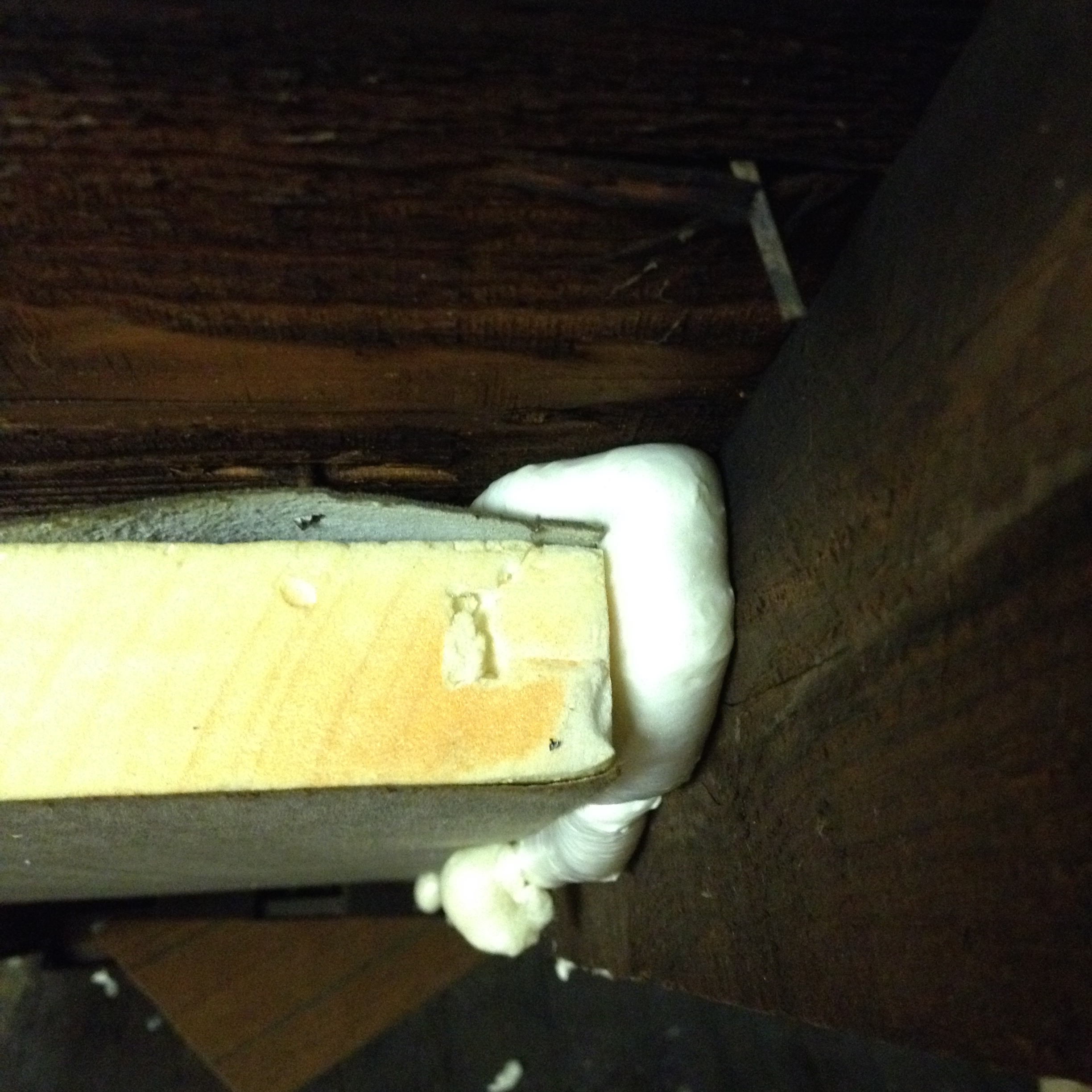
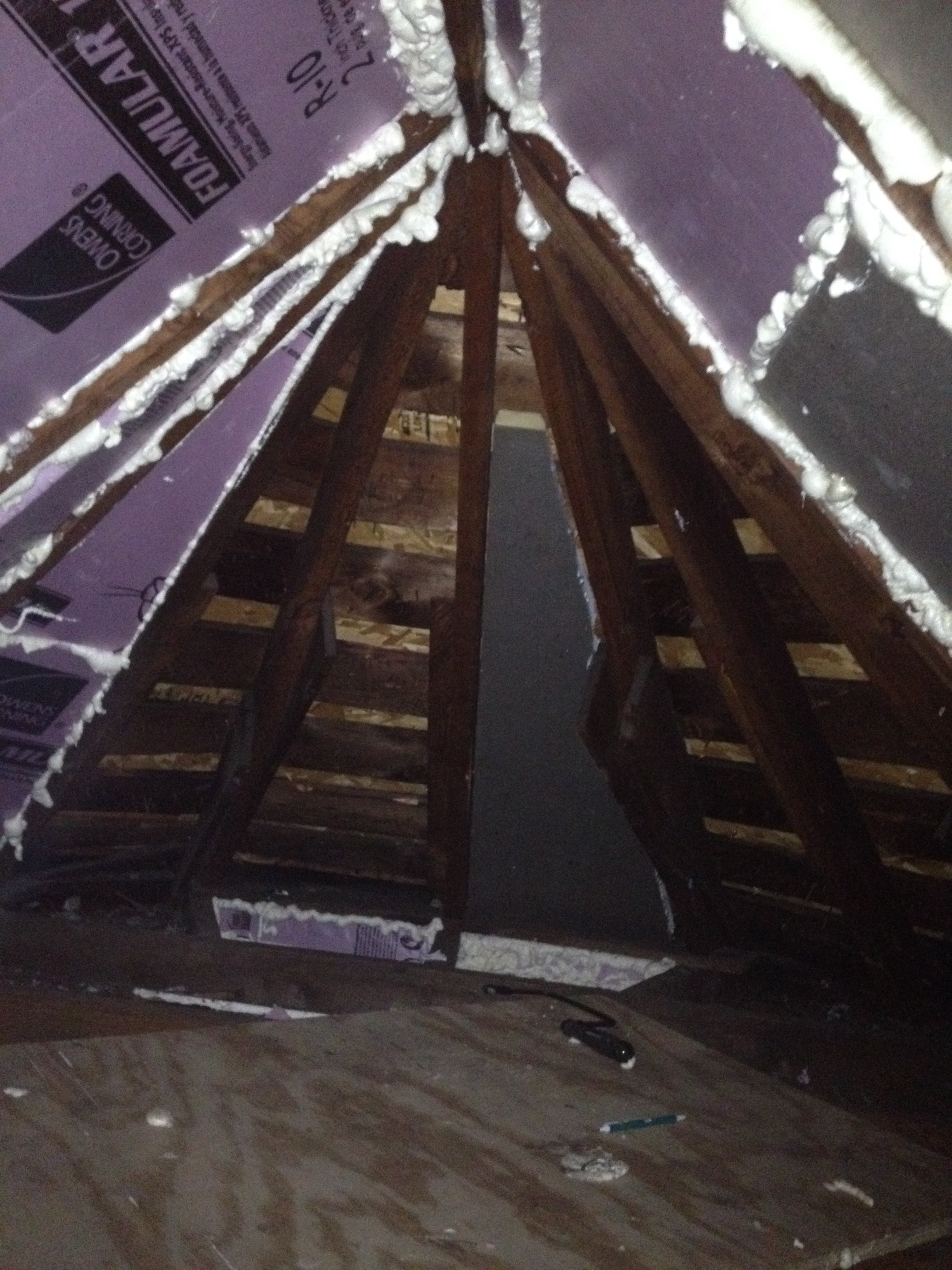
Cut & Cobble is an insulating technique where you cut pieces of rigid foam board to fit in-between joists or rafters.  Then you use canned spray foam to seal the edges.  Here is an example of where I have insulated using cut and cobble.

IMG_4819

The foam board should have about a half an inch gap to allow the spray foam nozzle to fit.  While you could fit the boards snugly against the wood you would have a hard time sealing the edges because you would either have to caulk or tape them.

IMG_4828

Ideally, an air gap would be left between the insulation and roof deck to allow air to circulate from the soffits to the ridge vent.  This helps keep the roof cool in the winter and prevents ice dams from forming.

RoofWithSoffitRoofVentAndBaffle

Yet another reason why I wanted to redo the insulation in the attic is because last year when our roof was redone, the roofers correctly installed a ridge vent.  The pre-existing fiberglass bats did very little to keep air from moving from the ridge vent/soffit system to the conditioned space.  In fact, in some spaces you can see the ridge vent while standing in the attic!

nada insulation  :-(

nada insulation 🙁

Cut & Cobble is meant as derogatory name because it has many critics.  For starters, it isn’t exactly pretty to look at.

IMG_4826

About 60% done with dormer

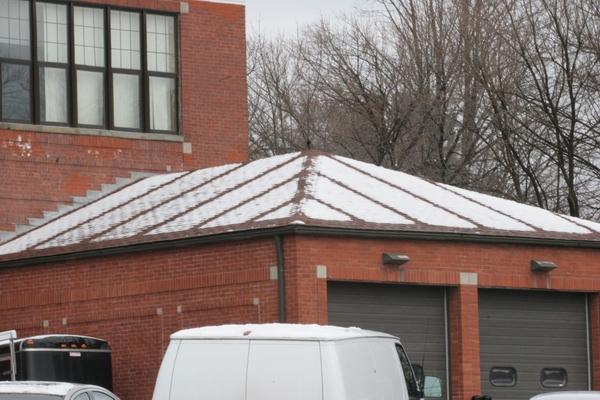
The process of measuring, cutting, fitting, and installing tens or even hundreds of panels is very time consuming.  C&C allows thermal bridging.  Thermal bridging is where heat moves through a less insulating material, such as a 2×4.  After a frost or light snowfall, thermal bridging may be visible from the outside.

guess where the rafters are

guess where the rafters are

Not many studies have been done on C&C, but there are many anecdotal stories of premature failure where the edge sealing fails either immediately or after some time has passed.  Finally, the cost of C&C is questionable compared to hiring out a professional spray foam contractor.

I have thought about these negatives and believe that C&C is still the right option in our circumstance.

  1. I am not interested in how it looks.  The areas that I am insulating are not living spaces.
  2. I am doing the work myself so it is not like I am paying an hourly wage to someone to install a tedious product.
  3. Fiberglass also allows thermal bridging and that is what we have installed right now
  4. premature failure *might* be an issue.  Then again, it might not.  This is a gamble.
  5. I got an awesome deal on factory seconds insulation meaning that the material cost for this project is well below what the alternatives would be.

For $80 + $20 delivery I bought approximately 25 panels of 4’x4′ x assorted thickness (between 1 1/2″ to 4″) of polyisocyanurate (polyiso) rigid foam board off a guy on craigslist.

IMG_4814If I had to guess, I would say the retail value of this insulation would be around $500.  Polyiso has one of the highest R values per inch of any insulation at 6.5.  Screen Shot 2014-11-08 at 6.30.59 PM

I only need a small fraction of that bundle to finish the dormer.  In the meantime, I moved the extra from the garage to the attic so it can ‘work’ while it is being stored.

IMG_4818

When I get this project wrapped up I’ll post a followup with pictures and any final thoughts that I had on doing the project.  So far, I can attest to the length of time required to C&C.  It will be interesting if there are any noticeable differences in temperatures when it is all done.

Posted in: DIY, House, Savings Tagged: foam board, insulation, polyiso, winter
« Previous 1 … 48 49 50 … 69 Next »

Recent Posts

  • Min/Maxing Car Sale for Highest Value and Lowest Headache
  • Buying a Car with Data Driven Decision Making
  • Hot Lunch
  • Baking with Dad
  • Winter Nights

Financial Goals

Recent Comments

  • suwaidi online on Building a New Desktop Computer
  • James Spurr on Building a Self Watering Raised Garden Bed
  • suwaidi online on Total Cost of Ownership – Inkjet vs Laser Printers
  • bcimechanical on Troubleshooting a Gas Furnace
  • g on Troubleshooting a Leaking Whirlpool Dishwasher [UPDATED]

Archives

  • December 2020
  • December 2018
  • July 2018
  • May 2018
  • April 2018
  • March 2018
  • February 2018
  • January 2018
  • December 2017
  • November 2017
  • October 2017
  • September 2017
  • August 2017
  • July 2017
  • June 2017
  • May 2017
  • April 2017
  • March 2017
  • February 2017
  • January 2017
  • December 2016
  • November 2016
  • October 2016
  • September 2016
  • August 2016
  • July 2016
  • June 2016
  • May 2016
  • April 2016
  • March 2016
  • February 2016
  • January 2016
  • December 2015
  • November 2015
  • October 2015
  • September 2015
  • August 2015
  • July 2015
  • June 2015
  • May 2015
  • April 2015
  • March 2015
  • February 2015
  • January 2015
  • December 2014
  • November 2014
  • October 2014
  • September 2014
  • August 2014
  • July 2014
  • June 2014
  • May 2014
  • April 2014
  • March 2014
  • February 2014
  • January 2014
  • December 2013
  • November 2013
  • October 2013
  • September 2013
  • August 2013

Categories

  • Business
  • DIY
  • Finance
  • Frugal Boy
  • Frugal Girl
  • House
  • Misc.
  • Parenting
  • Reading
  • Recipes
  • Savings
  • Technology
  • Travel
  • Uncategorized

Meta

  • Log in
  • Entries feed
  • Comments feed
  • WordPress.org

Copyright © 2026 Frugal Living.

Omega WordPress Theme by ThemeHall