Unless you are a masochist, you probably don’t enjoy all of those “congrats you have been pre-approved for xyz credit card” offers that plague your mailbox. A long time ago, I read the fine print and there is a way out!!
You will then have the choice to opt-in, opt-out electronically (5 year), or opt-out by mail (permanent).
Select the electronic option (I’ll explain a bit later why the mail option is a waste of time and money).
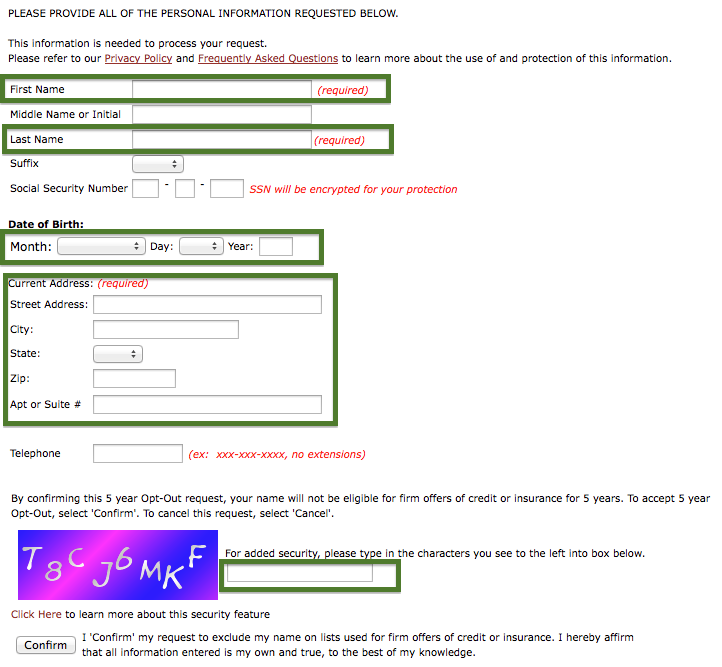
You should now see a big form. The good news is that most of these fields are NOT REQUIRED. I’ve highlighted in green the required fields.
First Name
Last Name
Date of Birth
Address
Captcha
Click on Confirm and you will get a confirmation page. In a couple of months that junk mail should be gone!
The Catch
I did this back in College (a long long time ago) and there is definitely a catch. If at any time you have a hard inquiry, say for example you apply for a credit card or loan, then you are put back on the list. That is why I wouldn’t recommend spending the extra time and money (postage) to do the permanent mail opt-out, because it really isn’t permanent. It DOES work. I enjoyed several years of no offers. Then I started shopping around for a house and applying for mortgages and BAM, back to the junk mail circus.
So there you have it, spend 5 minutes now to save some time and trees.
I’m not sure where I first heard about CreditKarma, it was likely on a finance related forum somewhere on the inter webs. Anyhoo, I decided to check it out for myself and try out the service. That was over a year ago.
What is CreditKarma.com you ask? Taken from their own website,
Credit Karma offers a new way to track your credit score and a unique way to benefit from it. For the first time you can get a truly free credit score with no hidden costs or obligations. Based on your score, you gain access to exclusive offers from companies that value your creditworthiness.
The last line should make you feel more comfortable because now you know the catch for the free service. They are going to offer and promote credit cards and other financial products to you. That is how they make their money, not by selling off your identity to some bloke in a country you cannot pronounce.
Now that we have determined that this is a legitimate business, we can go ahead and create an account. Accounts are free, and I can confirm that over the past year they have never asked me for my credit card #. You will need to fill out some information online, including your SSN. Don’t worry, this won’t affect your credit score in any way. The site advertises that it will take less than 2 minutes to create your account and get your credit score.
At this point, you may be asking yourself, “I can already get 3 free credit reports a year from Experian, Transunion, & Equifax. Why do I need to signup for this website?” Yes, you can get credit reports, but credit reports aren’t credit scores. The most popularly used credit score system is the FICO and it ranges from 300 to 850. A score of 300 means that you are extremely risky to lend to and are unlikely to pay it back. A score of 850 is extremely rare and signifies an almost zero risk loan. Your FICO credit score is computed using a proprietary formula that analyzes your credit report. Late payments, bankruptcies, hard inquiries, high credit utilization, number of lines of credit, and average age of lines of credit are all included on your credit report and therefore figure into your credit score.
Credit Karma calculates your number using the Transunion New Account Score. The TNAS also ranges from 300-850 and is claimed to closely correlate to your FICO score. Below you can see my TNAS score.
Credit Karma would be kind of pointless if all it did was show you a score. Fortunately, it offers a wealth of additional information that can be used to improve your score, compare your credit to other demographics, analyze credit card offerings, and much more. Let’s take a look at some of those features.
Credit Report Card
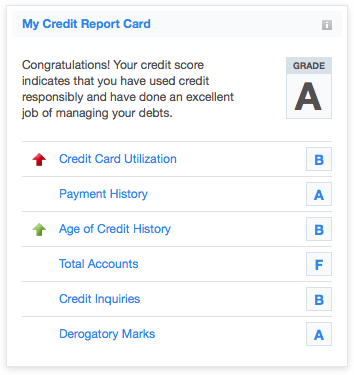
First up is the credit report card. You can see the summary of mine below.
The credit report card helps you improve your credit score by showing you where you are losing points. It also tells you the weighting of each category. For instance, Credit Card Utilization has a HIGH weighting and I currently have a B grade. That tells me, that I need to cut back on using my credit card in order to improve my score. On the other hand, Total Accounts has a low impact on your score. I currently have an F in that category because I do not have many lines of credit. It probably isn’t something that I need to rush out to fix though because it has such a low impact on the overall score.
If you click on any of the metrics you will get additional information about it like so.
They even offer a credit score simulator so you can see how opening a new credit card or paying off an existing balance would affect your score.
Demographic Comparisons
Do you want to see how you stack up to other people using Credit Karma? Not a problem! As part of the report card you can compare your numbers against the general user base. Below you can see how I compare to other Illinois residents aged 26-30 in making payments on time.
As you can see, 3 out of 10 peers have missed at least one payment. Ouch! Credit Karma offers some suggestions about how to avoid missing payments.
Reviews
The last noteworthy feature of Credit Karma doesn’t require an account. You can see score and demographic stats on different credit cards. For example, here is a link to the Chase Sapphire Preferred® Card review page. As you can see, the minimum credit score needed to obtain this card looks to be around 650.
A higher credit score will net you a higher limit (with exception to the very bottom, can someone explain to me what is going on there).
And the folks with high credit scores and high credit limits also tend to have the lowest balance.
There are a bunch of different card stats available online so you can look up your own card and see what kind of limits and scores are out there. (I don’t have a Chase Sapphire card, I just used it as an example).
Conclusion
Credit Karma offers a virtual (literally) treasure trove of information. You can use it to get an idea of what your current credit score is and then how to improve it. It is pathetically easy to compare your own situation to the anonymous masses and see how you stack up. Finally, if you are shopping for a new credit card it can help shed a little insight into the type of person a card is aimed at. I would recommend signing up for an account if for no other reason than to have a free “manual” credit monitoring service. Just log in once a month or once every other month and make sure no funny business has popped up on your credit report.
Oh, and make sure your password isn’t something stupid like 1234.
When was the last time you checked your credit report? Your credit score?
For the past couple of years we have been doing the bulk of our grocery shopping at Kroger. Kroger is one of the largest chains in the US, has decent prices, a modest selection, fuel center discount, and most importantly, three locations in town with one within walking distance. We didn’t always shop at Kroger though. Back when we were living frugally by necessity we did the majority of our grocery shopping at a different supermarket.
I wanted to do a post about that supermarket and coincidentally, I needed to get some shopping done. So what is the name of this mystery store? Before I tell you, let’s have a pop quiz. Look at the picture below, and pick out the more expensive bottle of garlic powder.
Have your answer?
Good.
If you said the one on the left cost more, you’re wrong.
If you said the one on the right cost more, you’re wrong.
If you said, “I know you Andrew and this is a trick question. They cost the same.” Then BINGO you are the winner. Yep, these two containers of garlic powder both cost $1.00. The one on the left is 5.5 oz and the one on the right is less than half of that at 2.0 oz. The smaller one came from Kroger’s value brand (aka the cheap generic store brand), the bigger one came from Aldi.
You may be asking yourself, what is Aldi? Don’t only poor people shop there? What’s the deal with the shopping carts? Let me put all of your questions to rest.
Aldi is a German supermarket chain that is found world wide. Like most things German, there is a high emphasis on efficiency. You’ll see that before you even enter the store because you will need to cross barrier #1.
#1 The Shopping Carts
The first step to making a more efficient supermarket is to cut jobs. What jobs can be cut with a little ingenuity and customer training/education? The cart boys & girls. As you step out of your car, one of the first things that you will notice is that ALL of the other shoppers are thoughtfully returning their carts to the singular cart coral on the side of the building.
Wow! What thoughtful and kind people. Haa, they just want their quarter back. You may have noticed the red chains on the cart handles. Those are a part of the cart return system. In order to get a cart, you have to deposit a quarter into the cart. It then unhooks from the other carts and you can go about your shopping. When you’re all done, you return the cart to the coral and hook it back up. You get your quarter back and go on your merry way.
Once you have your cart and are inside the store you will notice a couple of obvious things.
#2 The Store Interior
Probably the first item to catch your attention is that there are no shelves per se. Instead most of the merchandise is in boxes and those boxes are on palettes. By eliminating the extra work needed to stock shelves in the traditional manner, Aldi is able to cut down on employee hours and that, like the cart situation, saves you money. The second item that you will likely notice is that there is typically just the generic brand of each product. I don’t know how many hours of my life I have spent standing in an aisle trying to figure out the best bang for my buck among 10 different brands each with 3 different sizes. With Aldi, you generally get 1 brand and 1 size of each item. Grab it and move on, no dilly daddling here. That brings me to the 3rd point about the store interior. It discourages back tracking. If you forgot something at the start of the store, have fun fighting against the stream of budget conscious shoppers in the one way flow. The stores are designed fit all of the merchandise in the smallest footprint possible. A smaller store saves money in construction costs, land acquisition, and utilities. All of those savings are passed on to you.
#3 The Checkout Process
You won’t find any self checkout lanes at an Aldi. Nor will you see any baggers. Chances are good that there will only be 1-2 lanes open, but man do those lanes fly! Each item sold at the store is riddled with barcodes. The smart folks at Aldi decided that having a barcode on each side of a product (6 for boxes) means that the cashier doesn’t have to try and find it. They simply slide everything through the scanner and place it in an empty cart. Bagging is something that you are going to have to do yourself, but not at the checkout lane because that would slow down the process for the next person in line. Instead there is a large counter where you can bag up your groceries. Don’t forget to bring your own bags, Aldi doesn’t have plastic bags and charges money for their canvas totes. One last important note about the checkout process. Bring your debit card or a wad of cash. Aldi doesn’t accept personal checks (do people still use those at stores?) or credit cards. Credit cards cost merchants a % of the transaction (usually 1-5%), so by saying no to credit cards, Aldi can pass that saving on to you.
Conclusion
There you have it. Aldi is a great discount supermarket that saves you money by eliminating cart boys, baggers, stockers, cashiers, large store footprints, loyalty programs (yes those cost you money) and credit card fees. Do poor people shop there? Yes. Do rich people shop there? Yes. At the end of the day, it largely comes down to convenience. Is there a store close to you? Do you mind making a second stop at another store to pick up anything that isn’t carried at Aldi? Can you remember to leave a quarter in your car and some bags?
I still have memories of my childhood where my Mom would stock up at Aldi once a month to feed 4 very hungry boys. I am sure that the money saved by doing so contributed to vacation funds that let us see the world. Thanks Mom!
If you have frequented this blog in the past, you may have noticed a recent change. That’s right, the website looks different! I use WordPress to run this blog and one of the great things about WordPress is the ability to change the websites theme with a couple clicks of the button. There are many great (and free) designs to choose from. I am using a theme called Omega right now. A great feature of the Omega theme is that it is fully responsive. What does that mean? Well, it means that the content will scale to fit the size of the screen. Regardless of whether you are using a desktop computer or a smartphone to read this blog, you will see a rather clean reading experience. If you are on a desktop, you can see how the website resizes as you shrink and expand the browser window. Go ahead and give it a whirl.
This past Sunday we made a day trip up to Chicago to take in some sights. In particular we wanted to go to the Shedd Aquarium and Field Museum. The Shedd Aquarium was running a promotion for free general admission for Illinois residents over the weekend and extending into the start of this week. After seeing the extensive line the last time we were in Chicago, we figured that the best time to go would be on Sunday morning right when they opened.
Neither of us slept very well that Saturday night. I think our bodies knew that we had to be up early in order to make it by the 9am opening time. Watching the sunrise gave us some extra energy as we drove along the interstate. Parking in Chicago is a bit of a hassle and can be quite pricey. One of my uncles who lives in the Windy City knows all of the spots that you can park for free. Instead of trying to find one of those spots, we opted instead to pay to park at a lot on Wabash Street about 1/2 mile away. It was $11 for 10 hours of parking. Shae saw some closer and cheaper spots that we’ll have to use next time.
By the time we showed up to the aquarium the line wasn’t out of the pavilion yet and they hadn’t opened yet either. We didn’t have to wait too long and then we were inside and through admissions. Of course the aquarium tries to upsell you to their dolphin show and special exhibits. We stuck with the free general admission. The free ticket lets you see about 85% of the complex so it is a great deal!
This buck toothed puffer fish was a source of amusement.
The crab was quite imposing with its large size.
The sea dragons are always marvels to look at.
By 10:45am we were starting to feel a bit peckish so we headed down to the indoor picnic area so we could eat our packed lunches. We had made chicken salad the night before and used a cooler lunch box to keep it fresh. Food courts in touristy places such as the Aquarium are usually overpriced. Pack a lunch and snacks to save yourself money. Also, because we ate early on we had our choice of seating. The dolphin show was going on at the same time and the seating area looks into the underwater area of their pen, so in a way we got to see the dolphin show for free.
The line of parked strollers outside the dolphin show was quite impressive. Shae was able to rattle off the prices of each one as we walked by (hmm, I wonder why she can do that). I would feel a bit nervous about leaving a $500 stroller unattended. The $10 umbrella strollers out there seemed to have the right idea in mind.
Once the dolphin show finished around 11am a flood of people descended on the picnic area. It is a good idea to eat outside of the predefined lunch times (11-1). Our seats were snatched up about 10 seconds after we got up. Again, the people watching was superb. Of particular amusement was the mom who lysoled the table, her child’s hands, then put down a BPA-free tablecloth to keep the nasty, scary germs at bay. To each their own, right?
We left the aquarium around noon and the line had grown substantially. It seemed that our timing and estimates of peak visitation was spot on. The Field Museum was decidedly less busy. They were not having a free day, but we do have a membership with another museum that grants us reciprocal admissions to the Field (aka we get free admission at the Field). With this visit, we paid off the cost of the membership so there was no money wasted there. We had purchased the membership to motivate us to get out and see some other museums and to patronage a center of learning.
The Field Museum was enjoyable as always. We skipped a lot of the exhibits because we were getting tired and still had a long drive to get home. We did visit the dinosaurs because they are awesome.
The drive back was uneventful and the whole day’s outing only cost us around $40 for the two of us. $11 in parking and another $30 or so in gas.