Frugal Book Club #3 – The Total Money Makeover
School starts tomorrow for our local K-12 schools. That means that you should be wrapping up your summer reading program. We finished ours and turned in our logs a couple of weeks ago. Some of the goodies that we got included a half pound of beer nuts, a free haircut coupon, and a free zoo admission coupon.
I didn’t finish Do Fathers Matter as there are only so many ways that the same conclusion can be reached in the span of 200 pages. I was in the mood for another personal finance book so I picked up a copy of Dave Ramsey’s The Total Money Makeover from our local library. For those of you who are unfamiliar with Dave Ramsey, let me give you a few bullet points about him.
- He runs a self syndicated radio show that ranks in the top 10 in listenership
- He has authored several New York Times best selling books about personal finance
- He is anti debt
- He is openly Christian and uses bible quotes in his books and on the air
- His methods are controversial
The last point I will share my own thoughts as I walk through my summary of The Total Money Makeover.

What’s it all about?
Ramsey models the book after a fitness plan (there are many fitness analogies) and lays out seven steps to take the reader from debt laden to a golden retirement. The first five chapters cover some (un)common sense items about personal finance such as the importance of not racking up debt, ignoring the Joneses, the stupidity of gambling, and the importance of insurance. The next seven chapters Ramsey describes each of the seven steps of his plan along with some of the frequently asked questions. The last chapter paints a rosy picture of how good life will be once you have completed the makeover. It is also the chapter where his Christian ideologies come out in full force for better or for worse.
Step 1: Save $1,000
According to Ramsey, the first thing you should do to get out of debt and start building wealth is to put aside $1k for emergencies. Well, technically there is a step 0 where you have to get current, pay off any past due bills, on all of your existing debts. I digress. Ramsey spells out what qualifies as an emergency and what doesn’t. Christmas for example, isn’t an emergency because Christmas comes at the same time every year. The reasoning behind saving up $1k first is to keep you from sinking into any more debt when a real emergency such as your car’s strut coil blows out.
Step 2: The Debt Snowball
The second step of Ramsey’s plan is in my mind one of the most controversial points in the entire book. First I’ll describe the step as detailed by the author and then I will add in my 2¢.
With a $1k emergency fund in place, Ramsey suggests that the next prioritization to building wealth is to eliminate all debt. To do this, he recommends that you list all of your debts that are less than 50% of your gross annual income on a sheet of paper from smallest balance (e.g. $54 cell phone bill) to largest (e.g. $35,000 student loan). Then cut up all of your credit cards so you won’t use credit ever again. Finally, put every penny you can muster into paying off the smallest balance first while continuing to make the minimum payment on all of your other bills. When the smallest balance is paid off start on the next smallest and so on. If at any time your emergency fund dips below $1000, stop making extra debt payments and replenish the rainy day fund. According to Ramsey, most people should be able to finish steps 1 and 2 with two years.
Here is where I have some bones to pick with the author.
Number one, I don’t think that credit is the anti-christ. Ramsey tends to portray things in a very black and white world view; good vs evil, up and down, on and off. Credit cards are labeled as bad and dangerous when in reality they are no more dangerous than say a hammer. Sure, if you continually hit yourself or someone else in the face with a hammer, you can do a lot of damage. If you use the tool properly, it can make life a little easier for you. His assertion that debit cards provide the same level of protection as credit cards is incorrect. Yes, on paper they offer the same protection against fraud, but reality doesn’t line up nicely with what is written in the fine print. I had my debit card number stolen earlier this year and let me tell you what a pain in the ass that was. For starters, when a thief makes a bunch of charges using your debit card, that money is GONE from your checking account. Bye bye money, I hope you weren’t planning on buying anything important anytime soon. You contact your bank’s fraud department and they ask you a series of questions, then you print off, sign, and mail some affidavits to back up your claim. They credit your account with what is missing (assuming everything has gone according to plan) and you wait 4-6 weeks for confirmation that you really were robbed and the temporary credit will be made permanent. Compare that to when my credit card number was stolen several years ago. It was issued by the same card company. I called them up and reported the fraudulent purchases and because it was the company’s money that was taken, not mine, they took IMMEDIATE action.
With all of that said, if you are one of 60% of individuals who carries a card balance, aka you don’t pay the card off in full each month, then you should probably consider cutting up your credit cards. Hitting yourself with a hammer is no fun.
Number two, I cannot whole heartedly agree with his prioritization of debt repayment. Smallest balance to largest completely ignores the interest rates associated with the balance. Mathematically speaking, one should pay off the highest interest rate balance first and continue down the line until they are at the lowest rate. Logically, my way saves more money and would have debts paid off sooner, but humans are illogical and the psychological boost from paying off small debts probably does help individuals tackle the harder larger debts later on.
Step 3: Finish the Emergency Fund
Once all your debts except the house are paid off, Ramsey encourages the reader to finish funding their emergency stash. For the average American a full funded rainy day stash will be between $10-15k. Ideally that money should be kept in a savings, checking, or money market (with check writing) account for easy but not too easy access. CDs, bonds, and dresser drawers are not recommended because they are either too easy or too hard to access money in an emergency.
Step 4: Invest in Retirement
Only after paying off all debts except the mortgage and having a fully funded emergency fund does Ramsey suggest that you start contributing to a retirement account. Even if your company offers a match, he still doesn’t recommend contributing until the first three steps are complete. I have another beef with this because you are giving up FREE money for the sake of having debts paid off a month or two sooner. If I had to pick just one point of contention between Ramsey and other talking heads in the personal finance world, it would be concerning his investment advice. Ramsey swears by large cap growth mutual funds and their ‘unshakeable’ 12% annum return. Many of his calculations later on in the book use this magical 12% number to support ostentatious claims about golden retirements on small monthly investments. In fact, Ramsey only wants individuals to contribute 15% of their gross income to a tax preferred retirement account because that will be sufficient. If you have ever played around with a retirement calculator, you know that a change of even 1% return compounded over 20-40 years will have a HUGE impact on the final outcome. Consider for a moment that the de facto number used for most stock market investments is 8% and you have a pretty glaring difference between what Ramsey is preaching as truth and what may be truth.
Step 5: College Funding
If you don’t have kids or they have already graduated college you can skip this step. Going along with step 4, Ramsey discourages the practice of prepaying tuition at todays rates in favor of investing in a large cap growth mutual funds via an Education Savings Account, or ESA. His justification is that prepaid credits will only earn the rate of college tuition inflation, 8%, which is less than his superior 12% mutual funds. While 529 plans are okay, he thought they were too restrictive, mostly because they don’t allow you to arbitrarily pick investments like an ESA does. An ESA isn’t without restrictions. For starters, you can only contribute up to $2000 a year. Unlike 529s, you cannot roll the money over to another beneficiary. If money remains when the ESA beneficiary turns 30 years old, it must be withdrawn at a 10% penalty on top of regular capital gains taxes.
Either way, I would highly recommend that parents set up something for their kids education expenses. Student loans are a great catalyst for a life in debt.
Step 6: Pay off the home mortgage
If you forgive the fact that we haven’t cut up our credit cards (because we pay the balance each month), then this is the step that we are currently working on.
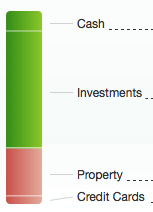
whittling down the mortgage
As you have probably learned by now, Ramsey despises debt. His first recommendation is that people should avoid mortgages and put down 100% cash on home purchases. Failing that, they should secure a 15 year fixed rate mortgage and work to pay it off early (that’s the route we went). One of the interesting conundrums that this step is challenged with is how one secures a mortgage if they have religiously followed the above steps. By closing all credit accounts, one’s credit score will drop. A low credit score makes it more challenging to get a prime mortgage. Ramsey’s ‘solution’ is to find a small bank or credit union that still does in house underwriting without relying on a FICO score. To me, this sounds like scuttling around the issue. Sure, there are probably some financial institutions out there that won’t pull your credit score but c’mon, most of them will.
Step 7: Build Wealth
By now you should be completely debt free, including your house, your retirement is on track for a dignified exit from this world, and your children are set to graduate from college with no student loan debt. Invest, spend, and give become the motto for this step. Continue to build your wealth but take some time to spend money on yourself and the wants that you have denied yourself for so long. Finally, Ramsey encourages a healthy dose of charity to help those that are less fortunate. In Ramsey’s eyes, you are considered wealthy when your money makes enough for you to live on.
Conclusion
So there you have it, one of the most popular financial planning books on the shelves. Is it a perfect one size fits all plan? No. Would I recommend the book to someone caught in a debt vortex. Yes.
Share your thoughts on The Total Money Makeover plan in the comments. What step are you on?